
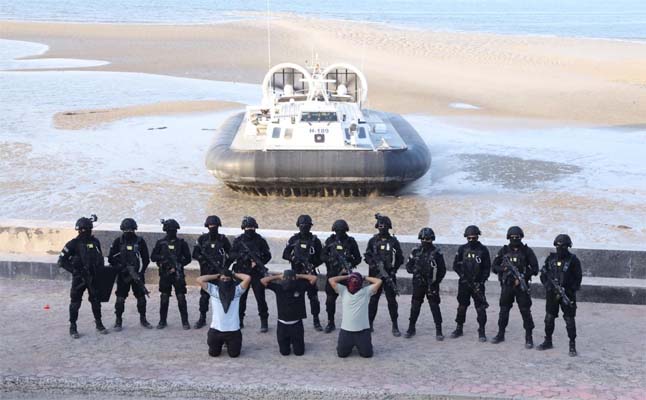
- Indian Coast Guard conducts two-day Exercise Sagar Kavach-02/2026 across Gujarat and Daman and Diu
- 17 agencies, one major port, 32 non-major ports and 100 air and sea assets participate in coordinated security drills
- Simulated seaward threats put standard operating procedures, inter-agency coordination and coastal surveillance to the test
- Indian Navy, Air Force, BSF, NSG, Gujarat Police and maritime authorities join the coastal security exercise
NE DEFENCE BUREAU
GANDHINAGAR, OCT 10
A coastline is only as secure as the speed with which its defenders can detect a threat, share intelligence and coordinate a response. Putting that readiness to the test, the Indian Coast Guard’s Regional Headquarters (North West) conducted Exercise Sagar Kavach-02/2026 on October 8 and 9, bringing together 17 agencies, one major port, 32 non-major ports and 100 air and sea assets to assess coastal security preparedness across Gujarat and Daman and Diu.

The two-day exercise focused on validating standard operating procedures (SOPs), testing inter-agency coordination and assessing the effectiveness of responses to simulated seaward threats. Its scale underscored the importance of an integrated security network along India’s western coastline, where maritime surveillance, port protection and rapid information-sharing are critical to safeguarding coastal communities and economic infrastructure.
The participating network included the Indian Navy, Indian Air Force, Border Security Force (BSF), National Security Guard (NSG), Gujarat Police, Central Industrial Security Force (CISF), customs authorities, Maharashtra Maritime Board, Gujarat Maritime Board and other maritime and port agencies.
Testing the chain from detection to response
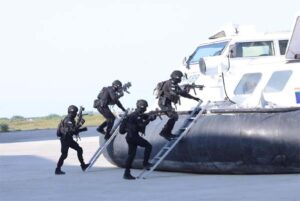
Sagar Kavach is designed to test how effectively security agencies work together when confronted with simulated threats from the sea. The exercise brings operational procedures out of manuals and into coordinated field activity, allowing participating organisations to assess preparedness, communications and response mechanisms.
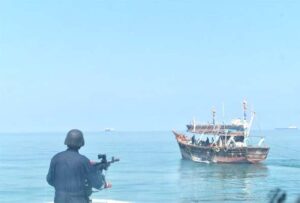
With 100 air and sea assets involved, the latest edition tested the coordination required to monitor maritime approaches and respond to potential security challenges. The participation of port authorities and multiple enforcement agencies also highlighted the need to connect coastal surveillance with security arrangements at ports and other vulnerable maritime locations.
A whole-of-government coastal security network
Coastal security depends on more than the capabilities of any single force. It requires seamless coordination among maritime security agencies, police, border forces, port operators and customs authorities, each bringing a distinct operational responsibility.
The participation of 17 agencies in Sagar Kavach-02/2026 provided a platform to assess these interdependencies across Gujarat and Daman and Diu. Such exercises help identify procedural gaps, improve communication and reinforce the coordination needed for a timely response to emerging threats.
The involvement of one major port and 32 non-major ports further brought the protection of maritime infrastructure into focus. Ports are vital to trade, industrial activity and regional economic growth, making their security an important component of wider coastal preparedness.
Gujarat’s maritime frontier in focus
Gujarat’s extensive coastline and concentration of commercial ports, industrial facilities and maritime activity make coastal vigilance an important element of regional security.
By testing standard operating procedures and joint responses to simulated seaward threats, the exercise sought to assess the readiness of agencies operating across the State and Daman and Diu. Its broader purpose was to strengthen coordination between sea-based surveillance, air support, law enforcement and port security.
The exercise also highlighted the importance of sustained preparedness rather than relying solely on individual agencies’ capabilities. Effective coastal protection requires timely information-sharing, clearly defined responsibilities and the ability to mobilise resources when a threat is identified.
Readiness that must be continually renewed
The successful conduct of a coordinated exercise is an opportunity to assess procedures and identify areas requiring improvement; it does not, by itself, establish that a coastline is impervious to every threat.
Sagar Kavach-02/2026 reinforced the continuing importance of vigilance, inter-agency cooperation and operational preparedness in protecting India’s western maritime frontier. By bringing multiple agencies and air and sea assets into a common exercise framework, the Indian Coast Guard and its partners tested the coordination on which an effective coastal security response depends.