
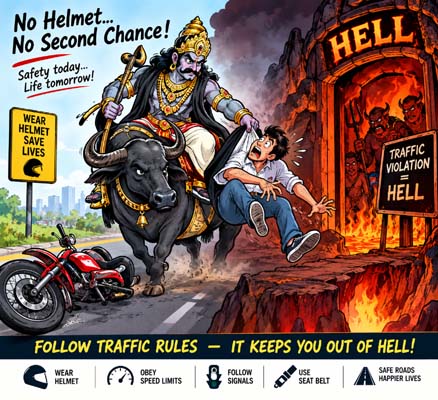
- Gujarat High Court’s question demands action: Why do mandatory helmet rules remain inadequately enforced on the state’s roads?
- A helmet must protect both seats: Riders and pillion passengers need genuine, standards-compliant helmets, correctly fastened.
- Uber and Ola bike taxis must lead by example: Aggregators and their driver-partners should ensure a suitable spare helmet is available for every passenger.
- Delhi’s enforcement offers a practical model: Traffic checks, challans and scrutiny of defective helmets demonstrate how compliance can be pursued.
- Fake ISI marks can create false confidence: BIS and enforcement agencies urged to crack down on counterfeit and non-compliant products.
- MY Bharat can mobilise young road-safety ambassadors: Youth volunteers can take helmet awareness into colleges, campuses and communities.
NE LAW & HEALTH BUREAU
AHMEDABAD, OCT 10
For a young person rushing to college, a delivery rider racing against time or a commuter booking a quick bike-taxi trip, is a helmet an inconvenient accessory — or a lifesaving companion? The Gujarat High Court’s reported concerns over the weak enforcement of helmet rules have brought this question sharply into focus. The message is especially urgent for young riders: a short journey can still end in a devastating crash, and a helmet can make the difference between a survivable accident and a life-changing head injury.
The Two Wheeler Helmet Manufacturers Association has welcomed the Gujarat High Court’s reported observations, urging the state government and traffic police to enforce helmet rules consistently for both riders and pillion passengers. It has also called for strict action against counterfeit and non-compliant helmets, and proposed that app-based bike-taxi operators make passenger protection a non-negotiable part of every trip.
From judicial concern to enforcement on every road
During proceedings concerning traffic management and road safety in Ahmedabad on October 9, the Gujarat High Court reportedly questioned the state government over inadequate implementation of mandatory helmet rules. Media reports said the bench also raised concerns about dangerous mobile-phone use while driving and fatal accidents involving two-wheelers and dumper trucks. The state reportedly informed the Court that 650 traffic personnel had been recruited and that Traffic Brigade personnel would receive traffic-management training before deployment.
Rajeev Kapur, President of the Two Wheeler Helmet Manufacturers Association, said: “We welcome and appreciate the Gujarat High Court’s firm observations on helmet rule enforcement. Helmet regulations exist to protect human lives, and their effectiveness depends on consistent implementation rather than merely having the rules on paper. Both riders and pillion passengers must comply with the applicable requirements. There should be no ambiguity in enforcement, and road safety must not be treated as a matter of convenience.”
The association wants the reported recruitment of traffic personnel to translate into regular roadside checks, appropriate penalties under the law, monitoring of repeat violations and sustained public-awareness campaigns.
Uber, Ola and bike-taxi operators: no passenger without a helmet
The association has urged app-based bike-taxi platforms, including Uber and Ola where such services operate, to make passenger helmet availability and use a firm operational requirement.
Driver-partners should carry a spare, genuine, standards-compliant helmet in suitable condition for the passenger, ensure it fits properly and insist that it is fastened before the journey begins. Passengers should not be left to choose between abandoning a ride and travelling without basic protection.
Uber’s published safety guidance says both the driver and passenger must wear helmets on its motorcycle trips and recommends that driver-partners keep a spare helmet in good condition for passengers. Its passenger guidance also says a trip may be cancelled if helmet use cannot be assured.
The association is calling for comparable, clearly communicated safeguards from all operators offering bike-taxi services, alongside a straightforward in-app facility for passengers to report missing, defective or non-compliant helmets. Platforms should monitor complaints and ensure that safety is not sacrificed for speed or convenience.
The message to young commuters is equally direct: do not begin a bike-taxi journey without a suitable helmet. Ask for one, fasten the strap and report repeated non-compliance through the app.
Delhi’s lesson: enforcement must cover defective helmets too
Delhi Traffic Police’s August 2025 newsletter reported that 77,447 riders and pillion passengers were challaned for riding without helmets in July 2025. It also reported 320 challans for defective helmets not conforming to BIS requirements and 161 for helmets worn without the strap properly fastened. These figures illustrate the scale of enforcement activity and the importance of checking helmet quality and correct use — not merely whether a helmet is visible.
Gujarat has already demonstrated that organised enforcement is possible. In May 2026, the state reportedly launched an intensive helmet-compliance campaign beginning with government offices, with checks and penalties intended to apply regardless of rank. The challenge now is to sustain and expand enforcement rather than allow it to become a short-lived drive.
The health evidence is too strong to ignore
The World Health Organization says that correctly wearing a quality motorcycle helmet can reduce the risk of death in a crash by more than six times and the risk of brain injury by up to 74%.
Road-safety practice therefore calls for a combination of enforcement and prevention: a genuine helmet that meets applicable standards, a secure fit and fastened strap, safe speed, no mobile-phone use while driving, and alertness around heavy vehicles. No helmet can eliminate every risk, but a proper one can substantially reduce the danger of serious head injury.
Fake ISI helmets: a hidden threat to consumers
The association has urged the Bureau of Indian Standards (BIS), Gujarat Police and consumer-protection authorities to intensify inspections and take action against the manufacture, distribution and sale of counterfeit or non-compliant helmets.
Kapur said: “We must address both sides of the helmet-safety challenge. While motorists must wear helmets, the market must also ensure that consumers have access to genuine, compliant products. A fake ISI-marked helmet can create a dangerous false sense of security.”
Consumers should not rely on appearance or a printed logo alone. They should buy from reliable sellers and check the relevant BIS certification details wherever possible. Authorities, meanwhile, should verify licence information and investigate suspected misuse of the ISI Standard Mark.
MY Bharat: turn young people into road-safety ambassadors
The association has also called for MY Bharat, the Ministry of Youth Affairs and Sports’ youth-engagement platform, to support road-safety awareness through volunteers and educational institutions. MY Bharat has previously facilitated road-safety experiential learning and volunteer engagement with traffic police. <Cite refs={[“turn384185search8″,”turn384185search11”]}/>
Young volunteers could conduct campus campaigns, demonstrate correct helmet fastening, promote genuine certified products and encourage students to speak up when friends ride without helmets. Such efforts should complement — not replace — consistent enforcement by traffic police.
Kapur said the association favoured a coordinated strategy built around strict compliance for riders and pillion passengers, a crackdown on counterfeit helmets, and sustained public education.
For Gujarat’s youth and daily commuters, the message is simple: a helmet is not merely a legal obligation; it is a life-saving companion. Every rider, every pillion passenger and every app-based bike-taxi operator must help make that principle a reality on the road.