- Surface Science, Smart Sprays and Precision Water Use Take Centre Stage
- International Experts Explore Droplet Behaviour to Cut Chemical Waste
- SPARC-Supported Meet Bridges Lab Innovation with Field-Level Farming
- Focus on Agriculture 4.0, Climate Resilience and Food Security
NE AGRICULTURE BUREAU
GANDHINAGAR, JAN 20
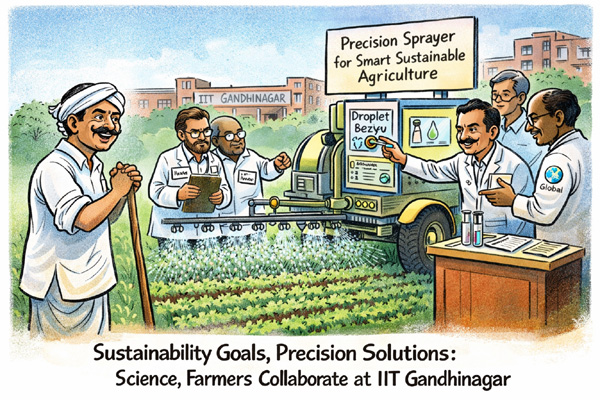
The Indian Institute of Technology Gandhinagar (IITGN) has reaffirmed its commitment to science-driven, sustainable agriculture by concluding a two-day international workshop titled “Toward Sustainable Agriculture: Managing Droplet–Solid Interactions through Surface Science.” The workshop brought together leading researchers, industry experts and agricultural practitioners from India and abroad to explore innovations that can significantly improve pesticide efficiency, water conservation and crop health.
Organised under the Ministry of Education’s SPARC (Scheme for Promotion of Academic and Research Collaboration) initiative, the workshop served as a platform for interdisciplinary collaboration and global knowledge exchange. Eminent participants included Prof Ranjan Ganguly (Jadavpur University), Prof Constantine Megaridis (University of Illinois Chicago), Prof Soumyadip Sett (IIT Gandhinagar), Prof Pallab Sinha Mahapatra (IIT Madras), Prof Jonathan Boreyko (Virginia Tech) and Prof Sunghwan (Sunny) Jung (Cornell University).
Interdisciplinary Research Key to Agricultural Sustainability
In the inaugural session, Prof Soumyadip Sett welcomed the delegates and underlined the importance of international and cross-disciplinary research in tackling agriculture-related sustainability challenges.
Highlighting the broader objective of the workshop, Prof Vimal Mishra, Dean (Research and Development), IITGN, said: “Meeting food security demands for over 1.4 billion people while simultaneously minimising chemical inputs and maintaining environmental stewardship is challenging. Platforms such as this workshop could foster meaningful dialogue across disciplines, enabling innovations that address food security, climate variability, resource efficiency, and environmental sustainability.”
How Droplets Shape Crop Health and Resource Efficiency
The workshop featured plenary lectures, technical sessions, flash talks and poster presentations, with a sharp focus on how liquids—pesticide sprays, irrigation droplets and rain—interact with plant surfaces. Speakers demonstrated how understanding these interactions can reduce chemical wastage, improve precision farming and lower environmental impact.
Prof Saptarshi Basu (IISc Bengaluru) and Prof Amitava Datta (Jadavpur University) explained how sprays are generated and how droplets break, travel and settle in the air, determining whether agricultural sprays reach crops or are lost to drift and evaporation. They emphasised that controlling droplet size and behaviour at the source is critical to reducing pesticide misuse.
From Onion Tears to ‘Sneezing’ Plants: Science Meets Farming
Building on these fundamentals, Prof Cameron Tropea (Technische Universität Darmstadt), Dr Sujoy Saha (ICAR-NRCG), Prof Sunghwan Jung (Cornell University), Prof Jonathan Boreyko (Virginia Tech) and Prof Amit Agrawal (IIT Bombay) presented innovative approaches to optimise spray technologies and liquid delivery systems.
Prof Tropea and Dr Saha demonstrated engineering methods to regulate droplet size, showing how this could drastically cut pesticide drift. Prof Jung illustrated droplet ejection and transport using the familiar example of onion cutting, revealing how everyday phenomena can unlock insights into complex fluid behaviour. Prof Boreyko described how infected plants naturally “sneeze” to spread disease, highlighting an often-overlooked mechanism affecting crop health. Prof Agrawal explained how fluid flow through textured microchannels can be leveraged to improve liquid transport systems in agriculture and energy applications.
Agriculture 4.0 and Capacity Building in Focus
Panel discussions stressed the urgency of bridging laboratory research with field-level applications, warning that inefficient pesticide use contributes to pest resistance, environmental contamination and food safety risks. The sessions also examined India’s transition towards “Agriculture 4.0”, with data-driven and autonomous solutions tailored to small landholdings and diverse cropping systems.
The workshop also showcased emerging talent, featuring 16 flash talks and 22 poster presentations, with awards presented to both faculty members and students.
“Such sessions reinforce SPARC’s emphasis on capacity building by equipping the next generation of researchers with the skills to build professional networks, communicate science effectively, and cultivate curiosity at the interface of engineering and agricultural science,” said Prof Pallab Sinha Mahapatra (IIT Madras).
Echoing the collaborative spirit of the event, Prof Ranjan Ganguly (Jadavpur University) said: “Sustainable agriculture cannot be achieved in silos; it requires co-creation of solutions grounded in real field challenges. The objective of this workshop was to advance scientific understanding and build a shared language between engineers, plant scientists, and agricultural practitioners.”
Backed by Government, Industry and Global Partners
The workshop was supported by ANRF and the Gujarat State Biotechnology Mission (GSBTM) under the Department of Science and Technology, Government of Gujarat, and sponsored by ATOS Instruments, Phantom AMETEK and Springer.
Through this initiative, the IITGN organising team—Prof Soumyadip Sett, Prof Subramanian Sankaranarayanan, Prof Sriharitha Rowthu and Prof Uddipta Ghosh—reinforced the institute’s role as a hub for interdisciplinary research, global collaboration and sustainable development, aligned with the United Nations Sustainable Development Goals and national priorities.