- Global team pioneers vermiculite-based nanofluidic technology that can control ions even in salty environments — a feat once thought impossible
- Breakthrough promises transformative applications in medical diagnostics, water purification, and sustainable energy
- “Nature has shown us the way — we’re learning to build technology that mimics life itself,” says Prof. Gopinadhan Kalon of IITGN
NE SCIENCE & TECHNOLOGY BUREAU
GANDHINAGAR, OCT 29
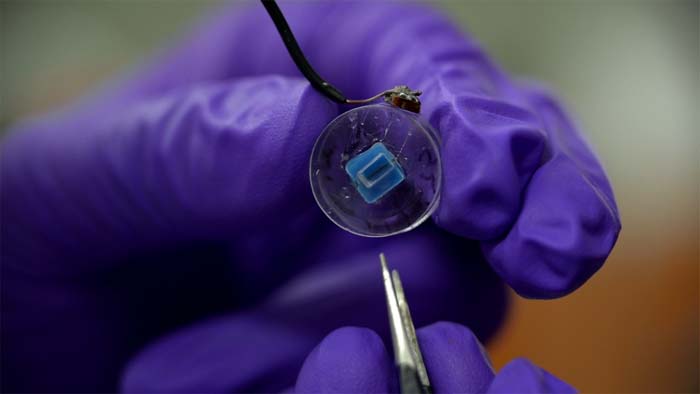
A team of researchers at the Indian Institute of Technology Gandhinagar (IITGN), in collaboration with scientists from Taiwan, Portugal, and the United States, has achieved a breakthrough that could redefine the future of lab-on-a-chip technology — by harnessing the power of clay.
In a groundbreaking study published in Nature Communications, the researchers demonstrated how vermiculite, a naturally occurring clay mineral, can act as an atomic-scale switch to precisely guide ions — the tiny charged particles that power both biological and electronic systems.
This innovation paves the way for affordable, scalable, and eco-friendly nanotechnologies that could transform water purification, medical diagnostics, and clean energy.
“Nature’s biological membranes are the ultimate nanofluidic systems — our work brings us one step closer to replicating that precision using simple, abundant materials like clay,” said Prof. Gopinadhan Kalon, Associate Professor of Physics at IITGN and Principal Investigator of the study.
A Natural Mineral with Atomic Precision
By fine-tuning the atomic layers of vermiculite — replacing magnesium with potassium, calcium, or aluminium — the team engineered ultra-thin membranes just 3–5 angstroms wide, allowing electrical signals to control the motion of ions even in highly salty environments, such as seawater or blood.
“At this ultra-confined scale, ions no longer behave randomly — they move in single file, almost like soldiers marching through a narrow pass,” explained Dr. Biswabhusan Dhal, the study’s first author and former PhD student at IITGN.
When tested with potassium ions, the clay-based nanofluidic device achieved a record 1400% change in conductivity, proving that this natural material could outperform existing nanostructures like graphene oxide or silicon — particularly in real-world, high-salt conditions where traditional systems fail.
From the Lab to Life: The Future of Claytronics
The implications stretch across disciplines. In water purification, these membranes could remove toxic ions from wastewater or seawater with minimal energy use. In medical diagnostics, they could enable smarter, faster lab-on-a-chip devices capable of detecting diseases from a single drop of blood. In energy technology, the same principles could enhance next-generation iontronic devices, including batteries and osmotic power generators.
Building on Global Collaboration
The research involved a truly international effort:
- IIT Gandhinagar, India: Dr Biswabhusan Dhal, Naman Chandrakar, Aparna Rathi, Dr Suvigya Kaushik, and Prof. Gopinadhan Kalon
- University of Colorado Boulder, USA: Dr Yechan Noh
- IIT Bhubaneswar, India: Prof. Saroj Kumar Nayak and Sanat Nalini Paltasingh
- International Iberian Nanotechnology Laboratory, Portugal: Dr Siva Sankar Nemala and Dr Andrea Capasso
- National Taiwan University of Science and Technology, Taiwan: Prof. Li-Hsien Yeh
The team now plans to explore ion transport under extreme confinement and higher salt concentrations, potentially unlocking a new frontier in nanofluidic design inspired by both Earth and biology.