NE SCIENCE & TECH BUREAU
NEW DELHI, NOV 3
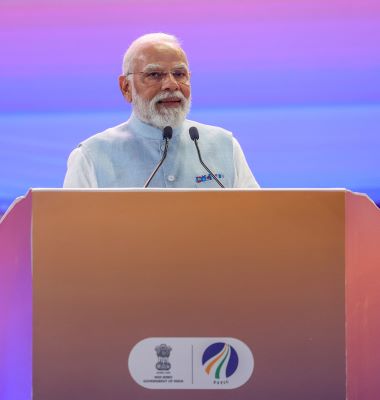
India is set to host the Global AI Summit 2026, marking a major step in shaping a global framework for ethical and human-centric artificial intelligence, Prime Minister Narendra Modi announced while inaugurating the Emerging Science, Technology and Innovation Conclave (ESTIC) 2025 at Bharat Mandapam in New Delhi on Monday.
India is rapidly building a vibrant ecosystem for research and development. Addressing the Emerging Science, Technology and Innovation Conclave in New Delhi. https://t.co/jIhdvjraIy
— Narendra Modi (@narendramodi) November 3, 2025
Unveiling a series of landmark initiatives, the Prime Minister launched the ₹1 lakh crore Research, Development and Innovation (RDI) Scheme, aimed at fostering a vibrant, private sector-driven R&D ecosystem to power India’s technological and scientific growth.
- PM Unveils ₹1 Lakh Crore RDI Scheme to Boost Private Sector-Led Research and Innovation
- ‘Ease of Doing Research’ to Build a Modern Innovation Ecosystem Across India, Says Prime Minister
- “India Is No Longer a Consumer of Technology, But a Pioneer of Transformation Through It,” PM Modi Declares at ESTIC 2025
“India is building a modern innovation ecosystem and focusing on the Ease of Doing Research,” the Prime Minister said, highlighting sweeping reforms in procurement rules, financial policies, and regulatory frameworks that allow prototypes to swiftly move from lab to market.
Science Meets Scale, Innovation Turns Inclusive
Calling the 21st century an age of exponential transformation, PM Modi underlined India’s emergence as a global leader in innovation, with R&D expenditure doubling, registered patents rising 17 times, and India now home to the world’s third-largest startup ecosystem.
He noted that over 6,000 deep-tech startups are currently engaged in cutting-edge fields such as clean energy, advanced materials, and semiconductor technology, while the country’s bioeconomy has expanded from $10 billion in 2014 to $140 billion today.
“When science meets scale, when innovation becomes inclusive, and when technology drives transformation — the foundation for great achievements is laid,” the Prime Minister remarked, adding that India has evolved from a consumer to a pioneer of technological transformation.
AI and the Future of Ethical Technology
PM Modi emphasized that Artificial Intelligence must be guided by human values, inclusivity, and safety. Under the India AI Mission, the government is investing over ₹10,000 crore to make AI accessible and beneficial for all sections of society.
“India is shaping a global framework for ethical and human-centric AI,” the Prime Minister said, announcing that the Global AI Summit 2026—to be held in India—will unite global experts, innovators, and policymakers to accelerate efforts toward inclusive and responsible AI.
Empowering the Next Generation of Innovators
To cultivate a culture of curiosity and invention, PM Modi announced the establishment of 25,000 new Atal Tinkering Labs, in addition to the 10,000 already functioning, where over one crore students are experimenting with science and technology.
He also said that 10,000 new Prime Minister’s Research Fellowships will be awarded over the next five years to empower young researchers. “We want to make research as aspirational as entrepreneurship,” he added.
Highlighting women’s growing leadership in science, the Prime Minister said women now account for 43% of STEM enrolments in India, surpassing the global average, and over 5,000 patents are now being filed annually by women scientists — up from fewer than 100 a decade ago.
India’s Vision: From Science to Self-Reliance
Calling for intensified innovation in nutrition security, bio-fertilisers, genomic mapping, and clean energy, PM Modi challenged researchers to make India self-reliant in critical technologies and materials.
He urged the scientific community to go beyond the questions posed and “explore new possibilities that will define the next century of Indian science.”
A Global Stage for Collaboration
ESTIC 2025, being held from November 3–5, brings together over 3,000 participants from academia, industry, and government—including Nobel Laureate Sir Andre Geim, global scientists, and innovators—to discuss 11 thematic areas spanning AI, quantum computing, advanced materials, green hydrogen, and space technology.
Concluding his address, PM Modi invoked the spirit of “Jai Vigyan, Jai Anusandhan”, expressing confidence that the collective outcomes from ESTIC 2025 will chart a roadmap toward a “Viksit Bharat” (Developed India) by 2047.