NE BUSINESS BUREAU
NEW DELHI, DEC 21
Indian Railways on Sunday announced a revision in passenger fares effective December 26, a calibrated move aimed at generating an additional Rs 600 crore in revenue while maintaining affordability for short-distance and suburban commuters.
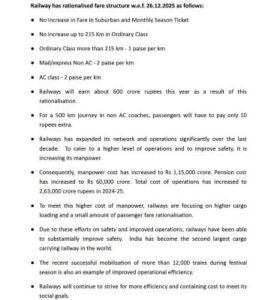
Under the revised pricing structure, passengers travelling beyond 215 km will pay an additional 1 paisa per kilometre in Ordinary Class and 2 paise per kilometre in Mail and Express services, including non-AC and AC classes. For instance, a passenger undertaking a 500 km non-AC journey will pay Rs 10 more. There will be no increase in fares for journeys shorter than 215 km, ensuring that daily and short-haul travellers remain unaffected.
- Marginal fare hike applies only to journeys beyond 215 km; short-distance travel untouched
- Suburban and monthly season ticket fares remain unchanged to protect affordability
- Railways cites rising manpower and pension costs amid network expansion
- Freight strategy, safety upgrades and bullet train progress highlighted
The Railways has also clarified that suburban services and monthly season tickets will see no fare revision, a move intended to keep rail travel accessible for low- and middle-income households that rely heavily on public transport.
Explaining the rationale behind the decision, the Ministry of Railways said in a statement, “Over the past decade, the Indian Railways has significantly expanded its network and operations, reaching even the remotest corners of the country. To support this higher level of operations and further enhance safety, the railways is increasing its manpower. Consequently, manpower cost has increased to Rs 1,15,000 crore. Pension cost has increased to Rs 60,000 crore. Total cost of operations has increased to Rs 2,63,000 crore in 2024–25.”
To manage these rising costs, the Railways said it is adopting a balanced approach. “To meet the higher manpower costs, the railways said it is focusing on increasing cargo loading, along with a small amount of rationalisation of passenger fares.”
The ministry highlighted operational improvements achieved in recent years, stating, “Due to these efforts on safety and improved operations, railways have been able to improve safety substantially. India has become the second-largest cargo-carrying railway in the world.”
Despite rising input costs, freight rates have not been revised since 2018, with the Railways instead relying on higher cargo volumes to boost earnings. The ministry pointed to the successful mobilisation of more than 12,000 trains during the recent festival season as evidence of improved operational efficiency.
In a parallel update, the ministry noted progress on infrastructure expansion, stating that construction work on the flagship high-speed bullet train project has gathered momentum in Maharashtra, with 100 per cent land acquisition already completed.
The fare adjustment, officials emphasised, reflects a targeted and restrained approach—seeking financial sustainability for Indian Railways while preserving its role as the country’s most affordable and inclusive mode of long-distance transport.