- Three-day conference unites 850+ global scholars to decode people, organisations, and policy in a fast-shifting economy
- Final day showcases 80+ poster presentations, cutting-edge research, and cross-disciplinary insights
- Tracks explore digital transformation, sustainability, AI, startups, logistics, behavioural science, and economic policy
- Valedictory address underscores India’s rapid rise in global research output and the need to scale quality further
NE EDUCATION BUREAU
AHMEDABAD, DEC 8
The Indian Institute of Management Ahmedabad (IIMA) concluded the second edition of the India Management Research Conference (IMRC 2025), held from December 5–7, with powerful conversations on the theme “The Future of the Economy: People, Organisations, and Policy.” The conference brought together over 850 scholars, researchers, and academics from around the world and reaffirmed IIMA’s goal of shaping India-centric scholarship that influences global economic thinking.
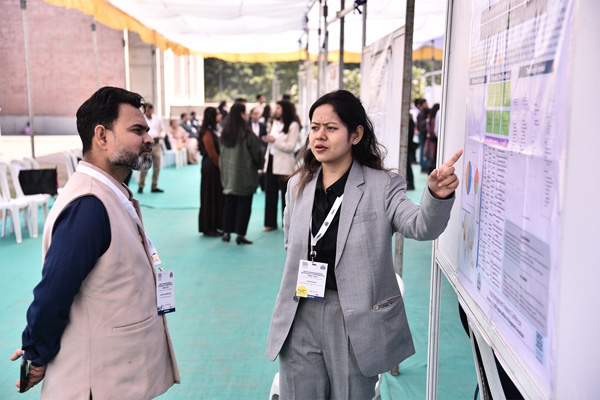
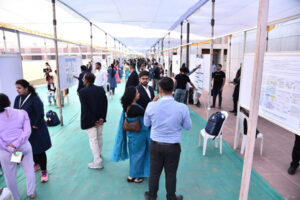
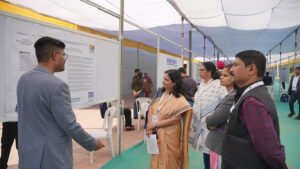
Building on the momentum from the earlier sessions—featuring keynote talks, panel discussions, workshops, and 12 parallel research tracks—the final day offered a dynamic display of intellectual depth. A conference-wide poster session saw more than 80 participants present research spanning healthcare, neuromarketing, digital governance, misinformation, solar energy transmission, private equity strategy, and consumer psychology. The interactive format encouraged dialogue, expert feedback, and collaborative opportunities.
Track-wise paper presentations continued throughout the day. The ‘Unpacking the Indian Startup Story’ track spotlighted early-stage dilemmas, digital public infrastructure investments, women empowerment, and sustainable MSME development.
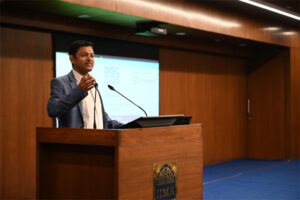
The Digital Transformation track featured a keynote by Anant Mishra of Vin University, who spoke on “Digital Systems and Frontline Workers,” highlighting how digital tools and onsite training can reduce stockouts in public health supply chains. Sixteen thematic papers explored consumer technology, sustainable digitalisation, e-governance, and technology adoption.
The Corporate Sustainability and Corporate Governance (IRCC 2025) track hosted keynotes by Gireesh Shrimali on assessing and mitigating physical climate risks, and Manu Srivastava on enabling large-scale renewable energy uptake. Panel discussions and mentor-led sessions deepened the understanding of ESG and governance landscapes.
In the Low Emissions Development Strategies track, experts discussed heat stress, low-emission urban planning, and state-level climate pathways. Leona Chandra delivered the keynote on “Leadership and Delegation in the Age of AI Agents.” The discussion also marked the launch of the India LEDS Research & Action Platform, developed jointly by IIMA and Kalpa Impact.
Marketing researchers assembled at the India Marketing Conference track, presenting high-quality doctoral work across Consumer Culture Theory, Consumer Behaviour, and Marketing Strategy. A specialist workshop on modern quantitative techniques was conducted by Arnab Laha.
The Management in Health Services track hosted panels on Viksit Bharat @ 2047, frontline healthcare workforce strengthening, and the future of public health in India. Concurrently, the Behavioural Science in Management track held a workshop by Mayur Jartarkar and panel discussions on women at the workplace and behavioural economics.
Transportation and Logistics sessions included insights from experts including Vinod Singhal on empirical supply chain research, Amar Sapra on inventory management, and Shashank Rao on navigating editorial decisions in academic publishing.
The Leadership Research & Practice track hosted 25 oral presentations, symposia on digital-era spatial leadership and the application of Kurt Lewin’s change frameworks, alongside a workshop on integrating design research into leadership studies. The track keynote was delivered by Leona Chandra.
A major highlight was the Gold & Precious Metals: Business and Economic Policies track, with guest addresses by Duvvuri Subbarao on the role of gold in central bank strategies and Sridhar Vembu on innovation and gold’s strategic significance. Keynotes were delivered by Praveena Rai, Anindita Chakrabarti, and V. S. Sundaresan, with contributions from policymakers, regulators, academics, and industry leaders.
The three-day event concluded with reflections and key takeaways during the valedictory ceremony.
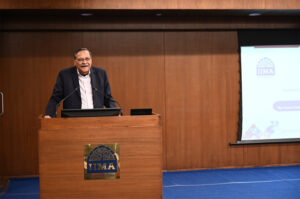
In his valedictory address, Bharat Bhasker, Director, IIMA, said India’s research output has grown rapidly in the past 15–17 years. “Just as the neighbouring countries like China and South Korea created their own international conferences as an enabler to boost research in their country, IMRC is IIMA’s attempt to create an enabler in the management domain to encourage India-centric research at a global scale. It serves as a platform to share ideas, find collaborators to work on those ideas, and continue to publish in international journals. We realise that there is a long way ahead, but with these kinds of enablers, India will continue to climb up in the research domain in the times to come.”
Conference Convener Debjit Roy added, “We were thrilled to witness the depth and diversity of research emerging from institutions across India. This reflects the strong and meaningful work being carried out in various domains. What researchers now need is to step up their writing, problem definition, editing skills, and the way they engage with reviewers to build stronger publications. One of the exciting themes that emerged at IMRC 2025 was the growing focus on building AI-enabled research capacity — how AI tools can help bridge research insights for practitioners, and class session learnings be extended beyond using AI tools such as Google Gems. I hope IMRC 2025 offered inspiration and momentum for participants to take their research journeys forward.”