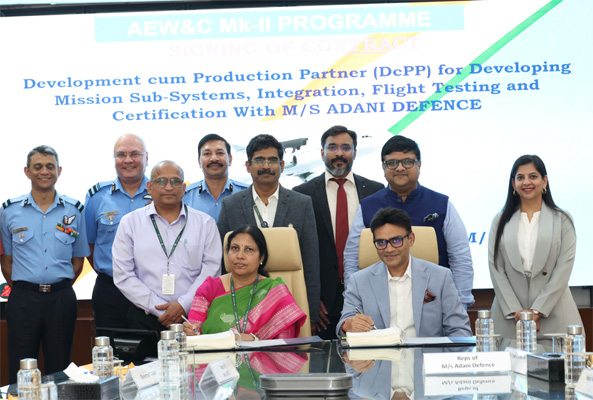
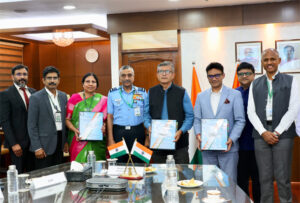
- Landmark AEW&C-MKII partnership places India on the global map of indigenous airborne surveillance powers
- Adani Defence to jointly develop, manufacture and integrate mission systems on six modified Airbus A321 aircraft for the Indian Air Force
- 30-year lifecycle support, including integrated logistics, MRO and technical assistance, to create a long-term indigenous defence ecosystem
- AEW&C-MKII to strengthen real-time surveillance, early threat detection, command and control and network-centric warfare capabilities
- India joins an elite group of only five nations with indigenous AEW&C capabilities as induction of the next-generation platform is planned for 2032-33
NE BUSINESS BUREAU
NEW DELHI, JULY 23
When the next war may be decided in seconds, the nation that sees first, understands first and responds first holds the decisive advantage. India has now taken a giant leap towards securing that advantage in the skies.
In a landmark boost to Aatmanirbhar Bharat and India’s strategic defence capabilities, Adani Defence & Aerospace and the Defence Research and Development Organisation (DRDO) have entered into a major partnership for AEW&C-MKII, the country’s next-generation Airborne Early Warning & Control programme for the Indian Air Force (IAF).
The agreement marks a defining moment in India’s journey towards building advanced, indigenous airborne mission systems and further deepening the role of private industry in the country’s most complex defence programmes.
Under the partnership, Adani Defence & Aerospace and DRDO will jointly develop, manufacture and integrate airborne mission systems on six modified Airbus A321 aircraft for the IAF.
The programme will also encompass integrated logistics, maintenance, repair and overhaul (MRO), and technical support for up to 30 years.
The induction of AEW&C-MKII is planned for 2032-33.
A new high-altitude command centre for India’s air power
Often described as the “eyes in the skies”, AEW&C aircraft are among the most crucial assets in modern warfare.
They can detect threats from long distances, monitor the battlespace, coordinate combat assets and provide commanders with real-time operational intelligence.
AEW&C-MKII is designed to significantly enhance the IAF’s:
- Long-range airborne surveillance;
- Early threat detection;
- Situational awareness;
- Secure communications;
- Command and control;
- Force coordination; and
- Network-centric warfare capabilities.
The platform will be integrated with the IAF’s Integrated Air Command & Control System (IACCS)—the nationwide command-and-control network linking surveillance, air-defence and operational assets.
The integration is expected to strengthen the speed and quality of decision-making while enabling seamless coordination across the battlespace.
Adani Defence enters India’s most advanced airborne mission space
The programme represents a major milestone for India’s private defence sector.
With the AEW&C-MKII partnership, Adani Defence & Aerospace becomes the first private Indian company to be entrusted with the development, integration and lifecycle support of an airborne mission platform of this scale and complexity.
The partnership brings together: DRDO’s expertise in defence research, mission systems and advanced technologies; and Adani Defence & Aerospace’s capabilities in advanced manufacturing, systems integration and long-term lifecycle support.
Together, the collaboration aims to create one of India’s most advanced indigenous airborne surveillance platforms.
India enters an elite club of airborne surveillance powers
The scale of the programme is underlined by its strategic significance.
Only five countries—the United States, France, Israel, China and Sweden—have developed indigenous AEW&C capabilities.
With AEW&C-MKII, India is positioning itself among this select group of nations capable of developing and integrating sophisticated airborne early-warning and command systems.
The programme therefore goes beyond the acquisition of another defence platform.
It represents the creation of a complete national capability spanning:
Research.
Design.
Systems integration.
Advanced manufacturing.
Mission-system development.
Lifecycle maintenance.
And long-term operational support.
SIX A321s to become India’s next-generation airborne sentinels
Six modified Airbus A321 aircraft will serve as the platforms for the AEW&C-MKII mission systems.
The aircraft will be transformed into sophisticated airborne command and surveillance platforms capable of extending the IAF’s vision far beyond the immediate battlefield.
With long-term integrated logistics, MRO and technical support extending up to 30 years, the programme is also expected to create a sustained indigenous ecosystem for advanced defence engineering and aerospace support.
The project could generate significant opportunities in:
- High-end defence manufacturing;
- Aerospace systems integration;
- Mission electronics;
- Artificial intelligence and data processing;
- MRO and lifecycle management;
- Skilled employment; and
- Indigenous defence technology development.
The strategic message: See first, decide first, act first
The modern battlefield is increasingly defined by information dominance.
The ability to identify an approaching threat, assess its nature, coordinate multiple assets and respond rapidly can determine the outcome of an operation.
AEW&C-MKII is expected to provide the IAF with a powerful airborne layer of surveillance and command capability.
Its integration with IACCS will enable faster information flow between airborne surveillance systems, ground-based networks and operational assets.
The result will be a more connected, responsive and technologically advanced air-defence architecture.
The Adani–DRDO partnership therefore sends a powerful message:
India is no longer content to merely operate advanced defence systems. It is building the capability to design, develop, manufacture, integrate and sustain them at home.