- MoU marks a major leap in digital construction research & education
- Robotic concrete printing lab to enable cutting-edge prototyping, structural innovation
- Collaboration to drive sustainable, future-ready building technologies
NE EDUCATION BUREAU
AHMEDABAD, DEC 2
CEPT University has signed a landmark Memorandum of Understanding (MoU) with Tvasta Manufacturing Solutions Pvt. Ltd., Chennai, to establish India’s most advanced 3D concrete printing workshop on its Ahmedabad campus—an initiative that positions the University at the forefront of next-generation construction technology.
Through this collaboration, Tvasta—India’s pioneering deep-tech startup in construction 3D printing—will provide CEPT with a state-of-the-art robotic arm capable of printing complex, high-precision concrete forms. With this, CEPT becomes one of the very few premier institutions in the country equipped with an automated concrete printing setup dedicated to design, architecture, material innovation, and construction research.
The facility will be operational in the coming months and will support a wide range of activities, including teaching studios, applied research, prototyping, and experimental projects designed to address real-world construction challenges.
A Research-Led Partnership
The initiative is led by Prof Jinal Shah, Program Chair of the Masters in Computational Design and Fabrication (MCDF) at CEPT University, and Kalyan Vaidyanathan, Chief Technical Officer – Construction, Tvasta Manufacturing Solutions. Their shared aim is to expand the possibilities of 3D-printed concrete for India’s construction sector.
Researchers from both sides plan to explore:
- Printed façade and building components
- Integrated structural systems where walls, roofs, and slabs are printed as a single unit
- Embedding electrical conduits within printed walls
- Climate-responsive printed forms
- Off-site printed components for difficult terrains
Academic–Industry Synergy
The collaboration offers CEPT students and faculty a rare opportunity to work at the intersection of design, engineering, and material science. By integrating Tvasta’s technological leadership with CEPT’s academic strengths, the partnership will foster a vibrant ecosystem of experimentation.
Prof. Chirayu Bhatt, Deputy Provost (Academics), CEPT University, said: “Technological innovation is central to our University’s vision for the future of the built environment. We are thankful to Tvasta for joining hands with us in bringing cutting-edge additive manufacturing directly into the heart of CEPT’s teaching and research ecosystem. It will enable students and faculty to prototype, experiment and rethink the way India conceives and constructs its buildings. At CEPT, we have maintained that industry-academia collaborations are crucial for meaningful advancement of the country and that this agreement marks an important step in shaping the next generation of construction technologies.”
Prof. Jinal Shah, Program Chair (MCDF), Faculty of Design, highlighted the academic value: “3D printing of concrete is a rapidly evolving construction technique in India, driven by its potential for mass customization, material efficiency and its ability to achieve sustainability goals in construction. The collaboration with Tvasta to establish a 3D Printing workshop at CEPT will strengthen research, design development and rapid prototyping, through an integrated design and construction approach within the domain of Additive Manufacturing. This will further enable students to develop efficient, innovative design solutions for real-world application by deepening their understanding of material and fabrication driven design processes.”
From Tvasta, Kalyan Vaidyanathan, Chief Technology Officer – Construction, said: “Tvasta has been a pioneer in 3D Concrete Printing, grounded in deep research and collaborative innovation, consistently pushing the boundaries of what is possible in construction automation. We are excited to collaborate with CEPT University, a world-renowned institution leading advancements in architecture and design.
Through this partnership, Tvasta architects and CEPT faculty will jointly offer studio courses in DFAM (Design for Additive Manufacturing), with projects being practically built using Tvasta’s 3D concrete printers at their workshop. We also look forward to collaborative R&D in energy-efficient construction and structural performance of various 3D-printed architectural elements, along with other breakthrough initiatives in the near future.”
Strengthening Future Readiness
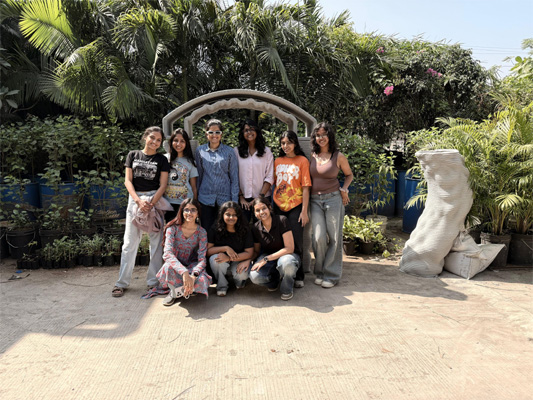
Over the past year, MCDF and Bachelor of Architecture students have visited Tvasta’s facilities in Chennai and Bhiwandi, learning about robotic printing workflows, materials, and prototyping. The new on-campus facility will expand these early learnings into a comprehensive body of work involving studio-based experiments, demonstrations for real construction scenarios, and long-term research.
Once operational, the CEPT–Tvasta workshop is set to become one of India’s most comprehensive academic platforms for 3D printing research and innovation—equipping students with future-ready skills in digital fabrication and reshaping how India imagines its built environment.