- IIMA’s July BIES puts one-year inflation expectation at 4.94%, up 10 bps
- Cost pressures send mixed signals as very significant increases stay stubbornly high
- More than half of firms see sales at or above normal levels
- Profit-margin outlook improves, with below-normal expectations falling to 70%
NE ECONOMIC BUREAU
AHMEDABAD, SEPT 5
Is inflation beginning to lose its grip on businesses even as the recovery in sales and profit margins gathers momentum? The latest Business Inflation Expectations Survey (BIES) conducted monthly by the Misra Centre for Financial Markets and Economy at IIMA presents a cautiously encouraging picture: while firms have marginally raised their one-year inflation expectations, improving sales levels and a gradual recovery in profit-margin perceptions point to strengthening business conditions.
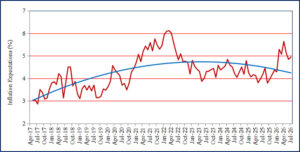
The July 2026 survey puts one-year-ahead business inflation expectations at 4.94%, a marginal 10-basis-point increase from 4.84% in June. Yet the more intriguing story lies beyond the headline inflation number—with sales expectations improving sharply and fewer firms reporting profit margins below normal levels.
Inflation expectations edge up, uncertainty stays elevated
Businesses have raised their one-year-ahead inflation expectations marginally in July, with the mean expected increase in unit costs climbing to 4.94% from 4.84% in June.
While the movement is modest, uncertainty surrounding the outlook remains a concern. The survey shows that the uncertainty surrounding business inflation expectations, measured through the square root of the average variance of individual probability distributions of expected unit-cost increases, remained above 2% for the seventh consecutive month.
The persistence of elevated uncertainty suggests that companies continue to face difficulty in accurately gauging the cost environment over the coming year.
Cost pressures send a mixed signal
The July cost-perception data does not point to a uniform easing of pressure.
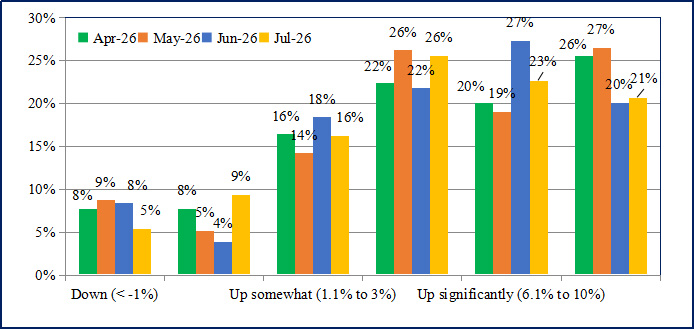
The share of firms perceiving significant cost increases of 6% to 10% declined from 27% to 24%, offering some relief. However, the proportion reporting very significant cost increases of more than 10% remained stubbornly around 20-21%.
At the same time, more companies reported moderately higher costs. The proportion describing costs as ‘up moderately’—more than 3% but below 6%—rose to 26% from 22% in the previous round.
The message is therefore mixed: fewer firms are experiencing significant cost escalation, but a sizeable proportion continues to confront exceptionally high increases, while moderate cost pressures have broadened.
Sales momentum offers a brighter signal
The strongest positive signal from the July survey comes from the sales front.
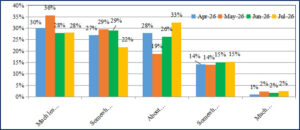
More than 50% of firms reported sales at ‘about normal’ levels or higher, a sharp improvement from 43% in June.
The rise suggests that demand conditions are strengthening and that a larger share of businesses is moving closer to, or exceeding, their normal sales performance.
For companies still negotiating elevated input costs, stronger sales could provide an important cushion by supporting revenues and helping absorb cost pressures.
Profit margins show signs of recovery
The improving sales picture is also beginning to reflect in firms’ perceptions of profitability.
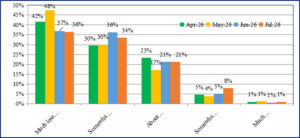
The proportion of firms reporting profit margins as ‘somewhat less than normal’ or below declined further to 70% in July, from 78% in May.
Although seven in 10 firms still perceive their margins to be below normal, the downward movement is significant. The improvement indicates that profit-margin conditions are gradually recovering.
Taken together, the sales and profitability indicators suggest that businesses may be entering a phase in which improving demand is beginning to offset some of the pressure from higher input costs.
The Big Picture: Cautious optimism, but inflation remains the watchpoint
The July BIES presents a nuanced economic picture.
Inflation expectations have ticked up, cost pressures remain uneven and uncertainty continues to be elevated. But stronger sales expectations and improving profit-margin perceptions provide counterbalancing evidence of better business conditions.
The key question now is whether this improvement in sales and margins can continue without triggering another sustained rise in business costs.
For policymakers and businesses alike, the coming rounds of the BIES will therefore be closely watched for one crucial signal: whether improving demand can translate into healthier profitability while inflation expectations remain anchored.