- International symposium lays blueprint to train next-generation scientists against air pollution, pandemics, and climate risks
- Experts from IITs, BARC, and global universities unite to transform aerosol science into a structured academic discipline
- White paper, modular courses, and certification pathways to anchor India’s deep-tech and sustainability ambitions
- Landmark initiative positions India to emerge as a global hub for aerosol research, innovation, and education
NE EDUCATION BUREAU
GANDHINAGAR, FEB 19
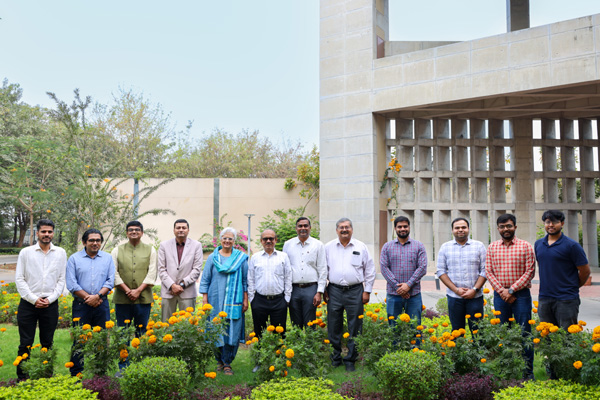
In a decisive step toward confronting some of humanity’s most urgent challenges—from air pollution and climate change to nanotechnology and public health—the Indian Institute of Technology Gandhinagar (IITGN), in collaboration with the University of Miami, hosted a landmark two-day international symposium titled “Promoting Aerosol Education and Research” on February 18–19, 2026.
Supported by India’s Ministry of Education under the Scheme for Promotion of Academic and Research Collaboration (SPARC), the symposium brought together leading scientists and educators from premier institutions including Indian Institute of Technology Bombay, Indian Institute of Technology Delhi, Indian Institute of Technology Goa, Bhabha Atomic Research Centre, and the Indian Aerosol Science and Technology Association to create a national roadmap for aerosol science education.
The initiative aims to establish structured academic pathways—from undergraduate modules to professional certification programmes—positioning aerosol science as a cornerstone discipline for India’s scientific and technological future.
A Critical Discipline for an Era Defined by Climate and Health
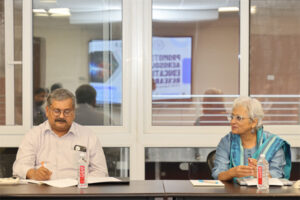
Welcoming participants, Dr Sameer Patel, Assistant Professor at IITGN, underscored the urgency of strengthening aerosol science education.
“Despite its increasing relevance in areas such as air pollution and climate science, aerosol studies remain underrepresented in mainstream academic curricula.”
He emphasized that the symposium was designed as a focused, outcome-driven exercise.
“The symposium was intentionally designed as a focused, discussion-driven meeting aimed at producing tangible outcomes, including a structured roadmap and action plan.”
The discussions highlighted how aerosol science underpins crucial applications such as nanomaterial synthesis, pollution control technologies, atmospheric research, and public health interventions—areas vital to India’s sustainability and Make in India ambitions.
A Discipline That Bridges Engineering, Environment, and Sustainability
Delivering key insights, Dr Chandra Venkataraman, Professor at IIT Bombay, emphasized the interdisciplinary nature of aerosol science.
“Aerosol science spans multiple disciplines including chemical and mechanical engineering, environmental science, physics, and sustainability studies.”
She stressed the need to embed aerosol education firmly within sustainability-focused academic frameworks.
“The discipline must reposition itself within emerging sustainability-focused academic frameworks and strengthen classroom integration through modular and flexible course structures.”
Training the Next Generation to Solve Global Challenge Problems
Highlighting the transformative potential of aerosol education, Dr Pratim Biswas, Professor at the University of Miami, said: “As Aerosol Science and Technology is an enabling discipline that can assist in tackling global challenge problems, there is a need to attract and train the next generation in this important field of endeavor.”
He emphasized that flexible learning formats could expand access and global leadership.
“Modular, certificate-based, and experiential course formats, including online platforms, could widen participation and position India as a global hub for aerosol education.”
Dr Biswas also stressed the importance of academic coordination and research integration.
“There is a need for a clear academic roadmap and stronger national research linkages.”
Certification, Curriculum, and Capacity: Building India’s Aerosol Ecosystem
Delivering the keynote on the evolution of aerosol science in India, Dr Y S Mayya strongly advocated formal certification and professional training.
He noted that professionals working with aerosol instrumentation and measurement systems would benefit from structured academic certification, drawing parallels with radiation safety training frameworks.
Other leading experts, including Dr Sagnik Dey, Dr Thaseem Thajudeen, and Dr S. Anand, contributed insights that will shape the proposed national curriculum roadmap.
Participants identified core curriculum pillars, including aerosol physics, chemistry, dynamics, instrumentation, and optical behaviour, alongside real-world applications in pollution monitoring, climate science, nanotechnology, and healthcare.
Innovative teaching methods such as experiential learning, peer-led modules, internships, laboratory immersion programmes, and field visits to air-quality monitoring stations were proposed as essential components.
White Paper to Shape India’s Scientific Future
A key outcome of the symposium will be a comprehensive white paper outlining curriculum frameworks, certification pathways, shared academic resources, and a national implementation strategy.
Participants also identified “Chapter Leads” for specialised course modules and established timelines for drafting both a national roadmap document and a global perspective paper articulating India’s leadership vision in aerosol science.
The initiative is expected to build long-term academic capacity, strengthen national research ecosystems, and enable India to lead innovation in aerosol science—a discipline increasingly central to solving global environmental, technological, and public health challenges.