R ARIVANANTHAM
CHENNAI, NOV 2
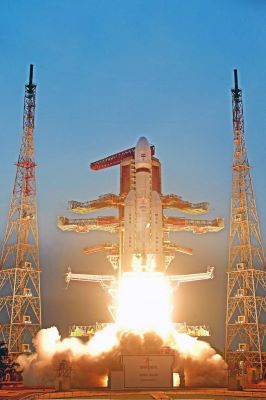
In a major boost to India’s defence and space communication capabilities, the Indian Space Research Organisation (ISRO) on Saturday successfully launched CMS-03 (GSAT-7R) — the heaviest and most advanced communication satellite for the Indian Navy — aboard the LVM3-M5 rocket from the Satish Dhawan Space Centre, Sriharikota.
The satellite, weighing nearly 6 tonnes, was injected precisely into a Geosynchronous Transfer Orbit (GTO), marking another milestone in India’s journey toward self-reliant space and defence technology.
What a moment! #LVM3M5 lifts off with #CMS03, marking another milestone in India’s space journey. Relive the liftoff highlights pic.twitter.com/HOPEvYYljK
— ISRO (@isro) November 2, 2025
- Prime Minister and Vice-President hail landmark collaboration between ISRO and Indian Navy
- CMS-03 to revolutionize secure maritime communications and bolster India’s strategic space capabilities
- Milestone in Aatmanirbhar Bharat journey as LVM3-M5 places GSAT-7R Satellite in Geosynchronous Transfer Orbit
PM Modi: “Our Space Sector Synonymous with Excellence and Innovation”
Our space sector continues to make us proud!
Congratulations ISRO on the successful launch of India’s heaviest communication satellite, CMS-03.
Powered by our space scientists, it is commendable how our space sector has become synonymous with excellence and innovation. Their…
— Narendra Modi (@narendramodi) November 2, 2025
Prime Minister Narendra Modi congratulated ISRO scientists for yet another historic achievement, calling the successful launch “a moment of national pride.”
“Our space sector continues to make us proud! Congratulations ISRO on the successful launch of India’s heaviest communication satellite, CMS-03. Powered by our space scientists, it is commendable how our space sector has become synonymous with excellence and innovation. Their successes have furthered national progress and empowered countless lives,” the Prime Minister posted on X (formerly Twitter).
He further remarked that CMS-03 would enhance India’s maritime communications and contribute to strategic readiness in safeguarding the nation’s oceanic boundaries.
Vice-President: “A Proud Milestone in Aatmanirbhar Bharat”
Hearty congratulations to ISRO and the Indian Navy!
India’s mighty LVM3-M5 rocket roared to the skies once again with the successful launch of GSAT-7R (CMS-03) — the heaviest and most advanced communication satellite for the Indian Navy — placed into Geosynchronous Transfer… pic.twitter.com/M4sAezw7uD
— Vice-President of India (@VPIndia) November 2, 2025
Vice-President C. P. Radhakrishnan also extended his heartiest congratulations to ISRO and the Indian Navy, describing the mission as a “triumphant demonstration of Indian excellence in space technology and defence synergy.”
“India’s mighty LVM3-M5 rocket once again roared to the skies, successfully placing GSAT-7R (CMS-03) — the heaviest and most advanced communication satellite for the Indian Navy — into orbit. The indigenously developed satellite will significantly strengthen space-based communications, connectivity, and maritime domain awareness across the Indian Ocean Region,” he said.
Calling it another proud milestone in the pursuit of Aatmanirbhar Bharat, the Vice-President commended the relentless efforts of Indian scientists and engineers, noting that ISRO “continues to script remarkable milestones in space exploration.”
ISRO Leadership: “A Leap Forward in Naval Communication Capability”
ISRO Chairman Dr. S. Somanath hailed the mission as a technological leap for India’s defence communications network.
“CMS-03 represents a major advancement in secure, multi-band satellite communication systems designed specifically for India’s naval and maritime needs. This mission showcases the growing synergy between our defence and space sectors under the vision of national self-reliance,” Dr. Somanath said at the post-launch briefing.
Mission Director S. Biju emphasized the precision and reliability of the LVM3 vehicle, India’s most powerful launcher, describing the flawless orbital injection as “a testament to ISRO’s evolving mastery over heavy-lift technology.”
A Strategic Asset for the Indian Navy
Developed by UR Rao Satellite Centre (URSC), CMS-03 (GSAT-7R) is designed to replace and augment the GSAT-7 (Rukmini) series currently serving the Navy. The satellite will enhance real-time communication, linking ships, submarines, aircraft, and command centres through secure and encrypted channels.
Officials from the Indian Navy said the successful launch would significantly enhance maritime domain awareness across the Indian Ocean Region (IOR), enabling faster, more resilient, and high-capacity communication links vital for both peacetime and strategic operations.
Another Feather in India’s Space Cap
The LVM3-M5 mission underscores India’s rapid rise in advanced space capability, coming on the heels of Chandrayaan-3’s success and Aditya-L1’s continuing mission. It reaffirms India’s commitment to using space technology for both national development and strategic strength.
With the CMS-03 launch, ISRO has once again demonstrated its technical prowess and reliability, reinforcing India’s position among the world’s leading spacefaring nations.
“This success is not just about technology — it’s about national confidence and global credibility,” said Dr. Somanath. “Each mission strengthens our resolve to make India self-reliant in every aspect of space and defence communication.”