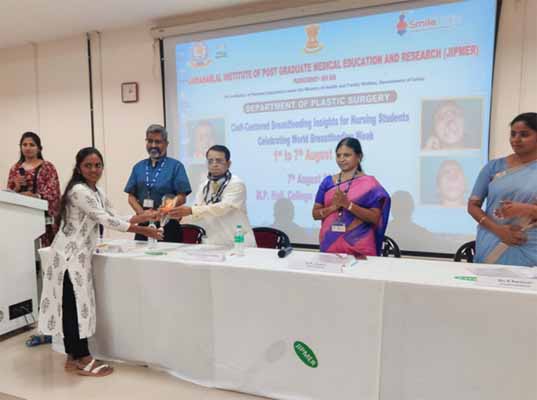
- Chief Guest Prof. Dr. Ravi Kumar Chittoria, Professor, Plastic Surgery, JIPMER, stresses the importance of integrating cleft care into mainstream nursing education
- Guest of Honour Dr. M. J. Kumari, Principal, College of Nursing, highlighted the critical role of trained nurses in supporting mothers through these challenges
- Building on this success, JIPMER and Smile Train plan to expand such programmes to further improve health outcomes for children born with cleft lip and palate.
NE HEALTH BUREAU
PUDUCHERRY, AUG 11
The JIPMER Smile Train Cleft Project, under the guidance of Prof. Dr. Vir Singh Negi, Director, JIPMER, organised a specialised training programme titled “Cleft-Centered Breastfeeding Insights for Nursing Students” at the College of Nursing, JIPMER, to mark World Breastfeeding Week (August 1–7).

This initiative aimed to strengthen nursing students’ clinical skills and confidence in managing the unique feeding challenges faced by infants with cleft lip and palate. The session drew participation from around 80 nursing students, along with social workers, faculty members, and patient counsellors.
Cleft lip and palate, caused by incomplete fusion of facial tissues during early pregnancy, often lead to difficulty in forming a tight seal during feeding, poor suction, nasal milk leakage, choking, swallowing excess air, and fatigue during feeds.
Malnutrition
One of the most immediate consequences of poor feeding is malnutrition, which can impede a child’s growth and development. Without proper nutrition, these infants may fail to gain weight at a healthy rate, a condition known as “failure to thrive.” This can stunt both physical and cognitive development, potentially leading to developmental delays and weakened immune systems, making them more susceptible to illnesses
Delayed speech development
Another serious long-term effect is the impact on speech development. The cleft condition affects the palate, which is crucial for forming certain sounds. Poor feeding habits can exacerbate these issues, as the muscles used for sucking and swallowing are also integral to speech production. Early intervention and proper feeding techniques are therefore vital not only for nutrition but also for laying the groundwork for future speech therapy.
Dental problems
Furthermore, inadequate feeding can contribute to dental problems and affect the alignment of teeth and jaws. The structural issues associated with the cleft can influence the growth and position of teeth, and the way a child feeds can further complicate these matters. These children may require extensive orthodontic work later in life.
Emotional strain for both mother and child
Finally, the stress and anxiety associated with feeding difficulties can have a profound impact on the mother-infant bond. When a mother struggles to feed her baby, it can lead to feelings of frustration and helplessness, which can affect their relationship and the baby’s emotional well-being.
The training emphasised practical, hands-on strategies such as modified cradle hold, football hold, and dancer hand position, along with techniques like pressing the infant into the breast, compressing the breast during feeds, cue-based feeding, and frequent burping. Sessions also covered indirect feeding options (hand expression, breast pumping, cup feeding), safe breast milk storage practices, and the use of specialised appliances such as lip taping and nasoalveolar moulding.
Chief Guest Prof. Dr. Ravi Kumar Chittoria, Professor, Plastic Surgery, JIPMER, stressed the importance of integrating cleft care into mainstream nursing education. Guest of Honour Dr. M. J. Kumari, Principal, College of Nursing, highlighted the critical role of trained nurses in supporting mothers through these challenges. Prof. Dr. Devi Prasad Mohapatra, Project Director of the Smile Train Cleft Project, commended the ongoing JIPMER–Smile Train collaboration in delivering free, comprehensive cleft care to deserving patients.
Gandhimathi John Peter, Deputy Nursing Superintendent, delivered a lecture on the benefits and techniques of breastfeeding for normal infants, while Vijayageetha, Senior Nursing Officer, detailed the specific challenges of breastfeeding and optimal feeding positions for babies born with cleft lip and palate. Rajeshwari, Project Coordinator, informed attendees that cleft lip and palate deformities are entirely treatable, with care provided free of cost to deserving patients at JIPMER.
By combining clinical knowledge with intensive skill-based demonstrations, this initiative equips future nursing professionals to provide effective, compassionate care for mothers and infants with complex feeding needs. Building on this success, JIPMER and Smile Train plan to expand such programmes to further improve health outcomes for children born with cleft lip and palate.