R ARIVANANTHAM
CHENNAI, JAN 10
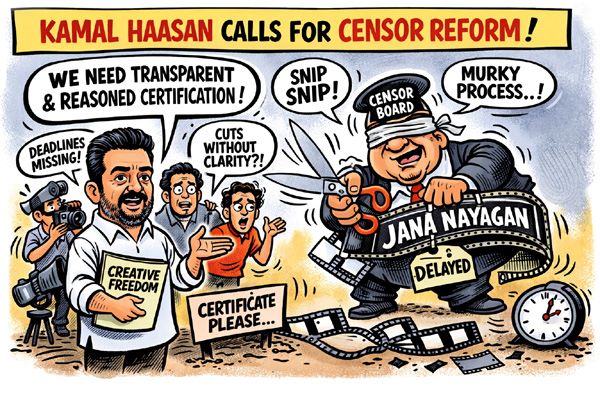
Veteran actor, filmmaker and parliamentarian Kamal Haasan has triggered a renewed national debate on film censorship by calling for a comprehensive overhaul of India’s film certification process, stressing the urgent need for transparency, accountability and clearly defined timelines.
Haasan’s intervention comes at a critical moment for the Tamil film industry, following the stalled release of actor Vijay’s much-anticipated film ‘Jana Nayagan’, which has once again drawn attention to delays and ambiguities in certification procedures.
- Actor-Parliamentarian seeks transparent, time-bound film certification
- ‘Jana Nayagan’ delay brings creative freedom back into national focus
In a formal statement, Kamal Haasan said, “What is required now is a principled relook at the certification processes with defined timelines for certification, transparent evaluation, and written, reasoned justification for every suggested cut or edit.” The statement reflects a growing frustration within the film fraternity over inconsistent standards and prolonged certification timelines.
Calling for unity within the creative community, Haasan urged filmmakers and artists to “engage in a meaningful, constructive dialogue” with government institutions. Emphasising the constitutional dimension of the issue, he added, “Such reform will safeguard creative freedom, uphold constitutional values, and strengthen India’s democratic institutions by affirming trust in its artists and its people.” Haasan, notably, is also a sitting Rajya Sabha Member of Parliament, lending legislative weight to his intervention.
Industry Voices Join the Chorus
Haasan’s remarks quickly gained traction across social media platforms, with filmmakers, actors, writers and producers rallying behind the call for reform. Hashtags such as #CreativeFreedom, #ReformCBFC and #CinemaWithoutFear began trending, reflecting widespread industry support.
Several directors and producers pointed out that opaque certification processes and unpredictable timelines often disrupt release plans and compromise creative intent. A senior filmmaker noted on social media that certification must focus on classification rather than control, while another producer highlighted the financial strain caused by last-minute cuts and delayed clearances, particularly for small and mid-budget films.
Actors and screenwriters also expressed solidarity, observing that Haasan had articulated concerns many in the industry discuss privately. Younger filmmakers, in particular, welcomed the emphasis on written justifications and transparent evaluation, arguing that such reforms are essential as Indian cinema increasingly competes on global platforms and streaming services.
Trade analysts believe Haasan’s dual stature as a cinema icon and parliamentarian has elevated the debate beyond a single film or industry grievance. With ‘Jana Nayagan’ emerging as a flashpoint, the discussion has now broadened into a larger conversation on institutional reform, artistic trust and democratic accountability.
As the debate gathers momentum, Haasan’s intervention has once again placed cinema at the intersection of culture, politics and constitutional values — raising the larger question of whether India’s film certification framework is ready to evolve with its creators and audiences.