
- Defence Minister says Operation Sindoor proved India can respond to Pakistan’s every misadventure with a severity ‘far beyond its imagination’
- ‘No talks with Pakistan; any dialogue will focus solely on PoK,’ says Rajnath Singh at 27th Kargil Vijay Diwas in Dras
- ‘India is designing chips, Pakistan is designing terror; India is building start-ups, Pakistan is constructing a terror ecosystem’
- From Akash-Teer and Tejas to INS Vikrant, Pinaka and Astra, India accelerates march towards defence self-reliance
- Rajnath calls Kargil heroes an enduring inspiration for youth and urges every Indian to carry a soldier’s courage, discipline and patriotism
NE DEFENCE BUREAU
NEW DELHI, JULY 26
Twenty-seven years after Indian soldiers reclaimed the icy heights of Kargil through extraordinary courage and supreme sacrifice, the message from Dras on Sunday was both a tribute to the past and a warning to the future: India remembers its fallen heroes, but it is no longer the India of 1999. It is a nation that is building its own missiles, aircraft carriers, fighter aircraft and drones, expanding its technological capabilities and, as Operation Sindoor demonstrated, possesses the will and capability to answer aggression decisively. As Defence Minister Rajnath Singh saluted the bravehearts, his message to the youth was unmistakable—patriotism is not merely remembrance; it is the courage to serve, innovate, sacrifice and build a stronger India.
Addressing the 27th Kargil Vijay Diwas celebrations in Dras, Defence Minister Rajnath Singh paid glowing tributes to the Indian soldiers who laid down their lives during the 1999 Kargil War and asserted that Operation Sindoor had demonstrated India’s ability to respond to Pakistan’s every misadventure with a severity far beyond its imagination.
“The success of Operation Sindoor is proof that India possesses the capability to respond to Pakistan’s every misadventure with a severity far beyond its imagination,” Rajnath Singh said.
He reiterated that there would be no talks with Pakistan, adding that any dialogue would focus solely on Pakistan-occupied Kashmir (PoK), which he described as an integral part of India illegally occupied by Pakistan.
Defence Minister said every nefarious act against India’s sovereignty would meet the same resolute response that the Indian Defence Forces delivered to terrorists and their patrons during Operation Sindoor.
‘India designs chips; Pakistan designs terror’
Rajnath Singh said the paths taken by India and Pakistan had diverged sharply since the Kargil War.
“While India is exploring new avenues of innovation, Pakistan is seeking new routes for infiltration. India is engaged in chip design, whereas Pakistan is busy designing terror. India is building a start-up ecosystem, while Pakistan is constructing a terror ecosystem. India is manufacturing semiconductors; Pakistan is preparing suicide bombers,” he said.
“India is recognised for space missions, while Pakistan is running proxy missions. India is sending satellites into space, whereas Pakistan focuses on sending terrorists across the border. India is providing software to the world, while Pakistan is exporting sleeper cells. India is establishing data centers; Pakistan is setting up radicalisation centers. India is connecting the world through UPI, while Pakistan is linking terrorism with hawala networks.”
“In short, our paths diverge; should Pakistan attempt to obstruct our path to prosperity with its nefarious designs, our defence forces stand ready to deliver a befitting response,” he stated.
Defence Minister asserted that the Central Government possessed the political will to give the armed forces a free hand to respond decisively to threats.
‘Sacrifice and service form the backbone of any nation’
Paying homage to the soldiers who secured victory in the 1999 war, Rajnath Singh remembered the countless Bravehearts, including Param Vir Chakra awardees Captain Vikram Batra and Captain Manoj Kumar Pandey, whose courage continues to inspire the nation.
He described Kargil Vijay Diwas as a day of inspiration for every young person seeking to understand the difference between personal success and national duty.
“This day teaches us that the spirit of ‘sacrifice’ and ‘service’ forms the backbone of any nation,” he said.
Defence Minister said the Kargil War Memorial represented the entirety of India, with fallen heroes drawn from every region of the country.
“This wall of unity, despite diversities, stands tall against those who wish to harm us,” he said.
‘Every Indian must carry a soldier’s courage’
Rajnath Singh said conflicts in West Asia and between Russia and Ukraine had tested not only military capabilities but also the resilience, patience and resolve of nations.
While India possessed a strong and capable military, he said, national security was a shared responsibility of every citizen.
“I am not suggesting that every citizen must become a soldier, but should the nation ever face a situation requiring the direct or indirect support of its people, every Indian must be mentally, morally and physically prepared to step forward in defence of the country,” he said.
“Just as every soldier is first and foremost an Indian, the courage, discipline and patriotism of a soldier must always remain alive within every Indian,” he added.
Defence Minister said the vision of Viksit Bharat@2047 extended far beyond economic prosperity.
It was, he said, a commitment to strategic strength, cultural pride and social harmony—a vision that could be realised only when the dedication and sense of duty displayed by the Kargil heroes became part of every sphere of nation-building.
‘Yeh Dil Maange More’ for Atmanirbhar Bharat
Drawing inspiration from Captain Vikram Batra’s iconic catchphrase ‘Yeh Dil Maange More’, Rajnath Singh said India was accelerating its march towards self-reliance in defence production.
“When our government assumed office, India used to import 65 to 70 percent of defence equipment. Today, we’re manufacturing 65 percent of our defence equipment on Indian soil,” he said.
He highlighted the indigenous Akash-Teer air defence control system, the next-generation Akash missile, India’s first indigenous aircraft carrier INS Vikrant, Light Combat Aircraft Tejas, Light Combat Helicopter Prachand, Advanced Light Helicopter Dhruv, Main Battle Tank Arjun, Pinaka multi-barrel rocket launcher, Astra air-to-air missile, and modern drones and counter-drone systems.
“But, ‘Yeh Dil Maange More’. We will continue working to manufacture even more modern weapons, next-generation fighter aircraft, submarines, and missiles right in India,” he said.
Defence Minister underlined that India’s military modernisation was being matched by a growing domestic defence-industrial base.
Kargil salute, India’s future resolve
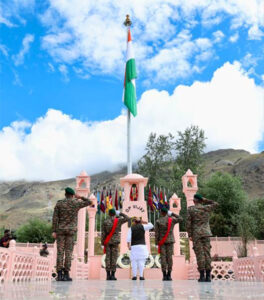
During the commemorative ceremony, Rajnath Singh laid a wreath at the Cenotaph and observed silence in remembrance of the bravehearts who made the supreme sacrifice during Operation Vijay.
Lieutenant Governor of Ladakh Vinai Kumar Saxena, Chief of the Army Staff General Dhiraj Seth, General Officer Commanding-in-Chief, Northern Command Lieutenant General Pratik Sharma, GOC 14 Corps Lieutenant General Madanraj Pande and GOC 8 Mountain Division Major General AP Singh joined Defence Minister in paying homage to the Kargil War heroes.
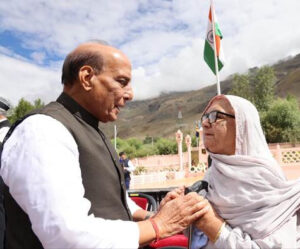
Kargil War veterans, gallantry awardees, Veer Naris, next of kin of the fallen soldiers and local citizens also attended the Shradhanjali Samaroh.
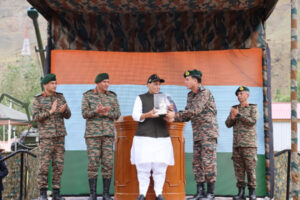
Rajnath Singh signed the Visitors’ Book and witnessed Gaurav Gatha, presented by two Non-Commissioned Officers, recounting the courage, determination and indomitable spirit displayed by Indian soldiers during Operation Vijay.
He also inaugurated the Virtual Walkthrough Portal, designed to provide wider public access to the history and legacy of the Kargil War, visited the Hut of Remembrance and paid homage at Veer Bhoomi.
Later, he interacted with dignitaries, soldiers and families over tea and flagged in the Shaurya Vijay Yatra, the motorcycle rally organised as part of the Kargil Vijay Diwas commemorations.
The message from Kargil remains eternal.
The nation remembers its heroes. The armed forces remain ready. And the new India, powered by courage, technology and self-reliance, is determined to ensure that the sacrifice of its bravehearts becomes the foundation of an even stronger tomorrow.