

- Adani Foundation Chairperson positions women as central architects of India’s economic destiny
- Grassroots success across agriculture, dairy, health and enterprise validates women-led development model
- Urges shift from policy intent to real economic participation, leadership and market access
- Says empowerment is not charity but expansion of skills, finance, opportunity and confidence
NE NEWS SERVICE
NEW DELHI, FEB 27
Delivering a powerful and visionary message that resonated across policy and grassroots circles, Dr Priti Adani, Chairperson of the Adani Foundation, declared that women must be recognised as the central force shaping India’s journey towards Viksit Bharat 2047, asserting her defining punchline: “Let her. And she will.”
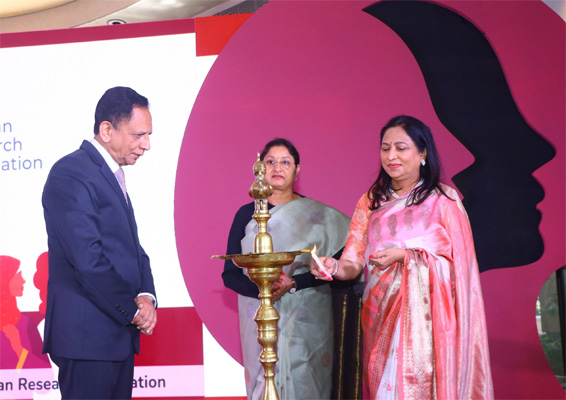
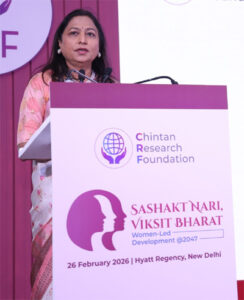
Speaking at the ‘Sashakt Nari, Viksit Bharat’ conference organised by the Chintan Research Foundation (CRF) in New Delhi, Dr Adani emphasised that India’s economic transformation will be driven not merely by policy intent but by sustained and meaningful economic participation of women across sectors.
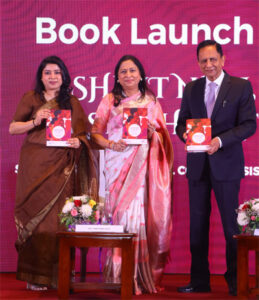
Welcoming Union Minister for Women and Child Development Annapurna Devi, Dr Adani acknowledged the growing national momentum behind women-led development and urged institutions to accelerate real access to opportunity, skills and enterprise.
“Empowerment begins with access. When women gain access to information, skills, finance and markets, they transform not only their own lives but entire communities,” she said.
Grassroots Transformation: Where Empowerment Becomes Economic Strength
Drawing from extensive on-ground experience through the Adani Foundation’s initiatives, Dr Adani highlighted how targeted interventions have delivered measurable economic and social impact.
In rural agricultural communities, women farmers introduced to simple mobile applications now access real-time guidance on irrigation, fertiliser use, seed selection and mandi price tracking. This access to knowledge has translated directly into higher productivity, improved incomes and enhanced decision-making confidence.
Similarly, in the dairy sector, collective enterprise models have unlocked new economic independence.
More than 3,500 women-led self-help group members now manage milk collection centres handling over 75 lakh litres annually, benefiting from transparent pricing, organised procurement and improved bargaining power.
Health, Enterprise and Financial Independence: Building Sustainable Livelihoods
Dr Adani also underscored the success of the Foundation’s flagship SuPoshan maternal and women’s health initiative, which has improved health outcomes for over 3.25 lakh women of reproductive age, supported by trained local women volunteers.
Through the Swabhimaan programme, over 4,500 women across 300 enterprise self-help groups have been empowered to build sustainable livelihoods, transitioning from financial dependence to entrepreneurship and economic leadership.
“Empowerment is not about charity—it is about expanding access to skills, finance, markets and leadership pathways,” Dr Adani emphasised.
Policy Convergence Strengthening Women’s Enterprise Ecosystem
Referring to the Union Budget’s Self-Help Entrepreneurs initiative, Dr Adani described it as a transformative policy step enabling women to transition from micro-credit participants into full-fledged enterprise owners with access to growth capital.
She noted that this policy direction aligns closely with the Foundation’s empowerment framework, reinforcing the national vision of inclusive economic growth.
“India’s next phase of development will be shaped in classrooms, training centres, village enterprises and digital marketplaces led by confident women,” she said.
Her closing words captured the spirit of India’s evolving growth narrative:
“Let her. And she will.”