R ARIVANANTHAM
CHENNAI, JAN 2
The Vice-President of India, C. P. Radhakrishnan, attended the third edition of the Ramnath Goenka Sahitya Samman in Chennai, an event that honoured outstanding literary contributions and reaffirmed the role of literature and journalism in sustaining democratic values.
No nation can emerge without fearless literature and journalism, says Honourable Vice President Shri CP Radhakrishnan at the third Ramnath Goenka Sahithya Samman. #RamnathGoenkaSahithyaSamman #IndianLiterature #Books #Authors #TheNewIndianExpress@santwana99 @etteth @CPR_VP… pic.twitter.com/PYh68902QN
— The New Indian Express (@NewIndianXpress) January 2, 2026
- Third Ramnath Goenka Sahitya Samman in Chennai celebrates power of ideas and free thought
- Ramnath Goenka remembered as conscience-keeper who defended press freedom during Emergency
- Call for newspapers to prioritise national development and constructive public discourse
- Writers and journalists urged to uphold ethical values amid rapid social and technological change
Addressing the gathering, the Vice-President said the Ramnath Goenka Sahitya Samman celebrates the enduring power of literature, ideas and fearless expression, which remain essential to a vibrant democracy.
Vice-President of India, Shri C. P. Radhakrishnan, attended the 3rd Ramnath Goenka Sahitya Samman in Chennai today
Paying tribute to Shri Ram Nath Goenka, he recalled the power of truth, ethical writing, and responsible expression, and called upon the media to contribute… pic.twitter.com/9D1e0KCjyy
— Vice-President of India (@VPIndia) January 2, 2026
Ramnath Goenka’s Legacy of Courageous Journalism
Paying tribute to Ramnath Goenka, the Vice-President described him as a towering figure of fearless journalism who upheld integrity, intellectual courage and democratic values. He referred to Goenka as a “conscience-keeper of Indian democracy”, whose legacy continues to inspire generations.
Recalling his personal association with the period of the Total Revolution led by Jayaprakash Narayan, the Vice-President noted that during the Emergency, Ramnath Goenka stood firmly against press censorship. He highlighted the iconic blank editorial published during that period as a powerful reminder of the moral strength of journalism and the expressive power of silence.
Call for Constructive and Development-Focused Journalism
The Vice-President urged newspapers to devote greater space to issues of national development, suggesting that at least two pages be regularly allocated to constructive discourse that strengthens national consciousness and informed citizenship. He emphasised that truth, when upheld with conviction, carries its own moral authority.
Referring to the vision of Prime Minister Narendra Modi, he said India’s progress must be inclusive, with all languages and cultural traditions advancing together. He acknowledged initiatives to promote Indian languages and traditions, including the conferment of Classical Language status on Marathi, Pali, Prakrit, Assamese and Bengali.
Literature as a Moral and Civilisational Force
Highlighting the Gyan Bharatam Mission of the Ministry of Culture, the Vice-President said the initiative integrates tradition with technology by using digital and AI-driven tools to preserve India’s manuscripts and knowledge systems.
Observing that literature has always served as a mirror of society and a torch-bearer of civilisational values, he said that in a period of rapid economic, technological and social transformation, the responsibility of writers and intellectuals becomes even more significant. Their role, he noted, extends beyond creativity to nurturing social harmony, constitutional values and ethical discourse.
Freedom of expression, he added, remains a cornerstone of democracy and flourishes best when exercised with responsibility, empathy and accountability.
Viksit Bharat Needs Enlightened Minds
Referring to India’s rich literary heritage — from the Vedas and Upanishads to the epics, Bhakti and Sufi poetry, and modern literature — the Vice-President said respect for plurality, debate and free expression is deeply rooted in India’s civilisational ethos.
He observed that a developed India is defined not only by economic strength and technological advancement, but also by social inclusion, cultural confidence and ethical values. The journey towards Viksit Bharat, he said, requires enlightened minds, creative expression and a strong moral compass. Literature and journalism play a vital role in fostering informed debate, constructive dissent and democratic vigilance.
Honouring Literary Excellence
Congratulating the award recipients, the Vice-President said their contributions enrich India’s intellectual landscape and strengthen the bond between ideas and society. He expressed confidence that their writings would inspire readers, particularly the younger generation, to think deeply, act responsibly and engage creatively with the world.
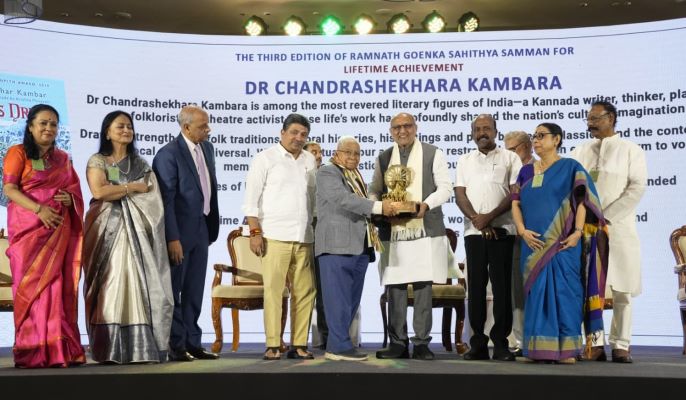
At the event, the Lifetime Achievement Award was conferred on Chandrasekhara Kambara, eminent Kannada writer. The Best Fiction Award was presented to Subi Taba from Arunachal Pradesh; the Best Non-Fiction Award to Shubhanshi Chakravarty; and the Best Debut Award to Neha Dixit.
A tribute to writers who wield the pen with courage, imagination and integrity: Manoj Kumar Sonthalia
Addressing the gathering, Manoj Kumar Sonthalia, Chairman and Managing Director of The New Indian Express Group, said the award was a tribute to writers who wield the pen with courage, imagination and integrity.
Tamil Nadu Health Minister Ma Subramanian, Tamil Nadu Minister for Information Technology and Digital Services Palanivel Thiaga Rajan, TNIE Editorial Director Prabhu Chawla, TNIE Editor Santwana Bhattacharya, Dinamani Editor K Vaidyanathan and TNIE CEO Lakshmi Menon were present at the event.