
NE SCIENCE & TECHNOLOGY BUREAU
GANDHINAGAR, SEPT 18
In a decisive push towards digital sovereignty, L&T Semiconductor Technologies (LTSCT), the Centre for Development of Advanced Computing (C-DAC), and IIT Gandhinagar have announced a strategic collaboration to develop a fully indigenous secure chip for critical identity applications, beginning with electronic passports (e-passports).
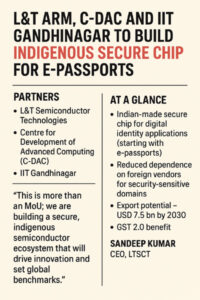
Key Highlights of the Partnership
- Made-in-India Secure IC: All intellectual properties (IPs) will reside in India, significantly reducing reliance on foreign vendors in security-sensitive domains.
- Dedicated Research Hub: The partners will establish a specialised research centre to accelerate chip design, testing, and deployment.
- Beyond E-Passports: The secure IC will form the foundation for next-generation cryptographic products, with potential use in defence, banking, IoT, and smart governance.
- Public-Private-Academia Alliance: This marks one of the strongest collaborations between industry (L&T), academia (IITGN), and government-led R&D (C-DAC) in the semiconductor ecosystem.
Economic and Strategic Implications
- Reduced Import Dependence: India currently imports over 90% of its secure chips from global suppliers. A domestic solution will curb the outflow of foreign exchange and lower chip import bills.
- Export Potential: With global demand for secure ICs expected to reach USD 7.5 billion by 2030, India could emerge as a trusted supplier for e-passport chips and secure embedded systems in Asia, Africa, and the Middle East.
- GST 2.0 Advantage: Under the new GST framework, indigenous chip manufacturing enjoys preferential tax treatment and supply-chain credits, making domestic solutions more cost-competitive than imports.
- Employment & Ecosystem Growth: The initiative is expected to create high-skilled semiconductor jobs and boost India’s role in the global value chain.
Leadership Speak
“This agreement is more than an MoU—it is a blueprint for how industry, academia, and government can unite to shape India’s technological future,” said Sandeep Kumar, CEO, LTSCT.
“By leveraging our combined strengths, we will deliver solutions made entirely in India, such as secure e-passports that the world can trust. This marks a decisive step in the ‘Make in India’ journey, ensuring our advanced security infrastructure is conceived, designed, and owned domestically,” he added.
Policy Context
- The partnership aligns with the Semicon India Programme, a ₹76,000-crore initiative to strengthen India’s position in global semiconductor manufacturing.
- It also supports the government’s Digital Public Infrastructure (DPI) agenda, which relies on secure chips for digital ID, payments, and e-governance platforms.