NE LEGAL BUREAU
NEW DELHI, AUG 8
At a time when the strength and speed of the judiciary remain crucial to access to justice, the appointment of 15 new judges to the Madras High Court stands out as the biggest component of the Centre’s latest round of judicial elevations. Thirty judges were appointed to four High Courts on Saturday, with advocates and members of the subordinate judiciary sharing the latest batch of appointments.
- 15 appointments to Madras High Court account for half of latest judicial elevations
- Eight judges appointed to Calcutta HC, six to Karnataka HC and one to Madhya Pradesh HC
- 20 advocates and 10 judicial officers among the 30 appointees notified by Centre
According to a statement issued by the Ministry of Law and Justice, the Madras High Court received 15 judges, while eight were appointed to the Calcutta High Court, six to the Karnataka High Court and one to the Madhya Pradesh High Court.
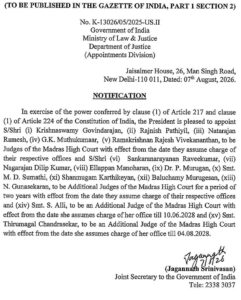
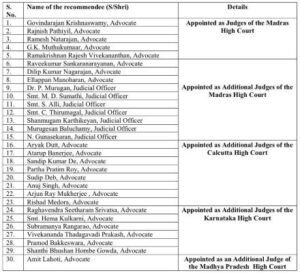
The appointments assume particular significance for the Madras High Court, where the induction of 15 judges is expected to add judicial capacity to one of the country’s major constitutional courts handling a wide range of civil, criminal, commercial, service, taxation and public-interest matters.
Of the 30 appointments across the four High Courts, 20 are advocates and 10 are judicial officers, bringing experience from both the Bar and the subordinate judiciary into the higher judicial system.
The latest appointments also underline the two principal routes through which lawyers enter the High Courts—direct elevation from the Bar and promotion from the lower judiciary.
Advocates bring extensive experience in courtroom practice and specialised areas of law, while judicial officers contribute years of experience in adjudication at the trial and district-court levels.
Those appointed as additional judges are usually considered for elevation as judges, commonly referred to as permanent judges, after two years, subject to the applicable constitutional and judicial process.
For the Madras High Court in particular, the appointment of 15 judges could prove significant in strengthening its ability to deal with its expanding judicial workload and improve the institutional capacity required for timely adjudication.
The larger picture is equally important. With 30 judicial appointments spread across four High Courts, the latest exercise represents an attempt to reinforce judicial strength through talent drawn from both the practising Bar and the subordinate judiciary.
The appointments come at a time when judicial vacancies, pendency and the need for efficient disposal of cases remain among the most closely watched issues concerning the administration of justice.
The immediate impact will be felt in the respective High Courts as the newly appointed judges take charge and begin hearing cases.
For the Madras High Court, however, the message from this round is particularly pronounced: 15 new judges mean a significant infusion of judicial strength into the State’s highest court, with the ultimate test being whether the additional capacity translates into faster and more effective access to justice.