NE EDUCATION BUREAU
CHENNAI, AUG 10
For thousands of Tamil Nadu students chasing a place in a medical college, the 2026-27 admission season has opened with a significant expansion of opportunity. The State Government on Monday released the rank lists for MBBS, BDS and allied and healthcare degree courses, even as Tamil Nadu recorded a major addition to its medical education capacity, with 850 new MBBS seats—150 in government medical colleges and 700 in private medical colleges.
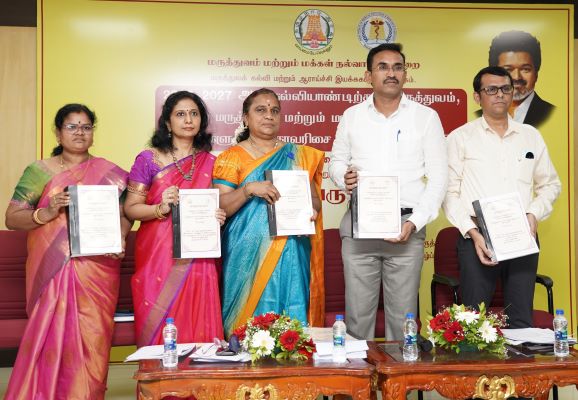
The rank lists were released by Tamil Nadu Health, Medical Education and Family Welfare Minister Dr Ko.Ka Arunraj at the Directorate of Medical Education and Research in Kilpauk, Chennai, in accordance with the guidance of the Tamil Nadu Chief Minister.
- State releases rank lists for MBBS, BDS and allied health courses after processing 72,633 applications
- Government medical colleges gain 150 additional MBBS seats—the first such increase since 2021
- Tiruppur, Tiruvallur and Namakkal medical colleges get 50 new MBBS seats each
- Private medical colleges add 700 MBBS seats; Tamil Nadu’s total MBBS capacity rises to 9,999
- 7.5% government-school quota attracts 4,860 applications, with 3,625 accepted for MBBS and BDS
- Dr Ko.Ka Arunraj cautions aspirants: Counselling will be synchronised with Centre and no schedule extension will be possible
The development comes as 72,633 applications have been received for various medical and allied healthcare programmes for the 2026-27 academic year, underlining the intense competition among students seeking entry into the State’s medical education ecosystem.
Big boost to government medical education
The most significant development this year is the addition of 150 MBBS seats in government medical colleges, the first such increase since 2021.
The three government medical colleges at Tiruppur, Tiruvallur and Namakkal have each received approval for 50 additional MBBS seats, creating 150 more opportunities for aspiring doctors through government medical institutions.
Private medical colleges have added another 700 MBBS seats.
With these additions, Tamil Nadu’s overall MBBS capacity has risen to 9,999 seats, while the total number of BDS seats stands at 2,000.
For government-quota admissions, Tamil Nadu has 7,157 MBBS seats, comprising 4,473 State Quota seats in government medical colleges and 2,684 government-quota seats in self-financing medical colleges.
For BDS, the government-quota pool comprises 1,383 seats, including 213 seats in government dental colleges and 1,170 government-quota seats in self-financing dental colleges.
72,633 applications: Girls lead the numbers
The State received 41,726 applications for government-quota MBBS and BDS admissions. Of these, 35,926 applications were accepted, comprising 12,551 male and 23,375 female candidates.
The 7.5% internal reservation for government-school students attracted 4,860 applications, of which 3,625 were accepted. The accepted applications included 981 male and 2,644 female candidates.
For management-quota seats in self-financing medical and dental colleges, 30,907 applications were received, with 26,956 found eligible. This included 9,105 male and 17,851 female candidates.
The 7.5% government-school quota covers 537 MBBS seats, including 335 seats in government medical colleges and 202 government-quota seats in self-financing medical colleges.
For BDS, the quota covers 104 seats, comprising 16 seats in government dental colleges and 88 government-quota seats in self-financing dental colleges.
Allied healthcare courses open another career avenue
The admission exercise also covers a broad spectrum of allied and healthcare programmes, opening pathways into healthcare beyond MBBS and BDS.
Applications were invited for B.Sc Nursing, B.Pharm, allied healthcare degree courses, Pharm-D, DGNM and Diploma in Pharmacy.
The State received 66,525 applications for allied and healthcare degree courses, of which 65,475 were accepted.
For Pharm-D (six years), 12,657 applications were received and 12,263 accepted, while Pharm-D (three years) received 32 applications, with 29 accepted.
The DGNM programme received 18,308 applications, of which 17,676 were accepted, while Diploma in Pharmacy received 13,018 applications, with 12,718 accepted.
The available seats include 2,786 government-quota and 3,969 self-financing-college seats in allied and healthcare degree courses; 400 and 11,807 respectively for B.Sc Nursing; 120 and 7,234 for B.Pharm; 1,011 self-financing seats for six-year Pharm-D; 72 self-financing seats for three-year Pharm-D; 2,080 government-quota and 5,455 self-financing seats for DGNM; and 240 government-quota and 6,540 self-financing seats for Diploma in Pharmacy.
7.5% government-school quota remains a key pathway
The sizeable response to the government-school reservation underscores the growing aspirations of students from State-run schools to enter professional medical education.
Of the 4,860 applications received under the 7.5% internal reservation for government-school students, 3,625 have been accepted.
The quota provides 537 MBBS seats and 104 BDS seats, strengthening access to medical and dental education for eligible government-school students.
The released rank lists now provide candidates with the next critical step towards the counselling process.
‘No scope for schedule change’ as counselling is synchronised
Dr Ko.Ka Arunraj said sufficient time had already been provided during the application process, including an opportunity for candidates to make corrections.
However, he stressed that students must strictly follow the counselling schedule announced by the Tamil Nadu State Selection Committee.
“As far as counselling is concerned, it will be conducted in synchronisation with the Union Government. Therefore, it will not be possible to make any changes to the schedule or provide any extension of time,” Dr Arunraj said.
He urged students to participate in counselling without fail according to the schedule published on the Tamil Nadu State Selection Committee website.
The warning assumes significance as thousands of aspirants now move from the application stage to the decisive phase of seat selection.
The release of the rank lists, coupled with the expansion of MBBS capacity, marks an important moment for Tamil Nadu’s medical education landscape—giving more students a chance to convert years of preparation into a seat while simultaneously widening the State’s healthcare talent pipeline.