- Conclave Showcases Coordinated National Resolve to Secure 7,500-km Coastline
- RRU Unveils Cutting-Edge Maritime Simulator Lab for Realistic Multi-Agency Training
- Top Naval, Coastal Policing and CISF Leadership Stress Technology, Collaboration, Vigilance
- Blue Acceleration, Port Security, Climate Threats Dominate Strategic Discussions
NE EDUCATION BUREAU
GANDHINAGAR, DEC 4
SAMUNDRARAKSHAN 2.0, the flagship coastal and maritime security conclave of the School of Integrated Coastal and Maritime Security Studies (SICMSS) at Rashtriya Raksha University, concluded on Indian Navy Day with a renewed national commitment to safeguarding India’s maritime frontiers. The platform reinforced India’s strategic move from SAGAR to MAHASAGAR—towards Mutual and Holistic Advancement for Security and Growth Across Regions—bringing together policymakers, security agencies, researchers, and maritime professionals.
The conclave served as a decisive forum to sharpen India’s coastal defence architecture through inter-agency coordination, technology integration, and community-led vigilance across the nation’s vast 7,500-km coastline.
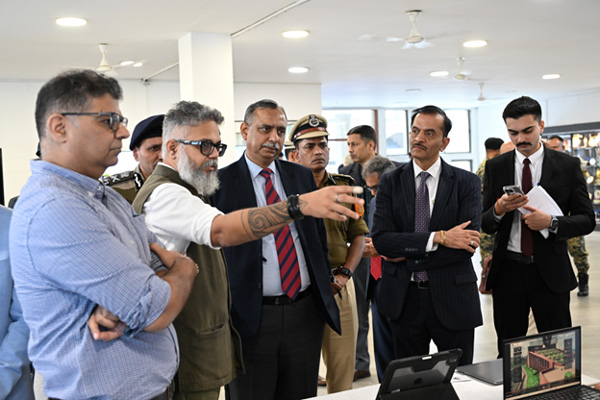
A major highlight of this edition was the unveiling of India’s state-of-the-art Maritime Simulator Lab, designed to provide realistic, hands-on training for maritime interdiction, hot pursuits, law enforcement, navigation, search and rescue, maritime security missions, and marine pollution response. The facility will serve Indian maritime forces, global trainees under MEA’s ITEC programme, and maritime law enforcement agencies—strengthening India’s role as a provider of world-class security training.
More than 200 personnel from the Marine Police of 13 coastal states and UTs, Indian Navy, Indian Coast Guard, CISF, BSF, port authorities, maritime boards, technology innovators, and global experts participated, underscoring RRU’s expanding role in shaping India’s maritime security consciousness.
The conclave examined critical issues including advanced technologies in maritime border surveillance, climate change-driven coastal vulnerabilities, countering narcotics trafficking via ports and coastlines, and sharing best practices through joint exercises.
In a virtual address, Vice Admiral Biswajit Dasgupta, National Maritime Security Coordinator, described SAMUNDRARAKSHAN 2.0 as a vital platform enabling officers to exchange ideas and forge unified responses to emerging challenges. He said the Maritime Simulator Lab would significantly enhance training outcomes and emphasised India’s “Blue Acceleration” over the past 25 years while warning about “increasing vulnerabilities posed by radical ideologies harboured at the neighbourhood country.”
Praveer Ranjan, Director General, CISF, highlighted the growing importance of multi-stakeholder synergy in coastal security and expressed confidence that CISF would replicate its aviation security success in the port security domain through specialised training at RRU. He referenced recent reforms, including CISF’s designation as RSO, updated shipping laws, hybrid port-security frameworks, and EXIM port audits, noting that “security and economic development must advance together.” He also called for deeper AI and Aadhaar-enabled technology infusion.
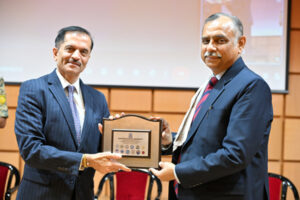
RRU Vice-Chancellor Bimal N Patel praised the programme’s impact, framing India as “a steady lighthouse in rough global seas,” echoing the Prime Minister’s Maritime Week 2025 vision. He emphasised India’s futuristic overhaul of colonial shipping laws, Maritime India Vision 2030, Sagarmala, and the ₹70,000-crore pipeline of maritime initiatives. Highlighting the School’s 70+ training programmes with 125 global experts, he reaffirmed RRU–NACP’s training of over 800 personnel across nine batches and welcomed the new MoU with CISF.
Ashwini Kumar Singh, DIG, National Academy of Coastal Policing (NACP), stressed the uniqueness of India’s maritime policing challenges, distinct from land-based borders. NACP has already trained over 1,600 of the 7,000+ deployed marine police personnel, with a world-class 250-acre campus rising on the Dwarka–Okha stretch. With specialised schools for technical and operational maritime training, he noted that “Samudrakshan 2.0 strengthens this vision, with RRU as a valuable and enduring partner.”
SAMUNDRARAKSHAN 2.0 concluded with a strong message: India’s maritime security is not just a strategic requirement but a national duty—and the country is accelerating its capabilities to match emerging threats across the Indo-Pacific.