R ARIVANANTHAM
NEW DELHI, NOV 18
Prime Minister Narendra Modi on Monday delivered the sixth Ramnath Goenka Lecture in New Delhi, using the platform to present a sweeping vision of a confident, self-reliant and culturally anchored India—while sharply attacking the Opposition and calling for a national mission to dismantle what he termed the “mindset of slavery” imposed by Macaulay’s education policies nearly two centuries ago.
Delivering the sixth Ramnath Goenka Lecture in Delhi. @IndianExpress https://t.co/ZJT2aoa52d
— Narendra Modi (@narendramodi) November 17, 2025
Addressing a packed audience at the Indian Express–organised event, the Prime Minister hailed media pioneer Ramnath Goenka as a “pillar of democracy” whose courage during the Emergency remains a timeless inspiration. He said Goenka embodied “positive impatience”—a trait he linked to the spirit of today’s India, “impatient to become developed and self-reliant.”
- PM pitches India as a global ‘Model of Hope’ amid global instability
- Calls for saturation governance to ensure no citizen is left behind
- Says Bihar voter surge proves ‘democracy delivers’ when people trust development
- Warns against rise of ‘Urban Naxalism’ and accuses Opposition of becoming ‘MMC’
- Urges national resolve to restore pride in Indian heritage, languages and knowledge systems
India as a Global ‘Model of Hope’
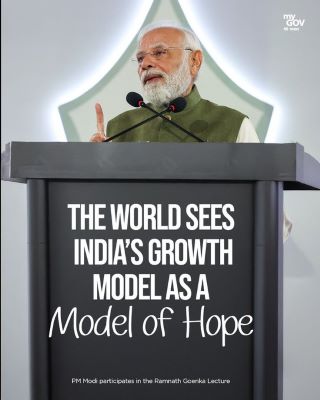
Reflecting on global instability over the last five years—from the Covid-19 pandemic to wars in Europe and West Asia—Modi said India’s consistent growth, hovering around 7 percent, has positioned it not just as an emerging market but “an emerging model.”
“At a time when the world fears disruption, India is confidently moving toward a bright future,” he said. “Today, the world sees the Indian Growth Model as a model of hope.”
Bihar Verdict Shows Rising Democratic Confidence
Citing the record-breaking turnout in the Bihar Assembly elections, with women voting nearly 9 percent more than men, the Prime Minister said the results reflected “the rising aspirations of India.”
He urged all state governments—“Left, Right or Centre”—to take the lesson from Bihar: development alone determines political longevity.
Hitting out at the previous regime in Bihar, he accused them of “15 years of jungle raj” and said the people “will never forget this betrayal.”
He clarified that his own political success was not a result of being in “24×7 election mode,” but in “24×7 emotional mode”—driven by the urge to ease the struggles of the poor and middle class.
Social Justice Through Saturation Governance
Modi highlighted social welfare achievements of the last 11 years, including:
- 12 crore toilets
- 57 crore Jan Dhan accounts
- 4 crore pucca houses
- 94 crore people under social security, up from 25 crore a decade ago
- 25 crore lifted out of poverty
“This is true social justice,” he said. “Our mission is saturation—no eligible beneficiary should be left out.”
He cited the Aspirational Districts Programme as an example of decentralised, data-driven development that turned neglected regions into outperformers.
Taking the example of Bastar, once synonymous with Maoist violence, he said the region’s transformation is proof that focused development “defeats despair.”
‘Urban Naxalism’ Has Captured the Opposition: PM
In one of his strongest political attacks of the evening, Modi claimed that while Naxalism is shrinking on the ground, it is “growing inside the Opposition.”
He accused them of turning into the “Muslim League–Maoist Congress (MMC)”, a party that “has abandoned national interest and threatens national unity.”
He said “urban Naxals” captured the Opposition 10–15 years ago and continue to influence major institutions.
Call to Dismantle Macaulay’s Influence by 2035
Marking 200 years since Macaulay’s 1835 education overhaul, the Prime Minister called for a decade-long national movement to:
- restore pride in Indian heritage,
- revive Indian knowledge systems,
- strengthen Indian languages, and
- end mental dependence on foreign models.
He said Macaulay’s policies broke India’s self-confidence by discarding centuries of science, culture, and learning. “If a nation does not honour itself, it loses its indigenous ecosystem,” he said.
Modi praised the National Education Policy for reinstating local languages at the centre of learning, clarifying: “We are not against English, but we strongly support Indian languages.”
Legacy of Resistance: Ramnath Goenka and the Emergency
Drawing parallels to contemporary challenges, Modi invoked Goenka’s defiance during colonial rule and the Emergency, recalling the Indian Express’ iconic blank editorial.
“He declared he would rather shut down the newspaper than obey British diktats,” Modi said. “Such courage is a reminder of what it takes to safeguard democracy.”
Closing Note
Thanking the Indian Express Group for upholding Goenka’s ideals, the Prime Minister said the media house has been a “witness to every transformation of the nation” and would continue to be a partner as India marches toward becoming a developed nation.
He concluded with a call for collective resolve in the next decade:
“Let us free ourselves from the mindset of slavery and build a future worthy of India’s civilizational greatness.”