
R ARIVANANTHAM
CHENNAI, NOV 2
A doctor’s greatest strength may not lie in the sophistication of a machine, the speed of an algorithm or the precision of a digital tool, but in the ability to listen, exercise sound clinical judgement and respond to another human being with compassion. Delivering this powerful message to the next generation of healthcare professionals, Dr Abhijat Chandrakant Sheth, Chairman of the National Medical Commission (NMC), Government of India, called upon students to embrace technological advances without surrendering the human values at the heart of medicine.
- HUMANITY BEFORE TECHNOLOGY: Dr Abhijat Sheth urges graduating students to safeguard clinical judgement, compassion and professional competence
- LISTENING IS HEALING: NMC Chairman stresses that attentive listening remains fundamental to effective medical practice
- MEDICINE’S FUTURE IS HERE: Artificial intelligence, precision medicine, digital healthcare and robotics are reshaping healthcare delivery
- 5,278 GRADUATES ENTER A NEW CHAPTER: 148 Ph.D. scholars, 667 postgraduate students and 4,463 undergraduates receive degrees
- RESEARCH GAINS MOMENTUM: University reports 12,802 Scopus-indexed papers, ₹16 crore in research funding and 97 patents secured
- MULTIDISCIPLINARY LEARNING: BIHER reports NIRF 2025 ranks of 76th among universities and 90th overall, alongside a global QS ranking in the 551–600 band
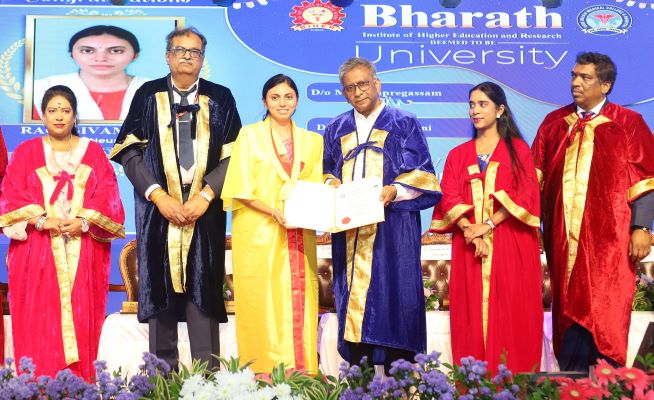
His clarion call set the tone for the 44th Convocation of Bharath Institute of Higher Education and Research (BIHER), also known as Bharath University, where 5,278 students received their degrees for the academic year 2025–2026.
The graduating cohort comprised 148 Ph.D. scholars, 667 postgraduate students and 4,463 undergraduate students across disciplines ranging from medicine, dentistry and pharmacy to engineering, nursing, physiotherapy, agriculture, science, technology, law, humanities and management.
Addressing the graduating students, Dr Sheth underscored the importance of combining professional competence with empathy and lifelong learning in a healthcare environment undergoing rapid technological transformation.
“Never surrender your insights and clinical judgement to technology or tools; it is human insight, clinical judgement, and professional capability that ultimately make a difference. Never lose sight of humanity, as compassion and concern for fellow human beings must remain at the heart of healthcare. Finally, strive to become a generation of competent and capable doctors, equipped to meet emerging challenges, embrace innovation, and remain lifelong learners,” he said.
His message carried particular significance at a time when artificial intelligence, digital diagnostics, precision medicine and robotics are opening new possibilities in healthcare, while placing an even greater premium on ethical responsibility, professional discernment and the doctor-patient relationship.
Listen closely, judge wisely, heal compassionately
Dr Sheth placed listening among the essential qualities of an effective medical practitioner, emphasising that doctors must remain attentive to patients rather than allow technology to dominate clinical decisions.
The ability to listen carefully can help medical professionals understand symptoms, recognise concerns and build trust with patients. In an increasingly technology-enabled healthcare system, the challenge is to use innovation to strengthen human care rather than diminish it.
The NMC Chairman urged students to cultivate independent clinical judgement and professional capability, warning against unquestioning dependence on technological tools.
His address offered the graduating students a broader definition of medical excellence: competence must go hand in hand with compassion, innovation with discernment, and scientific progress with an enduring commitment to humanity.
Artificial intelligence is reshaping medicine
Highlighting the pace of transformation in healthcare, Dr Sheth said medical education must evolve continuously to keep pace with changing societal needs and technological advances.
“Medicine has undergone a remarkable transformation, moving beyond conventional physical medicine to embrace artificial intelligence, precision medicine, digital healthcare, data-driven research, and robotics. Many of these developments would have been difficult to imagine just a few years ago,” he pointed out.
He congratulated BIHER on its emphasis on research, emerging technologies, collaborations and accreditation initiatives. Such efforts, he observed, help medical students understand the changing dimensions of their profession, appreciate interdisciplinary learning and develop a collaborative, team-based approach to healthcare delivery.
The message was clear: tomorrow’s healthcare professionals must be prepared not only to master established medical practices but also to adapt to emerging technologies, work across disciplines and continue learning throughout their careers.
5,278 graduates, a multidisciplinary academic legacy
Established in 1985, BIHER has developed into a multidisciplinary institution offering programmes across engineering, medicine, dentistry, pharmacy, nursing, physiotherapy, agriculture, science, technology, law, humanities and management.
The university’s institutional network includes Bharath Medical College and Hospital (BMCH), Sree Balaji College of Nursing, Sree Balaji Medical College and Hospital (SBMCH), Sree Balaji College of Physiotherapy and Sri Lakshmi Narayana Institute of Medical Sciences (SLIMS), Puducherry.
Its specialised academic schools include the School of Aeronautical Engineering, School of Agriculture, School of Bio-Engineering, School of Law, School of Medicine and School of Management and Commerce, among others.
Together, these institutions provide multidisciplinary learning opportunities to nearly 10,000 students from across India and abroad.
The convocation marked an important milestone for the graduating students as they prepare to carry their knowledge and skills into professional life, research, entrepreneurship and public service.
Research, funding and patents strengthen institutional profile
Outlining the university’s academic priorities, Dr S. Bhuminathan, Registrar, BIHER, said curriculum reforms had been initiated in alignment with the National Education Policy, with an emphasis on multidisciplinary learning, experiential education, skill development and learner-centred teaching.
“Our academic framework encourages students to go beyond the classroom and engage in innovation, entrepreneurship, community service, and lifelong learning,” he said.
Emphasising research as a central pillar of the university’s identity and future, Dr Bhuminathan said BIHER researchers had published 12,802 papers indexed in Scopus and 5,463 papers indexed in Web of Science.
During 2025–2026, the university received ₹16 crore in research funding from government and non-government agencies. Its network of 431 memoranda of understanding (MoUs) with national and international institutions continues to expand opportunities for research, academic exchange and innovation, he added.
The university also reported 1,406 patent applications during the year and 97 patents secured, including six international patents. Its Innovation and Incubation Centre received the Best IPR Centre Award from the Tamil Nadu State Council for Science and Technology.
These figures highlight the institution’s stated emphasis on research, intellectual property development and translating academic work into potential applications.
Medical education extends into community healthcare
Healthcare education and service remain important components of BIHER’s mission, with SBMCH contributing through medical education, clinical training, research and community-oriented healthcare services.
During 2025–2026, the institution organised 41 conferences, including 28 national and 13 international conferences, alongside 61 Continuing Medical Education programmes and guest lectures.
The university also conducted 384 community outreach activities aimed at extending medical services, health education and preventive healthcare to communities across the region.
Such initiatives provide opportunities for students and healthcare professionals to engage with practical challenges beyond academic settings and strengthen the connection between medical education and community needs.
National and international rankings
BIHER’s reported national and international rankings provide another indicator of its position in the higher education sector.
In the National Institutional Ranking Framework (NIRF) 2025 rankings, the university secured 76th place in the university category and 90th in the overall category.
In the QS World University Rankings 2026, it was placed in the global 551–600 band and ranked 82nd in Southern Asia.
The institution offers multidisciplinary programmes across professional and academic fields, catering to a student population of nearly 10,000.
Distinguished dignitaries grace the convocation
The convocation was attended by Dr S. Jagathrakshakan, Founder Chairman; Prof. Dr Mohamed Rela, Chancellor; Dr J. Sri Nisha, Pro-Chancellor; N. Elamaran, Managing Director, Sree Balaji Group of Institutions; Dr J. Sundeep Aanand, President; and Dr Swetha Sundeep Aanand, Managing Director, Bharath Group of Institutions.
Other dignitaries present were Prof. Dr M. Sundararajan, Vice-Chancellor; Dr S. Suresh Kumar, Pro-Chancellor (Research); J. L. Sri Rakshika, Chairperson, Bharath Group of Institutions; E. Shri Ritthvika, Chairperson, Sree Balaji Group of Institutions; Dr R. M. Suresh and Dr R. Hariprakash, Pro-Vice-Chancellors; Dr S. Bhuminathan, Registrar; Dr M. Sundararaj, Dean (Academics); Dr P. Sasikumar, Dean, Sree Balaji Medical College and Hospital, Chennai; Dr G. Jayalakshmi, Dean, Sri Lakshmi Narayana Institute of Medical Sciences, Puducherry; and Dr G. R. Rajashree, Dean, Bharath Medical College and Hospital, Chennai.
As the graduates step into their respective professions, Dr Sheth’s message offers a lasting principle for those entering medicine: technological advancement may change how healthcare is delivered, but the responsibility to listen, think independently and treat every patient with compassion must remain constant.
The ultimate test of a medical professional is not merely what technology enables a doctor to do, but how wisely, ethically and humanely that capability is used.