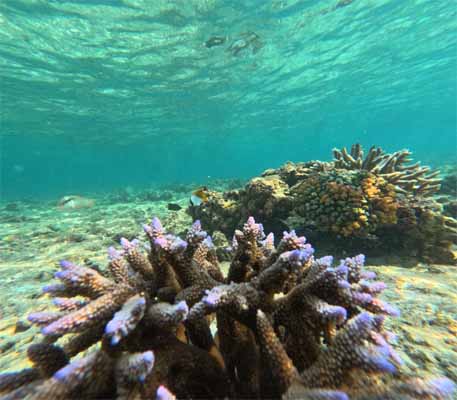
- As climate change accelerates and sea levels continue to rise, it becomes increasingly important to understand what sustains these fragile landforms and how their natural balance may be shifting
- Based on their fieldwork and analysis, the researchers found that more than 95 percent of the lagoon sediments in Agatti and Kavaratti consist of biogenic material, composed mainly of coral, mollusc, and foraminiferal fragments (less than 2 mm in size).
NE ENVIRONMENT BUREAU
GANDHINAGAR, MAY 20
Lakshadweep, India’s only chain of coral atolls, is more than a stretch of tranquil beaches and turquoise waters. These low-lying islands are living geological records, built over millennia by the remnants of marine life. As climate change accelerates and sea levels continue to rise, it becomes increasingly important to understand what sustains these fragile landforms and how their natural balance may be shifting.
To explore this, researchers from the REEFS Lab at the Indian Institute of Technology Gandhinagar (IITGN) studied the processes that form and maintain two of Lakshadweep’s atolls, Agatti and Kavaratti. Focusing on spatial patterns, sediment grain sizes, and dominant biological contributors, the study paints a detailed picture of how these islands are being shaped and reshaped by natural phenomena and biological as well as human activity.
“Our goal is to map spatial variability in sediment type produced by different organisms and how the natural forcings and anthropogenic activity influences the sediment production, accumulation, and their redistribution across the length and breadth of the atoll lagoons and islands,” said Prof Pankaj Khanna, an Associate Professor in the department of Earth Sciences at IITGN and lead investigator of the study. “This helps us understand not only how islands are built, but how stable they are over time.”
From corals, molluscs and algae to tiny shell-forming creatures like foraminifera, the ocean constantly produces and deposits calcium carbonate, the material that forms their skeletons and shells. As these organisms die, their remains accumulate and gradually break down into sand-sized particles. Over time, these sediments build up to create the very landmass of atoll islands like those in Lakshadweep. This continuous process of biological calcium carbonate production is referred to by geologists as a carbonate factory, a term that captures how marine life effectively drives the production of island-building material.
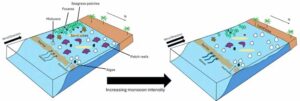
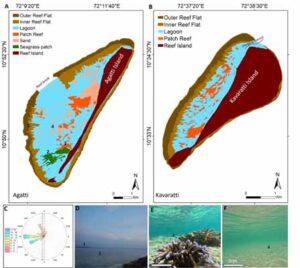
The study investigated the spatial variation in the functioning of these carbonate factories across different geomorphic zones within the lagoons, such as patch reefs, seagrass meadows, and reef flats. Each of these zones supports distinct biological communities and plays a different role in sediment production and accumulation. “These zones not only influence the types of organisms that thrive there but also determine the nature and quantity of sediment that enters the lagoon system,” explained Shradha Menon, a PhD student and first author of the study.
Based on their fieldwork and analysis, the researchers found that more than 95 percent of the lagoon sediments in Agatti and Kavaratti consist of biogenic material, composed mainly of coral, mollusc, and foraminiferal fragments (less than 2 mm in size). These sediments, known as biodetrital grainstone, reflect a system primarily driven by biological productivity rather than inorganic processes. Interestingly, unlike these atolls, the ones in the Maldives show a greater contribution from calcareous algae such as Halimeda, marking a distinct difference in sediment sources across the atolls.
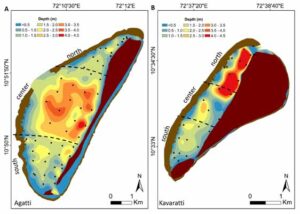
The study, published in Marine Geology, further revealed how local hydrodynamics—waves, currents, and tides—interact with biological zones to shape the patterns of sediment transport and deposition. Lighter particles, like mollusc fragments, tend to travel farther, while finer materials settle in calmer parts of the lagoon. These patterns, combined with the lagoon’s physical structure, create zones of sediment accumulation and erosion. The shallow lagoons of Agatti and Kavaratti, with depths averaging just 2 to 4 meters, are particularly sensitive to these processes.
Human activity has also left its mark on these delicate systems. In Kavaratti, particularly near a dredging channel, the researchers observed a noticeable shift in sediment composition, marked by a decline in coral clasts and an increase in contributions from Halimeda and molluscs. “We observed that coral clasts were less abundant in areas influenced by dredging,” said Ms Menon. “This suggests that anthropogenic disturbances, such as dredging and pollution, are altering the sediment-producing ecosystem, potentially affecting the island’s ability to sustain itself.”
By placing their findings within a broader regional context, the team compared Lakshadweep’s sediment dynamics with those observed in other Indian Ocean atolls, particularly the Maldives. While the basic biological processes of carbonate sediment production are shared, local ecological and geomorphological differences lead to distinct patterns in sediment composition and distribution. “Our work highlights the importance of understanding site-specific factors,” said Saikat Kumar Misra, a PhD student and co-author of the study. “Even subtle variations in lagoon structure or water movement can significantly impact sediment production and transport.”
As sea-level rise, coral bleaching, and expanding coastal development continue to pressure these ecosystems, the study underscores the need for locally informed conservation strategies. Safeguarding sediment-producing habitats such as coral reefs, patch reefs, and seagrass meadows is essential not only for marine biodiversity but also for the long-term physical stability of the islands. Sustaining these natural processes will help ensure that Lakshadweep’s islands remain resilient in the face of change.