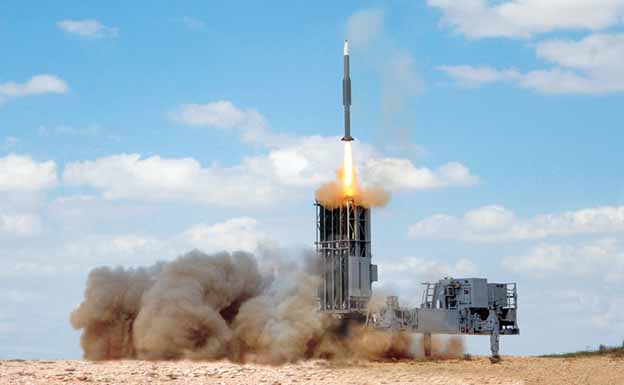
- By decisively employing BrahMos, Akash, and MR-SAM missiles in live combat, India has taken a big leap towards Atamanirbharta in offensive and defensive systems
- Akash’s low-cost, high agility and high kill probability dramatically showcased the power of value-engineered Indian technology
- The perception of unreliability, especially in the face of indigenous Indian systems, is likely to deter countries from depending on Chinese or Turkish platforms, especially those that lack adequate after-sales support or technological depth
VISHAL KANSAGARA

In the Atmanirbhar-based warfare, Operation Sindoor, Indian Armed Forces showed that terrorists and their masterminds have no place to hide and nuclear blackmail will not be a deterrent. Further, India has become the first country to immobilise the nuclear base of an enemy country with precision strike. The resurgent India has transformed into one of the serious global suppliers of cutting-edge weapon and no longer depends on others. Thanks to the synergy of the institutions like the DRDO and the ISRO, the public sector undertakings like HAL, BEL, and the setting up of Defence Corridors for private companies to set up shops have come handy for our Armed Forces to have an upper hand in modern warfare.
Indigenous defence manufacturing comes of age
Operation Sindoor marked a watershed moment for India’s defence sector, particularly in the context of its achieving self-reliance in military hardware (Atmanirbhar Bharat). For the first time in a real combat situation, the Indian Air Force (IAF) deployed multiple indigenously developed missile systems—BrahMos, Akash, and Barak MR-SAM—with decisive effect.
This operational use was not merely symbolic. These missile systems:
- Neutralized critical threats in live combat, such as fighter jets, drones, and airborne radar systems.
- Demonstrated reliability under battlefield conditions, one of the most important benchmarks for any weapon system.
- Hit targets with pinpoint accuracy, guided by navigation systems that can use NAVIC signals.
- Affirmed the effectiveness of Indian R&D, DRDO, and joint production ventures in a domain long dominated by imports.
This is a powerful endorsement of India’s maturing defence industrial base, positioning it not just as a consumer, but as a serious global supplier of cutting-edge weapon systems.
Missile Systems that redefined the engagement
BrahMos – The Spearhead of Indian Missile Power
- Jointly developed with Russia, yet with a significant Indian manufacturing and development footprint.
- Used across all three services—Air Force, Army and Navy.
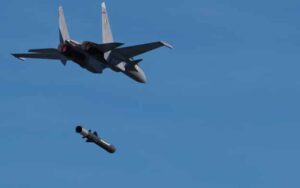
- The Indian Air Force has surface-launched and air-launched versions of BrahMos.
- The Indian Army has a surface-launched version of BrahMos.
- The Indian Navy has ship-launched and also mobile shore launched versions of BrahMos.
- During Operation Sindoor, BrahMos missiles launched by the Indian Air Force from bordering areas struck strategic targets deep within Pakistan with pinpoint accuracy.
- Su-30MKI aircraft of the Indian Air Force fired air-launched BrahMos at targets deep inside Pakistan. Each Su-30MKI can carry 1 BrahMos missile due to its size and weight.
- The kinetic energy of BrahMos is unmatched due to its high speed – Mach 2.8 – and heavy weight.
- Targets at premier PAF airbase with strategic installation like Sargodha, Jacobabad, Bholari, Chaklala and Nur Khan – have been hit by air-launched BrahMos.
- With a range of up to 600 km, supersonic speed, and pinpoint accuracy, BrahMos has been in service for a long time and has proven its combat capability.
This success boosts India’s export credentials, especially as 12 countries are in talks to actively procure it. The Philippines has already received two batches of BrahMos missiles to date.
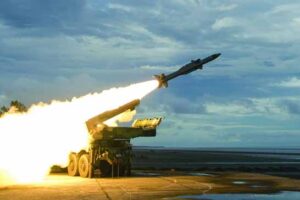
Akash – Quick, Indigenous and Cost-Effective
- Fully indigenous short to medium-range Surface to Air Missile (SAM) developed by DRDO.
- Successfully intercepted and destroyed a Pakistani JF-17 fighter aircraft jointly developed by China and Pakistan.
- It destroyed other aerial threats launched by Pakistan.
- This single interception severely undermines confidence in Chinese-built combat aircraft, especially among nations looking for affordable alternatives to Western jets and missile systems.
- Its low cost, high agility and high kill probability dramatically showcased the power of value-engineered Indian technology.
Barak-8 MR-SAM – Symbol of India-Israel Collaboration
- As the name suggests, it is a medium-range surface-to-air missile (MR-SAM) system co-developed by India’s DRDO and Israel Aerospace Industries.
- MR-SAM is used by the Indian Air Force, the Indian Army and the Indian Navy.
- An extended range version of MR-SAM is under development and may have range up to 140km.
IAF’s ability to deploy these systems in large numbers in sync reflects an integrated network centric air warfare capability, built on indigenous and co-developed platforms. It proved its effectiveness in neutralizing aerial threats like drones, missiles and aircrafts launched by Pakistan during Operation Sindoor.
Repercussions for China and Turkey: A blow to credibility
The failure of Chinese and Turkish-origin weapon systems during the operation has profound implications for their global defence exports.
- Chinese JF-17 combat aircraft—promoted as budget-friendly alternatives to Western and Indigenously developed Tejas aircraft—were shown to be vulnerable to Indian surface-to-air missiles. Their destruction by the Akash and MR-SAM has raised red flags among potential buyers like Argentina, Brazil, Egypt, Myanmar, Nigeria, etc.
- HQ-9 and HQ-16 air defence systems, promoted as a powerful shield against air attacks, proved vulnerable to modern aerial threats. Potential buyers like Turkmenistan, Uzbekistan and Iraq might consider Akash SAM for its excellent performance.
- Turkish drones, also used by Pakistan, failed to breach IAF air defence effectively and were either neutralized mid-air or jammed electronically.
- Turkey’s Bayraktar drones, which gained global visibility in conflicts like Azerbaijan vs Armenia, Libya and Ukraine, now face questions about effectiveness against credible and robust air defence systems.
The perception of unreliability, especially in the face of indigenous Indian systems, is likely to deter countries from depending on Chinese or Turkish platforms, especially those that lack adequate after-sales support or technological depth. In contrast, India’s demonstrably successful defence hardware, with lower costs and potential for technology transfer, presents a viable alternative, especially for countries in Asia, Africa, and Latin America.
Advantage for India’s Defence Industry
Operation Sindoor has demonstrated India’s resolve to impose a heavy cost on promoters of terrorism and also projected its rising status as a responsible weapons manufacturer on the global stage. By decisively employing BrahMos, Akash, and MR-SAM missiles in live combat, India has taken a big leap towards Atamanirbharta in offensive and defensive systems. Performance of these platforms will inspire many more startups and the established manufacturing ecosystem to innovate and carve out a niche in the defence and aerospace sector.
The author of this article is an Ahmedabad-based independent military analyst and writer with 20 years of experience in exploring the intersections of military and strategic affairs with a keen eye on public policy, business innovation, and its impact on society.