- 74th National Town & Country Planners Conference flags paradigm shift from static master plans
- City-region and metropolitan frameworks seen as engines of productivity and resilience
- Gujarat’s Sanand–Kalol–Savli–Hirasar–Bardoli initiatives cited as pressure-relief models
- AI-driven planning, data integration and predictive analytics gain consensus
- ‘Living city’ concept and post-event legacy planning emerge as new imperatives
NE INFRASTRUCTURE BUREAU
AHMEDABAD, FEB 7
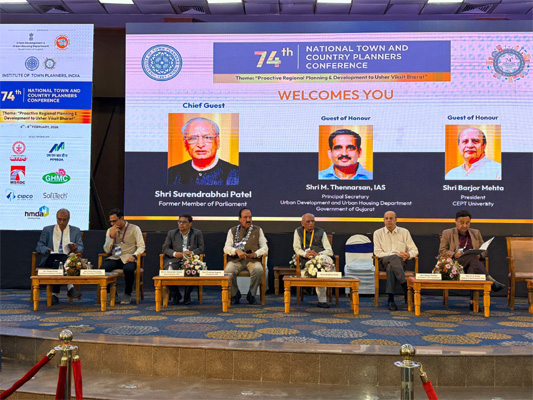
The 74th National Town and Country Planners Conference concluded here on Saturday with a strong call for a fundamental shift towards regional, transit-oriented and technology-enabled planning, as India’s cities grapple with rapid urbanisation, economic transformation and infrastructure stress.
Urban planning experts and practitioners emphasised that metropolitan and city-region planning must become central to India’s growth strategy, enabling high productivity, inclusive development and long-term resilience. Global city regions such as London, Singapore and Tokyo were cited as reference models where integrated regional planning has driven sustained economic and spatial efficiency.
City-regions as productivity engines
Participants noted that metropolitan regions can transition local economies towards higher productivity growth when supported by appropriate institutional frameworks and long-term economic planning. The Mumbai Metropolitan Region (MMR) was highlighted as a live example of a region undergoing a fundamental shift in planning strategy, institutional behaviour and development philosophy.
Delegates observed that MMR is now preparing a city-region economic plan aligned with local, national and international requirements, offering a replicable model that other metropolitan regions can adapt based on their unique resource base, spatial context and growth potential.
Gujarat models to ease urban pressure
The conference took note of schemes undertaken by the Government of Gujarat for Sanand, Kalol, Savli, Hirasar and Bardoli, which are expected to significantly ease urban pressure on surrounding major cities in the near future. Participants underlined that regional planning frameworks are essential instruments for achieving the national vision of Viksit Bharat by 2047, particularly through integrated planning and management of both rural and urban settlements.
Megacity regions and spatial hierarchies
Experts identified megacity regions in spatial planning as an effective tool for defining settlement hierarchies, infrastructure networks, transportation systems and service delivery frameworks. Existing land-use approaches such as Rural Rapid Development Formulation (RRDF) planning and cluster development under the Rurban Mission were recommended as useful reference points for strengthening metropolitan and regional planning practices.
AI-driven planning: data as the foundation
There was broad consensus on the use of artificial intelligence in city and regional planning, with delegates stressing that meaningful AI adoption would require a strong foundation of data volume, velocity and variety at city and regional levels. A structured, phased approach was recommended—beginning with data integration, followed by modelling, scenario simulation, predictive analytics and decision-support systems, all aligned with policy formulation and governance needs.
From events to enduring legacies
The conference also called for a paradigm shift in planning for large-scale events, including international sporting events, cultural festivals and religious gatherings. Such events, participants agreed, should be viewed not merely as temporary undertakings but as opportunities for inclusive infrastructure creation, employment generation, poverty reduction, environmental protection and institutional strengthening, supported by clear strategies for post-event utilisation of assets.
Towards a ‘Living City’ approach
Urban planners emphasised the need to move away from static master plans towards a “living city” concept that is dynamic, participatory and responsive within a city-region economic planning framework. Traditional town planning schemes, including newer land pooling models, were recommended for review with respect to implementation timelines, landowner participation, use of modern technologies, compensation mechanisms and governance effectiveness.
The deliberations collectively underscored that India’s next phase of urban development will be shaped not by isolated cities, but by well-planned regions connected through transit, data and economic strategy.