- From concept to commissioning in under a year
- Bamboo Orchid–inspired terminal blends regional identity with modern engineering
- Operations to begin by end-February after rigorous ORAT process
- Adani execution scale mirrors Navi Mumbai airport momentum
- ₹5,000-crore investment strengthens aviation, cargo and MRO ecosystem
NE BUSINESS BUREAU
Guwahati, Dec 20
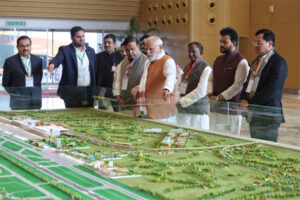
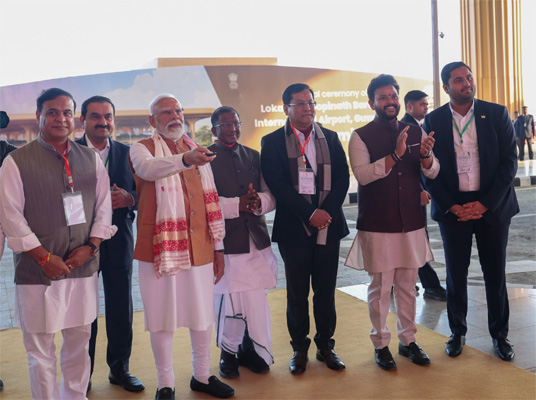
Prime Minister Narendra Modi on Friday inaugurated the new terminal at Lokapriya Gopinath Bordoloi International Airport (LGBIA), marking one of India’s fastest airport infrastructure deliveries—from design unveiling to commissioning—in under a year, backed by intensive operational readiness planning.
The terminal’s design was unveiled by the Prime Minister in February at Advantage Assam 2.0. With operations scheduled to commence by the end of February, the project underlines the compressed timelines now shaping India’s aviation infrastructure. A comprehensive Operational Readiness and Airport Transfer (ORAT) programme, supported by an expert visiting team from Munich, Germany, has aligned systems, processes, personnel and passenger flows to ensure safe and seamless operations from day one.
Conceived as a modern gateway rooted in regional identity, the terminal—named “The Bamboo Orchids”—draws inspiration from Assam’s iconic kopou phool (foxtail orchid) and indigenous bamboo varieties such as Bholuka bamboo from Assam and Apatani bamboo from Arunachal Pradesh. The architecture blends natural materials, abundant daylight and contemporary design, reflecting the Northeast’s ecological and cultural richness. About 140 metric tonnes of locally sourced bamboo have been used across the terminal, making it one of India’s most prominent examples of nature-inspired airport architecture where traditional craftsmanship is reimagined through modern engineering.
Developed by Guwahati International Airport Limited and operated by Adani Airport Holdings Limited (AAHL), the project showcases the Adani Group’s integrated approach to infrastructure delivery—combining design excellence, engineering capability, ORAT-led preparedness and time-bound execution across complex aviation projects.
Placing the inauguration in a broader national context, Prime Minister Narendra Modi described it as part of a wider Vikas ka Utsav unfolding in Assam and the Northeast. He said Assam is emerging as India’s eastern gateway under the Act East policy, with the bamboo-rich terminal symbolising strength, sustainability and the state’s growing role in powering Viksit Bharat as India advances toward becoming the world’s third-largest economy.
Commenting on the occasion, Gautam Adani, Chairman, Adani Group, said: “The Guwahati terminal demonstrates how world-class airport infrastructure can be delivered swiftly while remaining deeply rooted in local identity. It will strengthen connectivity, support economic growth across the Northeast, and offer passengers a seamless, modern travel experience.”
Equipped with DigiYatra-enabled processing, smart check-in systems and expansive passenger areas, the terminal is designed to handle 13.1 million passengers annually by 2032. In FY 2024–25, Guwahati Airport handled 6.50 million passengers, highlighting the region’s accelerating aviation demand. Guwahati currently ranks as India’s 10th busiest airport and serves as a critical hub for all eight Northeastern states.
The overall airport development entails an investment of ₹5,000 crore, including ₹1,000 crore earmarked for Maintenance, Repair and Overhaul (MRO) facilities. Planned integrated domestic and international cargo infrastructure is expected to further boost trade, logistics and employment generation across the region.
The Guwahati terminal milestone forms part of AAHL’s wider national aviation expansion, with execution momentum continuing through the scheduled operational launch of the Navi Mumbai International Airport on December 25—one of India’s largest greenfield airport projects. Together, these developments reflect an evolving infrastructure landscape where speed, scale, operational readiness and design excellence converge to create future-ready gateways for growth.