- Modi announces grand statues for Chola emperors Rajaraja Chola and Rajendra Chola I
- The Chola emperors had woven India into a thread of cultural unity, Today, our government is carrying forward the same vision of the Chola era, through initiatives like the Kashi-Tamil Sangamam and the Saurashtra-Tamil Sangamam, we are strengthening these centuries-old bonds of unity: PM
- When the new Parliament building was inaugurated, the saints from our Shaivite Adheenams led the ceremony spiritually; The sacred Sengol, deeply rooted in Tamil culture, has been ceremoniously installed in the new Parliament: PM
NE NEWS SERVICE
CHENNAI, JUKY 27
Prime Minister Narendra Modi on Sunday took part in the valedictory celebrations of the Aadi Thiruvathirai festival at the historic Gangaikonda Cholapuram temple in Tamil Nadu’s Ariyalur district. The event marked the birth anniversary of the legendary Chola emperor, Rajendra Chola I.
Bowing to the almighty Lord Shiva, reflecting on the profound spiritual energy experienced through the divine Shiva Darshan in the holy land of Raja Raja Chola, accompanied by the music of Ilaiyaraaja and the sacred chanting of the Odhuvars, Modi remarked that the spiritual atmosphere deeply moved the soul.
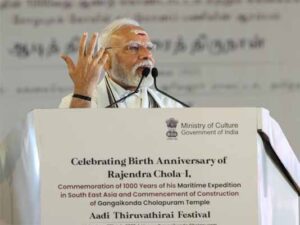
“The economic and strategic advancements achieved during the Chola era remain a source of inspiration for modern India. To become a developed nation, we too must prioritise unity; strengthen our Navy and Defence forces and look for new opportunities, even while safeguarding our core values,” Modi said at the valediction of the Aadi Thiruvathirai festival marking the birth anniversary of Rajendra Chola I at Gangaikonda Cholapuram.
The Prime Minister announced the Centre would install grand statues of the two emperors in Tamil Nadu, to serve as the pillars of country’s historical consciousness. “The legacy of Rajaraja Chola and Rajendra Chola is synonymous with India’s identity and pride. The history and heritage of the Chola Empire proclaim the true potential of India,” he said.
Paying glowing tributes to the military might and administrative acumen of Rajendra Chola I and his father Rajaraja Chola, he said the heights reached by the emperors were a source of inspiration, providing an ancient road map for the country to become a developed nation.
“The economic and strategic advancements achieved during the Chola era remain a source of inspiration for modern India. To become a developed nation, we too must prioritise unity; strengthen our Navy and Defence forces and look for new opportunities, even while safeguarding our core values,” Modi said at the valediction of the Aadi Thiruvathirai festival marking the birth anniversary of Rajendra Chola I at Gangaikonda Cholapuram.
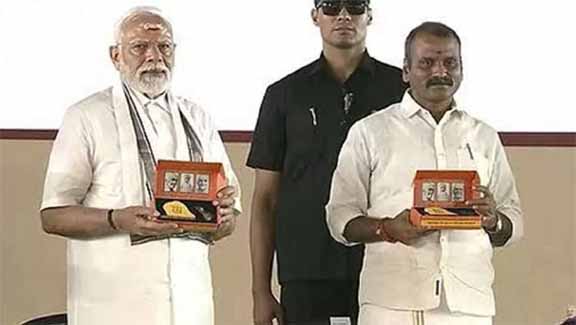
Modi released a commemorative coin in honour of Rajendra Chola I on the occasion. The king had built Gangaikonda Cholapuram, the ancient capital of the Imperial Cholas, along with the Brihadisvara Temple and the Cholagangam, a massive lake, after his victorious expedition to the Gangetic plains about 1,000 years ago.
The Prime Minister announced the Centre would install grand statues of the two emperors in Tamil Nadu, to serve as the pillars of country’s historical consciousness. “The legacy of Rajaraja Chola and Rajendra Chola is synonymous with India’s identity and pride. The history and heritage of the Chola Empire proclaim the true potential of India,” he said.
Rajaraja Chola built a powerful navy; his son Rajendra Chola I strengthened it. The Cholas strengthened local administration, established extensive trade and cultural links to bring out about development in various spheres to his country. The Chola rulers had extended their diplomatic and trade relations to Sri Lanka, the Maldives, and Southeast Asia, he pointed out.
India too placed the highest priority on its national security, Modi said and added that through Operation Sindoor, the world has witnessed the firm and decisive response of the country to any threat to its sovereignty.
Pointing out the Chola reign was considered to be one of the golden ages of the country by historians, Mr. Modi said the dynasty was not only known for their military strength but also for being the mother of democracy by introducing the kudavolai system of electing local representatives centuries ago.
The global discourse now revolves around water management and ecology preservation, but our ancestors understood the importance of these issues long ago, Modi said citing the Cholas excellent water management systems.
“The Chola rulers had woven a thread of cultural unity. Our government is carrying forward their ideals,” he said referring to the conduct of the Kashi Tamil Sangamam and the Saurashtra Tamil Sangamam to reinforce centuries-old bonds of unity. Over the past decade, the nation had worked on mission mode to preserve its cultural legacy. About 600 ancient statues and artefacts, which had been stolen and sold abroad, have been brought back to India since 2014. Of these, 36 belonged to Tamil Nadu.
Dressed in traditional Tamil attire — a white veshti (dhoti), half-sleeved shirt, and angavastram — the Prime Minister offered reverence at the majestic Gangaikonda Cholisvaram temple, a UNESCO-recognised architectural marvel built by Rajendra Chola as a counterpart to his father Rajaraja Chola’s iconic Brihadisvara Temple in Thanjavur.
To commemorate the occasion, PM Modi unveiled a special coin honouring Rajendra Chola I, acknowledging the emperor’s monumental contributions to India’s history, architecture, spirituality, and maritime achievements.
Upon his arrival, the Prime Minister was received with traditional poorna kumbham honours. He performed abhishekam to the temple’s presiding deity, Lord Choleeswarar (a form of Shiva), using sanctified water brought from the sacred Ganges in Varanasi — a symbolic gesture linking India’s northern and southern spiritual heritage.
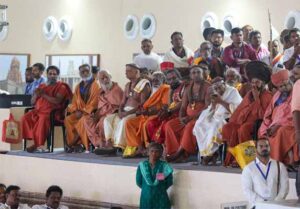
The Prime Minister participated in deeparadhana (ritual lamp offering), while Tamil Shivaacharyas recited ancient Vedic hymns in Tamil, preserving the deeply rooted Saivite traditions of the region. PM Modi also visited shrines within the complex dedicated to Goddess Durga, Goddess Parvati, and Lord Murugan.
Visibly captivated by the temple’s artistic grandeur, he spent time exploring its intricately carved stone sculptures, centuries-old bronze icons, and the remarkable Chola-era metal idols and copper plates that narrate a saga of devotion, craftsmanship, and imperial vision.
Adding to the spiritual ambience, odhuvars (temple singers) recited sacred Saivite hymns, while legendary music composer Ilaiyaraaja delivered a soul-stirring rendition of verses from Thiruvasagam, the poetic work of Tamil saint-poet Manikkavasagar.
This year’s celebration held added significance as it also marked 1,000 years since Rajendra Chola’s famed naval expedition to Southeast Asia — a feat that showcased the Chola Empire’s maritime dominance and far-reaching influence.
PM Modi concluded his visit by exploring a thematic photo exhibition curated by the Archaeological Survey of India (ASI), titled “Saiva Siddhanta and Chola Temple Arts.” He engaged with scholars, historians, and temple experts, expressing admiration for the enduring spiritual and architectural legacy of the Chola dynasty.
“This celebration is not only a tribute to Rajendra Chola I but also a recognition of Tamil Nadu’s unparalleled contribution to India’s civilisational journey,” the Prime Minister remarked during his visit.
Tamil Nadu Governor R.N. Ravi, Union Minister of State for Information and Broadcasting L. Murugan, State Ministers Thangam Thennarasu and S.S. Sivasankar, and Lok Sabha MP Thol. Thirumavalavan, were among the participants.