R ARIVANANTHAM
NEW DELHI, NOV 16
In an exclusive development closely tracked by our portal, Prime Minister Narendra Modi visited the under-construction Bullet Train Station at Surat to review progress on the Mumbai–Ahmedabad High-Speed Rail (MAHSR) Corridor — India’s first bullet train project and one of the nation’s most ambitious engineering endeavours.
COURTESY: PIB
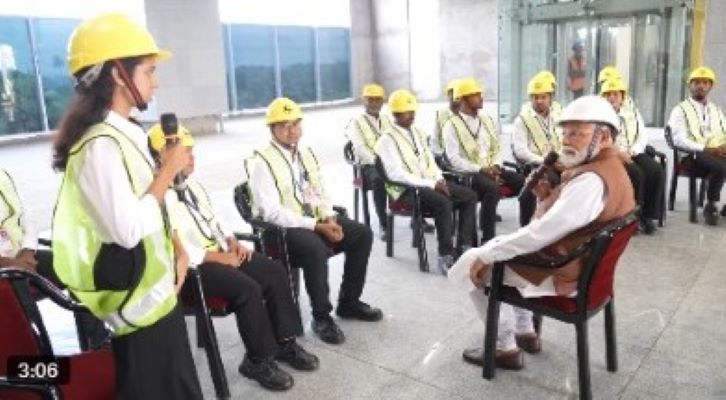
During his detailed review, the Prime Minister personally interacted with engineers and project staff, enquiring about construction timelines, speed targets and on-ground challenges. Workers assured him that the project was progressing smoothly and ahead on several parameters.
- Urges creation of a “Blue Book” to document learnings for future bullet train corridors
- Engineers share pride, stories and innovations behind the historic Mumbai–Ahmedabad project
- PM says working with a sense of nation-building becomes “the greatest source of motivation”
Engineers Share Experiences; PM Highlights Spirit of National Service
A young engineer from Kerala, working at the Navsari Noise Barrier Factory, shared her pride in contributing to India’s first high-speed rail network.
“Sir, it feels like a dream… It is a proud moment for my family and for me,” she said, describing her work with robotic welding units for rebar cages.
Responding, the Prime Minister underlined the transformative meaning of nation-building:
“Unless you feel from within that ‘I am working for my country, I am giving something new to the nation’, the work will never carry the same meaning. The scientists who launched India’s first satellite must have felt the same. Today we send hundreds into space.”
Shruti, an engineering lead from Bengaluru, explained the rigorous design controls in the project:
“At every stage we study pros and cons. If a solution fails, we explore alternatives immediately. That is how we progress step by step.”
PM Calls for a ‘Blue Book’ of Learnings to Guide Future High-Speed Rail Projects
Impressed by the team’s dedication and systematic approach, the Prime Minister suggested compiling a comprehensive repository of learnings:
“If your experiences are recorded and a ‘blue book’ is prepared, it will help the country immensely. India should not start from scratch for every corridor. Replication is only meaningful when we understand why we take certain actions. Your documentation will help future students and engineers—and become your contribution to the nation.”
One team member recited a heartfelt poem expressing the workers’ emotional connection with the project:
“The bullet train is our identity… this achievement is yours and ours, Modi ji.” The Prime Minister responded warmly with appreciation.
Union Minister Ashwini Vaishnaw accompanied the Prime Minister during the visit.
A Transformative Project on Track
The 508-km MAHSR corridor—352 km in Gujarat and Dadra & Nagar Haveli, and 156 km in Maharashtra—will connect key cities including Sabarmati, Ahmedabad, Vadodara, Surat, Vapi, Boisar, Thane and Mumbai.
Built using advanced engineering systems on par with global standards:
- 465 km (85%) of the route will run on viaducts
- 326 km of viaduct is already completed
- 17 of 25 river bridges have been finished
The upcoming Surat–Bilimora stretch is nearing completion with all civil and track-bed works done. The Surat station—modelled on the brilliance of the city’s diamond heritage—features spacious lounges, retail spaces, gender-friendly amenities and seamless integration with Surat Metro, city buses and Indian Railways.
When operational, the bullet train will cut travel time between Mumbai and Ahmedabad to around two hours, catalysing business growth, tourism, investments and regional development.
A Historic Leap for India
The Prime Minister’s on-site review and interaction with the engineering teams reaffirmed the government’s commitment to bringing world-class high-speed rail connectivity to India.
As he reflected during the interaction: “We will dedicate our lives here and leave behind something valuable for the nation.”