


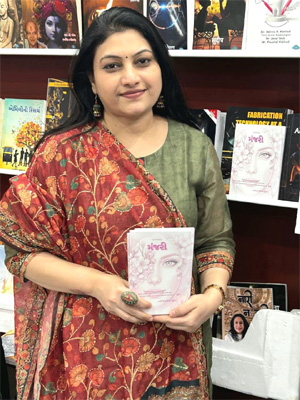
- The acclaimed poet’s second collection captures love, loss, faith, and self-reflection with lyrical intimacy
- From personal experiences to universal truths, ‘Manjari’ mirrors life in all its shades
- Literary voices hail the work as a seamless confluence of art, spirituality, and lived reality
- Author Yogini and chief guest underline poetry’s timeless power to heal and connect
NE LITERARY BUREAU
AHMEDABAD
As contemporary Gujarati literature continues to evolve and deepen its emotional vocabulary, poet Yogini’s latest poetry collection, Manjari, emerges as a resonant and introspective literary work, soaked in emotional warmth and a profound sense of belonging.
Nearly a decade after her debut poetry collection Shwaas, Yogini returns with Manjari, a thoughtfully curated volume that explores love and separation, relationships and seasons, inner conflict and lived struggles, spirituality and the search for the divine. Spread across 112 pages, Manjari reads like a poetic map of life itself—layered, intimate, and deeply reflective.
A Poet Blessed with Saraswati’s Grace
Widely regarded as a poet of rare depth and sensitivity, Yogini has contributed meaningfully across genres and themes rooted in everyday life. Her verses carry the unmistakable imprint of lived experience, seamlessly blending imagination with reality.
Each poem in Manjari reflects a personal journey while remaining universally relatable. The collection invites readers not just to read, but to reflect, contemplate, and emotionally engage with the unfolding “silk threads” of life’s moments.
Verses That Linger in the Heart
Poems such as ‘Taaro Shwaas’, with its tender line “My life merges into yours”, strike a deeply emotional chord. ‘Adhoori Mulakaat’ poignantly captures the ache of an incomplete meeting where eyes meet but destinies part. In ‘Maarama Badhu Taaru’, lines like “My breath, my faith—everything within carries your name” speak of profound love and unbreakable bonds.
Other poems—Ichchhaoni Yaadi, Darpan, Meera, Ek Sugandhit Shwaas, Pagharyo Chhe, Prem, Maaya No Megh, and Vasant Na Virah—unfold diverse emotional landscapes, from longing and devotion to quiet resilience.
Poetry as Philosophy, Art, and Awakening
Described by literary voices as expansive and contemplative, Manjari encapsulates every rasa of human existence. It reflects the eternal truth that life flows on, anchored by shwaas (breath) as the pillar of the body and self-realisation as the path to the soul.
The work urges readers to look beyond surface reflections—to seek not just roop (appearance) but svaroop (true self). As one evocative metaphor suggests: When a leaf falls, a branch trembles—and then a bud blooms. That bud is Manjari. That bloom is the song.
Author & Chief Guest Speak
Speaking about her creative philosophy, poet Yogini said, “I do not write poetry to seek gratitude. My poetry is my selfless offering—born from lived moments, inner journeys, and the quiet desire to give without expectation.”
She added that Manjari reflects her belief in burning like incense to spread fragrance, flowing like a river for others, and blooming like a rose despite the harsh sun.
The chief guest at the book release hailed the collection as a rare literary achievement, stating,
“‘Manjari’ is not merely a poetry collection—it is a confluence of art, music, and philosophy. Every page carries the poet’s voice, the reader’s emotion, and society’s shared consciousness.”
A Timeless Literary Offering
Manjari transcends being a mere ornamental literary work. It is a living dialogue between memory and time, between personal truth and collective experience. Each poem feels etched like a time-inscription—soft with emotion, rich with hope, and capable of forging a heartfelt journey from one soul to another.
Written after the pandemic, Manjari stands in poetic conversation with Yogini’s pre-pandemic work Shwaas, together inspiring readers to understand life, endure it, and ultimately celebrate it.
In a world weighed down by routine fatigue, emotional weariness, and everyday monotony, Manjari arrives as a literary breath of fresh air—reinvigorating, timeless, and deeply human.