


- Pathbreaking hybrid electrode delivers superior energy density, ultra-long cycle life and unmatched stability
- Innovative fusion of metal-organic frameworks, boron nitride and carbon nanotubes overcomes traditional energy storage limitations
- Breakthrough Aluminium-ion hybrid capacitors promise sustainable, cost-effective and high-performance storage solutions
- Research published in Journal of Energy Storage marks major leap toward renewable energy integration and grid resilience
- Discovery positions India at the forefront of advanced materials innovation for next-generation clean energy technologies
NE SCIENCE & TECHNOLOGY BUREAU
GANDHINAGAR, FEB 17
In a major scientific breakthrough that could redefine the future of sustainable energy storage, researchers at Indian Institute of Technology Gandhinagar (IITGN) have developed a novel hybrid electrode capable of dramatically enhancing the performance, stability, and longevity of Aluminium-ion hybrid capacitors (AIHCs)—a promising next-generation energy storage technology.
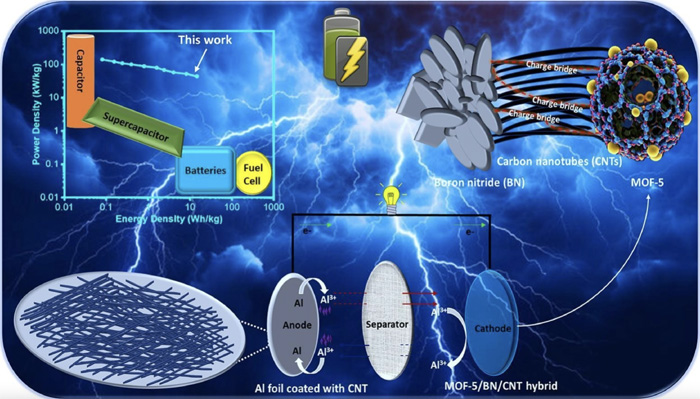
The pioneering research, published in the prestigious Journal of Energy Storage, introduces a unique hybrid cathode material composed of metal-organic frameworks (MOF-5), boron nitride (BN), and carbon nanotubes (CNTs), paired with a CNT-coated aluminium foil anode. This integrated material architecture delivers exceptional energy storage capability, mitigates corrosion, and ensures remarkable long-term operational stability.
Hybrid capacitors such as AIHCs represent an advanced class of energy storage devices that combine the prolonged energy retention of batteries with the rapid energy release characteristics of supercapacitors. Their appeal lies in aluminium’s natural abundance, low cost, and environmental sustainability. However, limitations related to material compatibility, corrosion, and cycle life have historically hindered their widespread adoption.
Addressing these critical challenges, the IITGN research team engineered a highly interconnected hybrid electrode structure that optimises ion transport and electrical conductivity. Metal-organic frameworks provide large surface areas and adjustable pore structures ideal for energy storage, while boron nitride enhances mechanical strength and thermal stability. Carbon nanotubes create conductive networks that enable efficient electron movement and structural durability.
“The combination of these components resulted in a hybrid material with superior properties. It is highly competitive, excelling in capacity, energy and power densities, and cycling stability. Its performance can be attributed to features like the hybrid and interconnected porous structure and efficient transport of ions or charged particles within the device,” explained Prashant Dubey, the first author of the study.
Dr Dubey completed this research as an Early Career Fellow at IIT Gandhinagar and is currently a postdoctoral fellow at Nagoya University under the Japan Society for the Promotion of Science (JSPS).
Highlighting another critical innovation, Atul Bhargav, Professor in the Department of Mechanical Engineering and Principal Investigator at the Energy Systems Research Laboratory (ESRL), said:
“An important feature was the use of CNT coatings on aluminium foil. These coatings increase the surface conductivity and cause the aluminium ions to spread evenly during the charge and discharge process. It effectively prevents the corrosion and formation of a thin ‘blocking’ layer on the aluminium surface that is bad at conducting electricity (passivation).”
The hybrid device demonstrated outstanding performance metrics, significantly outperforming conventional electrode systems. It achieved an impressive energy density of 140 Wh/kg, more than double that of comparable boron nitride- or MOF-based systems, along with a high power density of 14.6 kW/kg, enabling rapid energy delivery.
Equally remarkable was its durability—the device retained 92.2% of its initial capacity even after 20,000 charge-discharge cycles, a crucial benchmark for real-world energy storage applications such as electric vehicles, renewable energy grids, and portable electronics.
The research underscores the transformative potential of integrating multiple advanced materials into a single hybrid electrode to overcome long-standing technological barriers. By improving energy density, enhancing durability, and ensuring environmental sustainability, the breakthrough offers a viable pathway toward next-generation energy storage solutions essential for accelerating the global transition to renewable energy.
This innovation aligns with India’s broader clean energy ambitions and strengthens its position as a global leader in advanced materials research, energy innovation, and sustainable technology development.