R ARIVANANTHAM
NEW DELHI, JAN 4
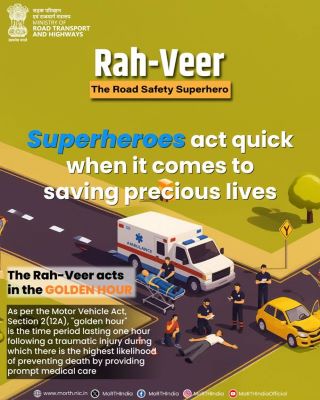
Every second counts after a road accident. In that fragile window known as the Golden Hour—the first hour following a serious injury—timely help can mean the difference between life and death. To ensure that fear never stops compassion, the Ministry of Road Transport and Highways notified the Good Samaritan Rules in 2020 under Section 134A of the Motor Vehicles (Amendment) Act, 2019.
At the heart of these rules lies a powerful assurance: no one who helps an accident victim will ever be punished for doing so.
- Good Samaritan Law Empowers Citizens to Act Without Legal Anxiety
- Golden Hour Response Can Prevent Deaths, Disabilities and Trauma
- Anonymity, Dignity and Legal Protection Guaranteed for Helpers
- ₹25,000 Reward and National Recognition for Real-Life Road Heroes
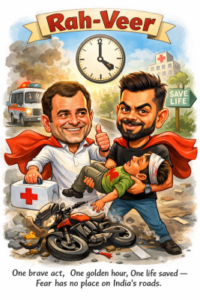
Those who step forward in moments of crisis—lifting an injured stranger, arranging transport, or rushing them to the nearest hospital—are honoured as Rah-Veers, true guardians of human life.
Golden Hour: When Humanity Saves Lives
The law clearly defines the Golden Hour as the most critical phase for medical intervention. Immediate assistance during this time can prevent permanent disability, reduce trauma, and avert countless fatalities.
Most importantly, becoming a Rah-Veer requires no medical degree, no special equipment, and no formal training. Often, the simple courage to act is the greatest lifesaving tool.
Good Samaritan Protections: What Every Citizen Must Know
Do’s: Your Rights as a Rah-Veer
- Help without fear: You are protected from civil and criminal liability when acting in good faith.
- Remain anonymous: You are not required to disclose personal details unless you choose to be a witness.
- One statement only: If you volunteer as a witness, police examination is limited to a single instance at a time and place convenient to you.
- Hospital acknowledgement: You are entitled to a simple confirmation that you brought the victim for treatment.
Don’ts: Myths That Should Never Stop You
- Do not hesitate due to legal worries: The law is designed to protect Rah-Veers.
- Do not feel compelled to stay: Once the patient is admitted, you are free to leave.
- Do not pay for treatment: Hospitals cannot demand payment from you for emergency care.
- Do not feel forced to file an FIR or testify: Being a witness is entirely your choice.
- Do not reveal personal details if you prefer privacy: Anonymity is your right.
- Do not accept detention: Detaining a Good Samaritan is strictly prohibited.
Why India Needs More Rah-Veers
Despite improved highways and expanding infrastructure, India continues to record one of the highest numbers of road accidents globally. Union Minister for Road Transport and Highways Nitin Gadkari has highlighted that road crashes impose a massive economic burden, costing the nation nearly 3% of its GDP, as estimated in a report by IIT Delhi.
Many deaths occur not because help was impossible, but because help arrived too late. Fear of police questioning, hospital formalities, or legal entanglements often paralyzes bystanders. Those lost minutes during the Golden Hour cost lives.
The Good Samaritan framework removes this fear—transforming hesitation into action.
Recognition and Financial Support for Roadside Heroes
The Rah-Veer (Good Samaritan) Scheme goes beyond legal protection. It celebrates courage.
Any individual who ensures that an accident victim receives medical care within the Golden Hour is eligible for:
- ₹25,000 financial reward, and
- A Certificate of Appreciation
Recognition can be awarded up to five times a year for repeated acts of bravery, reinforcing a culture where helping others becomes a shared national responsibility and a source of pride.
Rah-Veer Is a Movement, Not Just a Policy
Rah-Veer represents courage over fear, compassion over doubt, and humanity over indifference. It reminds every citizen that roads should connect lives—not end them.
The next time you witness an accident, remember this:
You may be the only hope standing between tragedy and survival.
You don’t need to be a doctor to save a life.
You just need to be human.