- Global scholars gather at IITGN to rethink South Asia’s Palaeolithic past
- New dating evidence pushes human presence in India back to 1.7 million years
- Experts challenge Eurocentric frameworks in interpreting Indian archaeology
- Young researchers and interdisciplinary science energise prehistory studies
- Four-day symposium sparks rigorous debate on transitions, identities and origins
NE EDUCATION BUREAU
GANDHINAGAR, JAN 31
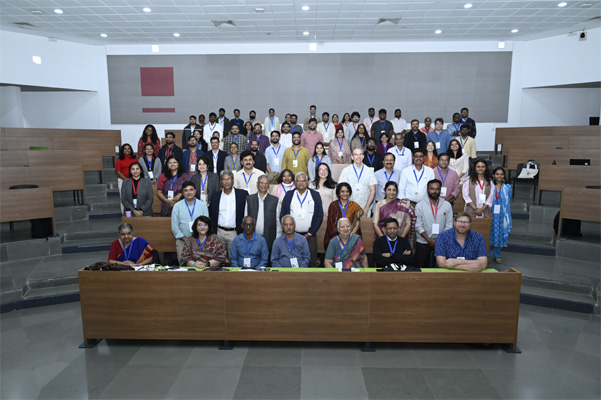
The Indian Institute of Technology Gandhinagar (IITGN) has emerged as a global forum for re-examining India’s ancient past with the hosting of a four-day international symposium titled ‘Rethinking Deep Time: Debating Transitions, Origins, and Identities in South Asian Palaeolithic Archaeology’. Organised by the Archaeological Sciences Centre and funded by the Wenner-Gren Foundation, the symposium has brought together leading scholars to challenge long-held assumptions about human origins and technological transitions in South Asia.
Speaking at the inaugural session, senior archaeologist Prof Ravi Korisettar, adjunct professor at the National Institute of Advanced Studies (NIAS), Bengaluru, highlighted why India remained marginal in global debates on early human history for decades.
“Despite decades of archaeological research, India’s deep past remains poorly understood due to the lack of reliable dating frameworks,” Korisettar said. “For a long time, India was absent from global debates on human origins simply because we did not have secure chronological evidence.”
He noted that recent scientific advances are now transforming that understanding.
“Recent advances in dating techniques and interdisciplinary research are pushing human presence in India back to nearly 1.7 million years,” he said. “Discoveries linked to the Toba volcanic eruption have also forced us to rethink earlier assumptions about continuity and survival of early humans in South Asia.”
Korisettar cautioned against imposing European models on Indian evidence.
“Technological transitions in India follow their own trajectories, and unless we recognise this, we risk misreading our past,” he said, stressing that archaeology today is fundamentally interdisciplinary and no single specialist can reconstruct deep history on their own.
Reflecting on the evolution of Indian prehistoric research, Prof Sheila Mishra, former Head of the Department of AIHC & Archaeology at Deccan College, Pune, traced the discipline’s long journey.
“When I started in the late 1970s, there were very few opportunities in Indian archaeology, and pursuing this field was a career risk,” she said. “At that time, Indian research was often unfairly compared to European archaeology, without recognizing its unique context and contributions.”
Highlighting generational change, she added:
“It is encouraging to see so many active young researchers today, bringing fresh energy and perspectives to Indian prehistory.”
On the importance of scholarly debate, Mishra observed:
“The more disagreements we have, the more successful the symposium is, because it gives us a chance to examine evidence, challenge assumptions, and arrive at informed conclusions.”
She further reinforced the need to recognise India’s distinct archaeological trajectory.
“Indian evidence cannot simply be fitted into European sequences; our cultural and technological developments have their own path,” Mishra said. “If you think about where India falls in the global sequence, we need to recognize that our archaeological record has its own trajectory.”
Stressing methodological rigour, she added:
“Symposia like this allow us to examine evidence, challenge assumptions, and strengthen understanding,” adding that interdisciplinary perspectives are essential to study artifacts within their full context.
Outlining IITGN’s growing role in archaeological sciences, Prof V N Prabhakar, coordinator of the Archaeological Sciences Centre, highlighted the institution’s emphasis on technology-driven research.
“We have built projects and workshops to expose students to technologies like remote sensing, GIS analysis, and petrography,” he said.
Emphasising collaboration across disciplines, he added:
“The synergy between sciences and archaeology opens a bright future for research in India,” and invited scholars to collaborate with the centre for meaningful national and international research.
Dr Anil Devara drew attention to India’s globally significant prehistoric record and recent breakthroughs.
“Although historically underrepresented, recent studies at sites like Attirampakkam, Jwalapuram, Mehtakheri, and Dhaba show the complexity of India’s human evolutionary record. This symposium provides a platform to discuss these findings and guide future research,” he said.
The symposium’s opening day featured keynote addresses and thematic paper presentations under ‘My Acheulian–Your Middle Palaeolithic’, examining transitions from the Late Acheulian to the Early Middle Palaeolithic across the Indian subcontinent. Panel discussions addressed chronology, nomenclature, and technological change, with contributions from scholars including Prof Sheila Mishra, Prof Shanti Pappu, Founder-Secretary, Sharma Centre for Heritage Education (Adjunct Professor, Krea University), Dr Kumar Akhilesh, Director, Sharma Centre for Heritage Education, and Prof Michael Petraglia, Director, Australian Research Centre for Human Evolution, among others.
Over the next three days, the symposium will continue to foster dialogue on transitions, origins, and identities in South Asian Palaeolithic archaeology, promising deeper insights into India’s deep past through rigorous debate and interdisciplinary engagement.