
- Two-Week International Training Unites 23 Participants from 15 Nations to Reimagine Correctional Systems
- Experts Highlight Scientific, Psychological, and Humanitarian Approaches to Behavioural Transformation
- Under Vice-Chancellor Dr. Bimal N. Patel’s Leadership, RRU Strengthens Global Role in Correctional Innovation
NE EDUCATION BUREAU
GANDHINAGAR, OCT 15
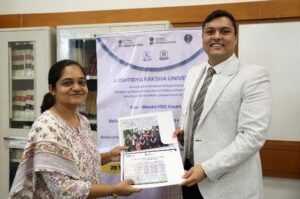
The School of Behavioural Sciences and Forensic Investigations (SBSFI), in collaboration with the International Cooperation and Relations Branch (ICRB) of Rashtriya Raksha University (RRU), successfully concluded the International Training Programme on Reformation and Rehabilitation of Offenders. The two-week programme brought together 23 participants from 15 countries, reaffirming RRU’s global commitment to correctional excellence and international cooperation in advancing humane criminal justice systems.
The inaugural session featured Dr. K. L. N. Rao, Director General of Police, Gujarat, who drew on his vast experience in correctional administration. Quoting, “All saints have a past and sinners have a future,” he emphasized that meaningful reform is possible through small, consistent efforts. Highlighting Gujarat Prisons’ initiatives—such as improving nutritional standards to enhance inmate health and reduce medical costs—Dr. Rao underlined that while a few offenders may adopt crime as a profession, the majority can be positively transformed through guided reformative interventions. His insights, drawn from his book “Gujarat Police X Factor,” set an inspiring tone for the sessions that followed.
The first lecture was delivered by Dr. S. L. Vaya, Lifetime Professor, RRU, a pioneer of forensic psychology in India. She laid the conceptual foundation for the training by emphasizing the psychological roots of criminal behaviour and the need for scientific yet compassionate correctional practices to achieve sustainable behavioural change.
Over the two weeks, participants engaged in structured modules covering reformation to rehabilitation, including empathy and emotional intelligence, anger and stress management, ethical decision-making, communication, conflict resolution, and reintegration through education, vocational training, probation, and parole. Later sessions explored human rights protection, relapse prevention, family reintegration, financial literacy, and pathways to self-reliance.
To connect classroom learning with field experience, participants visited Sabarmati and Vadodara Central Prisons, observing real-world implementation of reformative and rehabilitative programmes.
At the valedictory session, participants were awarded certificates and shared reflections on the programme’s academic rigour and practical relevance, commending RRU’s evidence-based and empathetic approach to offender rehabilitation. Many expressed interest in forging future collaborations with India in behavioural sciences and correctional reform.
Under the visionary leadership of Prof. (Dr.) Bimal N. Patel, Vice-Chancellor, Rashtriya Raksha University continues to establish itself as a global hub for education, research, and capacity-building in behavioural sciences, criminology, and correctional studies—shaping a more just, humane, and rehabilitative global society.