
NE DEFENCE BUREAU
AHMEDABAD, NOV 17
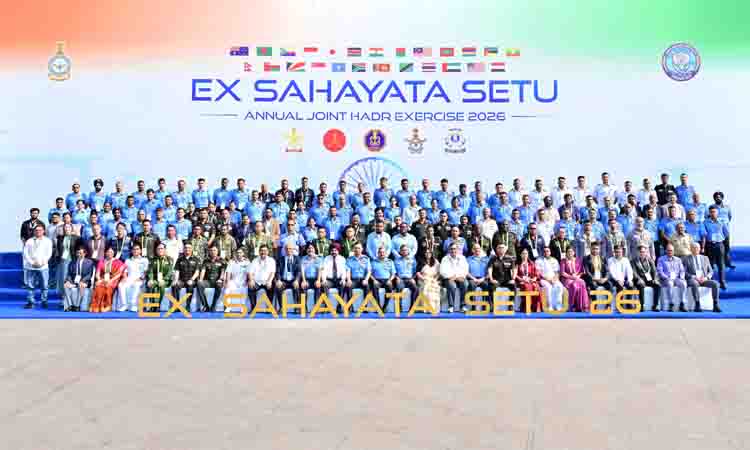
When disasters strike, national boundaries cannot constrain humanitarian responsibility. Underscoring this imperative, the Indian Defence Forces have brought together 24 friendly foreign countries and key national agencies at Air Force Station Jamnagar for Exercise Sahayata Setu 2026, a major multinational initiative to strengthen collective preparedness, operational interoperability and rapid humanitarian response across the Indian Ocean and adjoining regions.
The three-day Annual Joint Humanitarian Assistance and Disaster Relief Exercise (AJHE-26), being conducted from November 17 to 19 under the guidance of Headquarters Integrated Defence Staff (HQ IDS) and Headquarters South Western Air Command (HQ SWAC), opened with strategic deliberations on India’s expanding global humanitarian footprint, technology-driven disaster management and the need for seamless coordination among participating nations and agencies.
24 nations, one humanitarian mission: Jamnagar emerges as a regional cooperation hub
The opening-day brainstorming seminar brought together representatives of 24 friendly foreign countries associated with the Indian Ocean Rim Association (IORA), BIMSTEC and the Quadrilateral Security Dialogue (QUAD).
The participating countries are Australia, Bangladesh, Comoros, Indonesia, Kenya, Madagascar, Malaysia, Maldives, Mauritius, Mozambique, Oman, Seychelles, Singapore, Somalia, South Africa, Sri Lanka, Tanzania, Thailand, the United Arab Emirates, Yemen, Japan, the United States, Myanmar and Nepal.
The multinational participation underscored the importance of regional partnerships, shared responsibility and collective preparedness in responding to humanitarian emergencies and complex disaster situations. It also provided a platform for exchanging operational experiences and best practices in Humanitarian Assistance and Disaster Relief (HADR).
Air Marshal Shivanand calls for integrated planning and seamless coordination
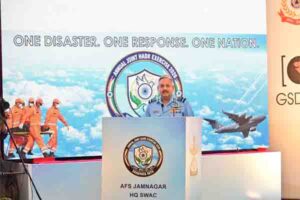
Delivering the keynote address, Air Marshal PV Shivanand, Air Officer Commanding-in-Chief, South Western Air Command, emphasised the need for integrated planning, joint capability development and seamless coordination among stakeholders to ensure swift, effective and cohesive responses to natural disasters and humanitarian emergencies.
The deliberations featured distinguished speakers from the Ministry of External Affairs, Indian Army, Indian Navy, Indian Air Force, National Disaster Response Force, disaster management agencies and Defence Research and Development Organisation.
From Operation Amistad to Sagar Bandhu: India’s growing HADR footprint in focus
A major theme of the discussions was “India’s Growing Global HADR Footprint”, supported by case studies on Operation Amistad, Operation Brahma and Operation Sagar Bandhu.
The presentations examined India’s expanding contribution to international humanitarian assistance, disaster relief and regional cooperation, highlighting the importance of preparedness, operational experience and coordinated action when disasters transcend national boundaries.
Other key themes included “Leveraging Technology to Enhance Disaster Management” and “Joint Capability Enhancement for HADR Operations”. Discussions explored emerging technologies, improved situational awareness, coordinated operational planning and interoperability among participating agencies to strengthen responses to complex disaster scenarios.
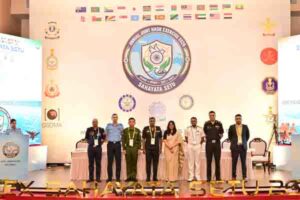
A QUAD working-level meeting was also convened during the afternoon to synchronise collective efforts towards humanitarian assistance and disaster relief.
From strategic deliberations to live disaster-response scenarios
Exercise Sahayata Setu is designed to familiarise participants with national and State-level disaster management structures, clarify inter-agency responsibilities and validate established procedures for coordinated emergency response.
The exercise will subsequently move into scenario-based activities revolving around a simulated severe cyclonic storm. The operational sequence will encompass aerial and ground reconnaissance, search and rescue, evacuation, relief operations and casualty management.
The simulated response will also involve activating emergency operation centres, establishing an incident command post, distributing relief materials and setting up relief camps.
Through this multinational initiative, the Indian Defence Forces seek to reinforce joint preparedness, advance a whole-of-government approach and strengthen India’s ability to deliver timely, coordinated and effective humanitarian assistance and disaster relief, both within the country and across the wider region.
At Jamnagar, the message is unmistakable: disaster preparedness is no longer merely a national capability; it is a shared regional responsibility.