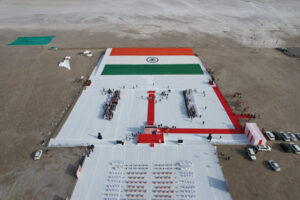
- Historic Republic Day spectacle as monumental Khadi tricolour rises at Dhordo with full military honours
- Millions of Khadi artisans salute the flag through video messages, creating a national record
- Indian Army and BSF pay ceremonial salute as Kutch’s resilience and rebirth are remembered
- 25 years after Bhuj earthquake, Kutch stands tall as a symbol of reconstruction and resolve
- KVIC honours martyr’s family and empowers artisans under Gramodyog Vikas Yojana
NE DEFENCE BUREAU
AHMEDABAD, JAN 26
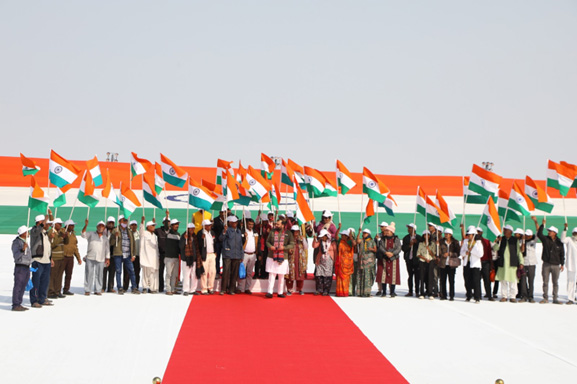
A historic confluence of patriotism, indigenous strength and national pride unfolded on the 77th Republic Day at Dhordo in the Rann of Kutch, Gujarat, where the world’s largest Khadi national tricolour was displayed in a grand and awe-inspiring ceremony.
Set against the surreal canvas of the white salt desert, the monumental tricolour—crafted from hand-spun and hand-woven Khadi, the legacy of Mahatma Gandhi—emerged as a powerful symbol of self-reliant India, unity, cultural heritage and constitutional values. The landmark event was organised by the Khadi and Village Industries Commission (KVIC) under the Ministry of Micro, Small and Medium Enterprises.
The ceremony witnessed a new national record, as millions of Khadi artisans across the country saluted the world’s largest tricolour through video messages from their homes, reinforcing the deep emotional bond between Khadi, craftsmanship and nation-building.
In a moment of profound patriotic reverence, personnel of the Indian Army and the Border Security Force installed the massive Khadi tricolour with full military honours and rendered a ceremonial salute, reaffirming the inseparable bond between India’s soldiers and its indigenous strength.
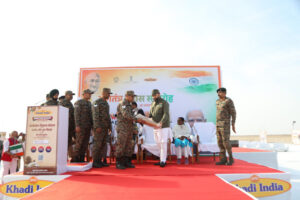
A deeply moving moment followed when the KVIC Chairman honoured Rajkumari, wife of martyr Sergeant Muralidhar of the Indian Army, on stage, paying tribute to her sacrifice, courage and service to the nation.
The event was attended by KVIC Chairman Manoj Kumar, senior officers and personnel of the Indian Army and BSF, officials of the Gujarat government, KVIC officials, local representatives and Khadi artisans. As part of the celebrations, equipment and toolkits were distributed to artisans of Gujarat under the Gramodyog Vikas Yojana, reinforcing the government’s commitment to grassroots empowerment.
Significantly, January 26, 2026, also marked the 25th year of remembrance of the Bhuj earthquake of 2001. The programme paid tribute to the victims while highlighting the indomitable spirit of Kutch, its extraordinary journey of reconstruction, resilience and development, and its transformation into a model of planned growth.
Addressing the gathering, KVIC Chairman Manoj Kumar said:
“The display of the world’s largest Khadi tricolour in the Rann of Kutch on Republic Day is a matter of pride for the Nation. This program is dedicated to the brave soldiers of ‘Operation Sindoor’. The planned redevelopment of Kutch after the Bhuj earthquake was made possible under the visionary leadership of Prime Minister Narendra Modi.”
He appealed to citizens to purchase Khadi flags from Khadi outlets and hoist them at their homes, and recalled that January 26 also marks the 25th anniversary of the Bhuj earthquake, after which Bhuj emerged as a symbol of courage, determination and planned reconstruction.
Referring to the redevelopment of Bhuj, he said the safe, organised and self-reliant city of today is a testament to visionary leadership and long-term planning, transforming adversity into opportunity. He added that Bhuj’s strategic location near the border has made it a crucial pillar of national security, symbolising the strength, resolve and confidence of new India.
Highlighting Smriti Van, he said it stands not merely as a memorial, but as a living symbol of remembrance, showing how grief can be transformed into strength and disaster into inspiration for nation-building.
The KVIC Chairman further stated that under the leadership of Prime Minister Narendra Modi, the Khadi and Village Industries sector has achieved unprecedented growth, enabling millions of artisans to become self-reliant. Over the past 11 years, KVIC has recorded significant improvements in production, marketing, design and technology, with sales crossing Rs. 1.70 lakh crore and employment generated for over 2 crore people. He highlighted the increase in artisan remuneration from Rs. 4 per hank to Rs. 15 per hank, calling it evidence of enhanced income, dignity and living standards.
The monumental Khadi tricolour, originally prepared by KVIC during Azadi Ka Amrit Mahotsav, measures 225 feet in length and 150 feet in width, weighs around 1,400 kilograms, and covers 33,750 square feet. Crafted using 4,500 metres of Khadi fabric, the flag required 3,500 extra work hours, with 70 artisans working for 49 days. The Ashoka Chakra alone measures 30 feet in diameter.
The display of this colossal tricolour at the Great Rann of Kutch stood as a stirring reminder of India’s glorious past, resilient present and confident future, with Khadi at the heart of national identity.