
- Bhupender Yadav unveils Gujarat Action Plan to build viable Great Indian Bustard population
- Plan targets 30-plus GIBs and 200–500 sq km of safe, contiguous habitat in Kachchh
- Naliya grassland restoration, predator-proof fencing and nest management gain fresh thrust
- Minister says conservation must move beyond individual species to restore entire landscapes
- Cheetah population rises to 52 as India expands protected habitat to 3,428 sq km
- Banni Grassland among ecosystems set for scientific assessment under proposed national framework
NE WILDLIFE & ENVIRONMENT BUREAU
BHUJ, SEPT 14
What if saving one of India’s most endangered birds could also mean saving an entire landscape? That question lies at the heart of India’s latest conservation push in Kachchh, where Union Environment Minister Bhupender Yadav has called for a decisive shift from protecting isolated species to restoring the ecosystems that sustain them.
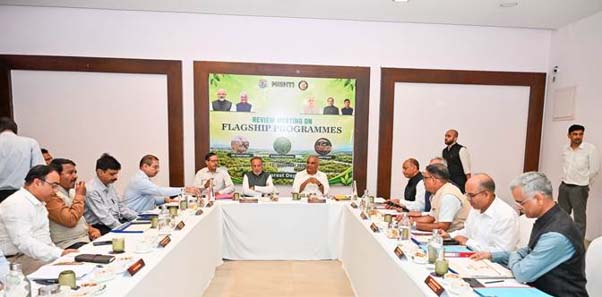
Reviewing the conservation of the Critically Endangered Great Indian Bustard (GIB), grassland restoration and Project Cheetah at Bhuj, Yadav said conservation succeeds only when entire landscapes are restored through scientific management, habitat recovery and community participation.
“Conservation must move beyond individual species to the restoration of entire landscapes,” Yadav said, stressing that India is working towards becoming a global benchmark in landscape-level conservation.
The review meeting was attended by Gujarat Cabinet Minister for Forest and Environment, Climate Change and Science & Technology Arjun Modhwadia, besides senior officials of the Union Environment Ministry, Gujarat Forest Department, Wildlife Institute of India and National Tiger Conservation Authority.
GIB gets a science-backed survival blueprint
The biggest announcement from Bhuj was the release of the Gujarat Action Plan for Great Indian Bustard Conservation, prepared by the Wildlife Institute of India in collaboration with the Gujarat Forest Department.
The plan seeks to establish a minimum viable population of more than 30 GIBs in Gujarat while securing 200–500 sq km of safe, contiguous habitat.
The immediate priority is the approximately 200-sq-km Lala–Rawa landscape, with conservation measures encompassing habitat restoration, grazing management, removal of invasive species, predator management and mitigation of infrastructure-related threats.
Kachchh supports an important but small and isolated GIB population, making habitat security crucial to the species’ long-term survival.
Naliya shows conservation on the ground
The strategy is already translating into field-level intervention.
At Naliya, around 11 sq km of grassland affected by the invasive Prosopis juliflora has been restored. A 30-km predator-proof fence has been installed around a 15-sq-km enclosure, accompanied by targeted management of nest predators.
Yadav underlined that protecting the GIB is not simply about rescuing a single bird species.
“GIB conservation is ultimately the conservation of Kachchh’s open natural ecosystems,” he said, pointing out that these landscapes also support the lesser florican, chinkara, desert cats, raptors, vultures and other specialised wildlife.
That makes the GIB an ecological indicator: when its habitat survives, an entire web of wildlife gets a chance to survive with it.
A breakthrough in the wild
A pioneering conservation intervention has also produced an encouraging result.
Under the ‘jump-start’ intervention, infertile eggs laid by wild GIB females were replaced with viable eggs from the conservation breeding programme. The chick resulting from the second such attempt has survived beyond the critical first three months in the wild, marking a significant step forward in Gujarat’s recovery efforts.
A GIB Soft Release Centre near Naliya has also been developed to house and acclimatise captive-bred birds from Rajasthan before their eventual release, subject to appropriate protocols and habitat conditions.
Grasslands move to centre stage
The Kachchh review also placed India’s grasslands firmly on the national conservation agenda.
Yadav noted that grasslands cover nearly 24% of India’s land area, yet remain among the most degraded and under-conserved ecosystems.
A proposed five-year national assessment, in collaboration with the Wildlife Institute of India, Indian Council of Forestry Research and Education and Forest Survey of India, with National CAMPA support, is expected to establish a scientific foundation for a national grassland-management framework.
The exercise will focus on mapping, ecological assessment, restoration and improved management of Open Natural Ecosystems, including Gujarat’s iconic Banni Grassland.
Cheetahs add another success story
Project Cheetah, meanwhile, is showing encouraging signs of population establishment.
According to the review, India’s cheetah population has grown from 29 founder cheetahs to 52, including 49 cubs born in India. The cub survival rate at Kuno, around 68%, was highlighted as evidence of the potential for successful population establishment under suitable ecological conditions.
Protected habitat for cheetahs has expanded to 3,428 sq km through integrated management of Kuno National Park and Gandhi Sagar.
Gujarat’s Banni Grasslands and Madhya Pradesh’s Nauradehi Wildlife Sanctuary have been identified as potential future release sites.
The next challenge, Yadav emphasised, is therefore not merely increasing numbers but creating landscapes with adequate habitat, prey base and ecological connectivity.
And that may well be the most important takeaway from Kachchh: India’s conservation future cannot be built species by species, fence by fence or sanctuary by sanctuary. It has to be built by restoring the landscapes on which entire ecological communities depend.