A travelling exhibition that bridges tantra, temple memory and contemporary feminist thought
- 81-day, 16-state art pilgrimage culminates in a powerful Ahmedabad showcase
- Beena S Unnikrishnan reimagines Yoginis as archetypes of courage, consciousness and inner awakening
- 64 original canvases, a new book and a documentary create a multi-layered immersive experience
- On view at Hutheesing Visual Art Gallery till February 13 before continuing its 10,000-km national trail
R MANICKAVASAGAM
AHMEDABAD, FEB 11
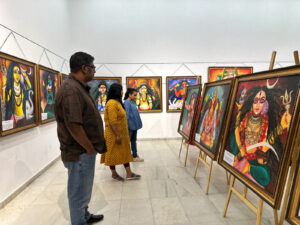
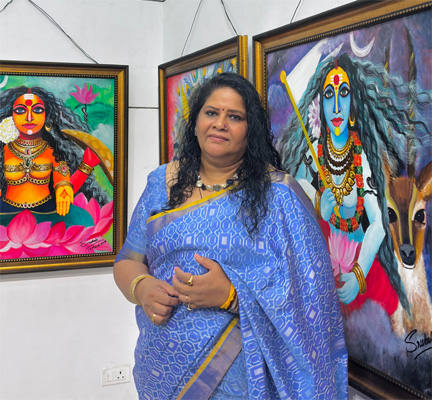
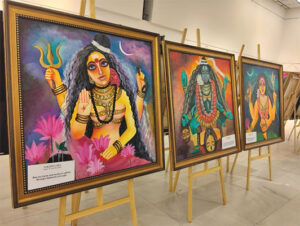
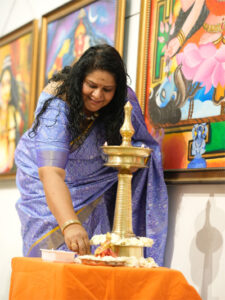
In a luminous convergence of art, archaeology and awakening, contemporary artist Beena S Unnikrishnan has brought her acclaimed travelling exhibition “Ekaa – The One: The 64 Yoginis Trail” to Ahmedabad, transforming the Hutheesing Visual Art Gallery into a sanctum of living Shakti.
Part of an ambitious 81-day, 16-state national tour, the exhibition features 64 original paintings that reinterpret India’s ancient Yogini goddesses for a contemporary feminist and spiritual discourse. Open for three days until February 13, the Ahmedabad chapter marks a significant cultural pause in a journey that has already traversed cities including New Delhi, Kochi, Coimbatore, Bengaluru, Mumbai and Bhopal since its launch on December 4, 2025.
Beyond Ritual: Yoginis as Living Energies
Rather than presenting the Yoginis as ritual icons frozen in stone, “Ekaa – The One” repositions them as living, breathing energies of Shakti—embodying 64 dimensions of knowledge, consciousness and inner power.
The exhibition unfolds as an immersive environment, where each canvas is both autonomous and interconnected, forming a mandala of feminine strength that speaks as much to modern psychology as to ancient tantra.
“The Yoginis are not relics of a forgotten past. They are energies that continue to move through us,” says Beena S Unnikrishnan. “Through Ekaa, I wanted to shift the gaze—from worshipping the feminine outside to awakening it within.”
A Decade-Long Pilgrimage
The project is rooted in a decade-long artistic and spiritual quest that began in 2015. Beena travelled extensively to significant Yogini temple sites—Hirapur in Odisha, Morena in Gwalior, Bhedaghat in Madhya Pradesh and Khajuraho—studying temple histories, mythological narratives and, in her words, “the subtle vibrations that linger in sacred spaces.”
Instead of replicating sculptural forms, she developed intuitive, meditative interpretations that blur the boundaries between the human and the divine. Her Yoginis emerge with expressive eyes, flowing hair and poised intensity—serene yet unyielding.
“I did not want to copy the sculptures,” she explains. “I wanted to listen to them. Each Yogini revealed herself through silence, travel and contemplation.”
Feminine Archetypes for Modern Times
Figures such as Gauri, associated with renewal and transformation; Charchika, fierce protector of truth and courage; and Bhadrakali, who cuts through ignorance, are rendered as psychological and spiritual archetypes for contemporary viewers navigating uncertainty and change.
The canvases emphasise qualities of protection, transformation, resilience and awakening, situating the Yoginis within a larger discourse on reclaiming India’s feminine heritage and rebalancing masculine–feminine energies.
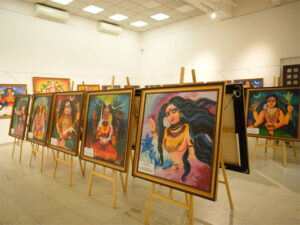
“In today’s world, we urgently need a rebalancing of energies,” Beena reflects. “The Yoginis represent not aggression, but conscious power—strength rooted in wisdom.”
Art as Cultural Reclamation
Ahmedabad, with its vibrant cultural history and deep engagement with spiritual traditions, forms a meaningful node in this 10,000-km journey. The exhibition’s conceptual arc extends beyond aesthetics into intellectual and political terrains, inviting viewers to reconsider how India’s sacred feminine legacy has been remembered—or forgotten.
By presenting all 64 canvases together, Beena constructs not merely an art show, but a moving shrine of consciousness, where myth becomes metaphor and heritage becomes living dialogue.
Book and Documentary: Extending the Experience
The exhibition is accompanied by Beena S Unnikrishnan’s book, “Whispers of the Unseen: The Quest for Sixty-Four Yoginis,” which chronicles both the outer temple travels and the inner transformation behind the paintings, weaving mythology with memoir.
Visitors can also experience previews of the 65-minute documentary “Y64 – Whispers of the Unseen,” directed by Jain Joseph, capturing the artist’s pilgrimage, process and philosophical reflections.
Following Ahmedabad, “Ekaa – The One” will continue to Jaipur, Delhi, Gwalior, and conclude its expansive tour in April.
As viewers step out of the gallery, the impression lingers—not of 64 separate goddesses—but of one unified presence. Ekaa. The One.