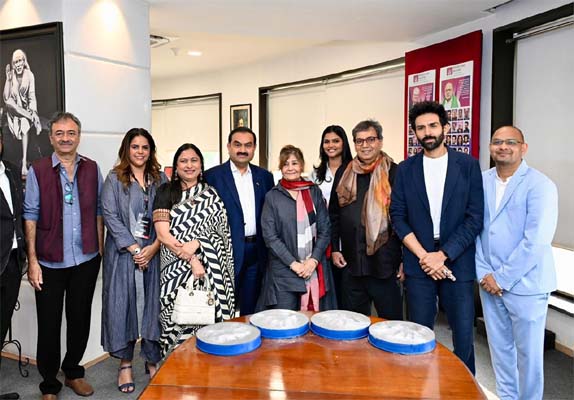
- At Whistling Woods, Gautam Adani urges young creators to shape Bharat’s narrative with authenticity and courage in an AI-driven world
- Never again will the story of any Indian Mahatma be written through the lens of a foreigner. Never again will our sorrow of slums be sold as a spectacle to foreign markets. It is time to write our own story — our way: Gautam Adani
- When intelligence can mimic emotion and algorithms can shape meaning, who will guard the truth? That duty must be yours: Adani to students
R MANICKAVASAGAM
MUMBAI, OCT 10
“Silence is not humility; it is surrender. If we do not narrate who we are, others will rewrite who we were.”

With this stirring declaration, Gautam Adani, Chairman of the Adani Group, set the tone for one of the most powerful speeches of his public life — a cinematic reflection on storytelling, nationhood, and the power of narrative — delivered at Whistling Woods International, Mumbai.
Adani’s address, titled “Jeena Yahan, Marna Yahan: The Cinematic Soul of Nation-Building”, wasn’t about business or infrastructure. It was about identity — India’s identity — and how the world perceives it. Speaking before filmmakers, students, and industry veterans, including Subhash Ghai and Rajkumar Hirani, Adani called upon India’s creative generation to reclaim the country’s story from foreign hands.
“For too long, India’s voice has been firm within our borders but faint beyond them,” Adani said. “And in that silence, others have lifted the pen, sketching Bharat through their lenses tinted by bias and shaped by their convenience.”
He pointed to films like Gandhi and Slumdog Millionaire — stories of India told through Western eyes — as examples of “cultural outsourcing.” “Our sorrow has become their spectacle,” he said, adding that India must now own its cinematic narrative “not with arrogance, but with authenticity.”
‘Narratives Move Markets Faster than Numbers’
In a rare moment of introspection, Adani turned to his own experience — the 2023 Hindenburg short-seller episode — to illustrate the dangers of narrative warfare.
“In a matter of days, over USD 100 billion of our market value was erased, not because fundamentals had changed, but because a false story had been weaponised,” he said. “It showed me that we now live in an era where headlines can undo decades of hard work — where stories of truth trail stories of perception.”
He described the episode as a turning point — both for his conglomerate and for himself — underscoring his belief that truth must also be loudly told in the age of algorithmic amplification.
Storytelling as Statecraft: Cinema as Power
Adani’s most striking insight came when he compared American cinema to strategic diplomacy. “When America promotes Top Gun, it’s not just selling cinema; it’s projecting power,” he said. “Behind the dogfights and heroism lies a crafted narrative — one that showcases national pride, the might of the US military, and defines American identity.”
He listed Rocky, Apollo 13, and American Sniper among films that “conquer mindshare” even as soldiers conquer land. “Each film projects not just America’s might, but also its moral authority,” he observed — urging Indian creators to wield similar narrative power with purpose.
Cinema Meets AI: The Next Great Revolution
Turning to the future, Adani painted a vivid picture of AI-powered storytelling, predicting that artificial intelligence will collapse the cost of filmmaking by up to 80% and democratise creativity:
“The next great unlocking of human potential will not come from what we discover — but from what we dare to create,” he said.
He envisioned a near future of:
- Instant global releases in every language,
- AI-composed music and adaptive scripts,
- Hyper-personalised storytelling, where heroes mirror the viewer, and
- Immortal actors, whose digital selves live across generations.
But he cautioned that this power must be handled responsibly.
“When intelligence can mimic emotion and algorithms can shape meaning, who will guard the truth? That duty must be yours,” he told students, urging them to be “the sutradhars of Bharat’s digital future.”
Owning India’s Story, One Frame at a Time
Blending poetry, patriotism, and pragmatism, Adani closed his address with a call to artistic arms: “Never again will the story of any Indian Mahatma be written through the lens of a foreigner. Never again will our sorrow of slums be sold as a spectacle to foreign markets. It is time to write our own story — our way.”
He ended with a promise to the next generation: “May your generation give Bharat her voice back, her song back, and her stories back. Because while soldiers defend borders, storytellers defend identity.”
As the auditorium rose in applause, Adani had done what few industrialists dare — turn a corporate titan’s narrative into a nation’s moral compass.