R ARIVANANTHAM
CHENNAI, DEC 10
SIMS Hospitals from SRM Group of Institutions has performed India’s first endoscopic keyhole removal of a left ventricular heart tumour, marking a breakthrough in minimally invasive cardiac surgery. The one and half hour procedure avoided the conventional sternotomy—where the chest bone is cut open—and instead used an advanced endoscopic approach to remove an extremely rare tumour lodged inside the heart’s main pumping chamber of a 45-year-old working woman.
- Minimally invasive endoscopic cardiac surgery replaces the need for open-chest sternotomy
- Tumour removed from heart’s main pumping chamber—an occurrence seen in just 1 in 20–30 million people
- Tiny 3 cm access ensures faster recovery, less pain and no prominent chest scar
- SIMS team completes breakthrough procedure using advanced endoscopic guidance and precision tools
- Patient returns to normal life within two weeks after this landmark medical feat
The patient, a working professional, was incidentally found to have a mass attached to the left ventricle. Cardiac MRI confirmed a left ventricular mass/thrombus measuring 1.6 × 1.5 cm. Primary cardiac tumours account for only 0.6% of all cardiac surgeries, and a tumour in the left ventricle is exceptionally rare—occurring in only one in 20–30 million people.
While such cases are typically treated through open-heart surgery, the SIMS cardiac team opted for a minimally invasive endoscopic procedure. Through small inter-rib openings, surgeons accessed the heart chamber, navigated with endoscopic visualisation and successfully removed the tumour, preventing further complications such as stroke.
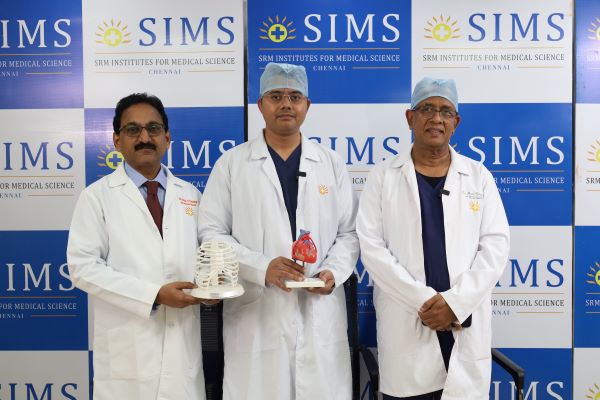
The surgery was performed by Dr A. Mohammed Ibrahim, Consultant – Cardiothoracic Surgery, under the guidance of Dr V. V. Bashi, Director & Senior Consultant – Institute of Cardiac & Advanced Aortic Diseases. The team used specialised minimally invasive instruments along with endoscopic guidance to ensure precision and safety.
Congratulating the team, Dr Ravi Pachamuthu, Chairman, SIMS Hospital, said: “This success reflects the strength of our clinical environment, the sophistication of our endoscopic capabilities and infrastructure, and above all the dedication and precision of our team. Together, we continue to uphold the highest standards of care and deliver hope and healing when it matters most.”
Explaining the rare nature of the condition and the procedure, Dr V. V. Bashi said: “Left ventricular mass is a rare condition, and performing its removal through a minimally invasive technique is exceptionally uncommon in the world. It is done for the first time in India. The patient was under general anesthesia and placed on heart-lung machine support through the blood vessels in the right groin. Through a tiny 3 cm incision, right chest cavity was approached. Right lung was collapsed, after the patient was initiated on heart-lung machine support. Heart was stopped and chambers of the heart were opened. Endoscope was used to visualise the main pumping chamber and the tumour was excised completely. The chambers were closed and the heart was allowed to beat. The patient was gradually weaned off the heart-lung machine. She is now completely normal and has resumed her routine work without any discomfort in two weeks.”
Highlighting the advantages of the keyhole technique, Dr Mohammed Ibrahim said: “Cardiac surgery generally involves cutting through the central sternal bone, which increases pain, hospital stay and the risk of morbidities. However, endoscopic cardiac surgery is an advanced minimally invasive approach that enables faster recovery while reducing pain and blood loss. It also avoids a prominently visible scar in the middle of the chest after surgery. Endoscopic assistance further enhances precision and allows us to access areas that may not otherwise be easily reachable. We have already performed five such cases with a 100% success rate. We also use minimally invasive approaches to treat other cardiac conditions such as coronary artery disease, valvular heart disease, septal defects of the heart, and mediastinal tumours. About 90% of cardiac tumours happen due to random changes in the heart’s cells, with no clear reason. The remaining 5–10% occur in people who have a genetic tendency to develop these tumours.”
Dr Raju Sivasamy, Vice President, Medical and Senior Consultant, SIMS Hospital said: “This landmark medical achievement reinforces SIMS Hospitals’ leadership in advanced cardiac procedures and ushers in a new era of minimally invasive interventions for rare and complex heart conditions.”