- A Millennium Since 1026, Somnath Stands as India’s Eternal Answer to Destruction
- From Ruins to Revival, the Jyotirlinga That Refused to Fall
- Prime Minister Modi Leads a Nation in Reaffirming Civilisational Self-Respect
GOWRI MANICKAVASAGAM
AHMEDABAD, JAN 10
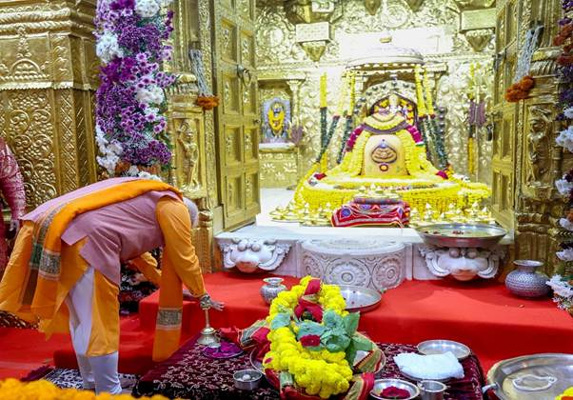
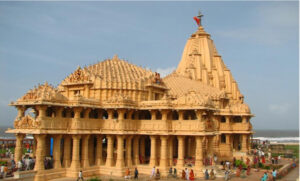
Standing on the sacred shores of Prabhas Patan, where the Arabian Sea meets India’s spiritual memory, Somnath Temple rises not merely as an architectural marvel, but as a timeless declaration of faith, resilience and civilisational pride. The Somnath Swabhiman Parv (8–11 January 2026) marks a defining milestone — one thousand years since the first recorded attack on the Somnath Temple in 1026 — not as a moment of mourning, but as a collective affirmation of India’s unbroken spiritual consciousness.
Mentioned first among the Dwadasha Jyotirlingas in the sacred verse
“सौराष्ट्रे सोमनाथं च…”,
Somnath occupies the very foundation of Bharat’s spiritual geography. Located near Veraval in Gujarat, the temple has for centuries drawn the prayers of millions, even as it endured repeated attempts at annihilation. What survived each onslaught was not stone alone, but a faith that refused to surrender.
Swabhiman Parv: Remembering Resilience, Not Ruin
The Somnath Swabhiman Parv is a national commemoration of endurance — a tribute to the civilisational spirit that rebuilt Somnath every time it was broken. Organised from 8 to 11 January 2026, the observance reflects a conscious shift from remembering destruction to celebrating resilience, revival and self-respect.

The year 2026 also marks 75 years since the present Somnath Temple was reopened on 11 May 1951, following India’s Independence. These twin milestones — a millennium since desecration and seven-and-a-half decades since restoration — form the spiritual axis of the Swabhiman Parv.
Throughout the four days, Somnath has transformed into a vibrant centre of devotion and reflection. The 72-hour Akhand Omkar chanting, devotional music, spiritual discourses and cultural programmes together symbolise unity, continuity and collective faith.
A Thousand Years of History, A Timeless Soul
The spiritual roots of Somnath stretch deep into antiquity. According to tradition, Chandra, the Moon God, worshipped Lord Shiva at Prabhas Tirtha and was relieved of his curse, lending immense sanctity to the site. Over centuries, Somnath witnessed multiple reconstructions, each reflecting renewal and devotion.
The most turbulent phase began in January 1026, with the first recorded attack by Mahmud of Ghazni. What followed was an unparalleled historical cycle — repeated destruction followed by unwavering reconstruction. Somnath never vanished from the collective consciousness of the people; it endured as a living symbol of identity and belief.

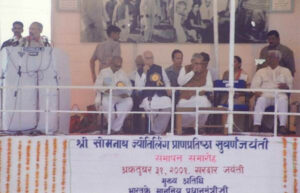
On 12 November 1947, Diwali day, Sardar Vallabhbhai Patel visited the ruins and resolved to rebuild Somnath as an assertion of India’s cultural confidence. The reconstruction, supported by public participation and national resolve, culminated in the consecration of the present temple on 11 May 1951, in the presence of President Rajendra Prasad. It marked the rebirth not just of a shrine, but of civilisational self-respect.
Living Heritage of Faith and Grandeur
Revered as the first Aadi Jyotirlinga of Lord Shiva, the Somnath Temple today stands majestic beside the sea. Its 150-foot shikhar, crowned by a 10-tonne kalash, the 27-foot dhwajdand, 1,666 gold-plated kalash, and 14,200 dhwajas together narrate centuries of devotion and craftsmanship.
Somnath remains a living centre of worship, drawing 92–97 lakh devotees annually. Nearly 98 lakh pilgrims visited in 2020, while rituals like Bilva Pooja attract over 13.77 lakh devotees. Maha Shivratri 2025 alone witnessed 3.56 lakh pilgrims.
Cultural initiatives such as the Light and Sound Show, enhanced with 3D laser narration, and the Vande Somnath Kala Mahotsav, have revived traditions dating back nearly 1,500 years, connecting history with living devotion.
Women, Sustainability and Sacred Stewardship
Declared a Swachh Iconic Place in 2018, Somnath exemplifies sustainable temple governance. Floral waste is converted into vermicompost nurturing 1,700 Bilva trees. Plastic waste is transformed into 4,700 paver blocks monthly under Mission LiFE. Rainwater harvesting treats 30 lakh litres of sewage water per month, while a Miyawaki forest of 7,200 trees absorbs nearly 93,000 kg of CO₂ annually.
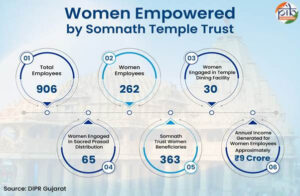
Equally striking is Somnath’s role in women empowerment. Of 906 employees, 262 are women, with 363 women earning livelihoods through temple activities — from Bilva Van management to prasad distribution and dining services — generating nearly ₹9 crore annually.
Prime Minister Modi’s Participation: A National Moment
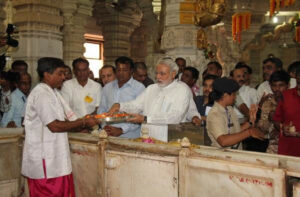
The Swabhiman Parv gains national resonance with Prime Minister Narendra Modi’s visit on 10–11 January 2026. On 10 January, the Prime Minister participates in the Omkar Mantra chanting and witnesses the drone show, symbolising spiritual continuity and modern expression.
On 11 January, he leads the Shaurya Yatra, representing courage, sacrifice and the indomitable spirit that preserved Somnath through centuries of adversity, before offering prayers and addressing the gathering on the temple’s civilisational significance.
Conclusion: Faith That Time Could Not Break
Somnath Swabhiman Parv is a declaration — that faith rooted in righteousness, unity and self-respect outlives destruction. As the Prime Minister shared, the ancient verse reminds humanity that Prabhas Kshetra is a land where spiritual perfection and liberation are attained.
Standing tall on Saurashtra’s shores, Somnath continues to tell the world that while forces of destruction fade into history, civilisations anchored in faith endure forever.