R ARIVANANTHAM
CHENNAI, NOV 25

In a landmark achievement for transgender health care in Tamil Nadu, SRM Prime Hospital has successfully performed a pioneering endoscopic procedure using a bovine pericardial patch to close a rare and highly complex recto-neovaginal fistula in a 22-year-old transgender woman. The condition, which caused passage of stool and flatus through the surgically created neovagina, is seen in only about 1% of gender-affirming surgeries globally—and is seldom managed without major abdominal intervention.
- First in Tamil Nadu to close rare recto-neovaginal fistula using bovine pericardial patch
- Minimally invasive endoscopic innovation saves patient from major surgery
- Dual-Endoscopist Technique marks a new milestone in gender-affirming care
- Doctors hail it as a safe, affordable, day-care solution for a highly complex condition
By using a minimally invasive, day-care endoscopic technique, the hospital has averted the need for an extensive open abdominal surgery, offering timely, affordable, and advanced care to the young patient who comes from an economically disadvantaged background.
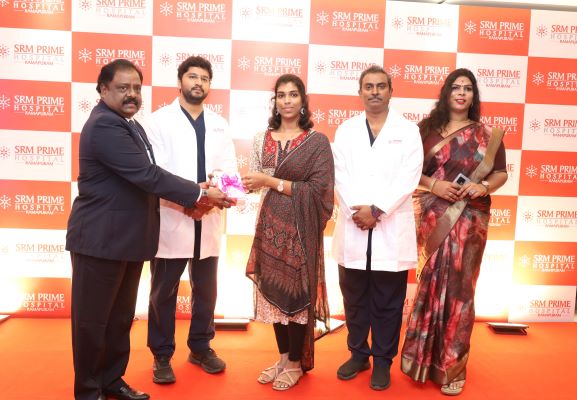
The groundbreaking procedure was led by Dr. Arulprakash S., Clinical Lead & Senior Consultant, and Dr. Tarun J. George, Senior Consultant, Medical Gastroenterology and Hepatology, under the guidance of Dr. C. Paul Dilip Kumar, Director – Medical Services, SRM Prime Hospital.
“A Rare and Challenging Case—Managed with Precision, Innovation and Compassion”
Explaining the critical nature of the case, Dr. Arulprakash said: “The patient had undergone gender-affirming surgery elsewhere and soon developed a recto-neovaginal fistula. Such fistulas in transgender patients are rare complications, occurring in only about 1% of cases. An endoscopic clip was placed earlier, but the relief was temporary. This was a rare and challenging clinical situation.”
Describing the innovative decision that shaped the outcome, he added:
“An open abdominal surgery was considered the only option at that point. But when she came to us, we chose to attempt an endoscopic closure using a novel bovine pericardial patch—the first such procedure in Tamil Nadu. The patch acts as a biological scaffold, helping tissues close naturally. Two endoscopists had to work simultaneously, a capability not available in many centres. With this approach, we avoided major surgery entirely. She is recovering well and is very satisfied with the outcome.”
How the Procedure Was Performed: A First-of-Its-Kind Endoscopic feat
Detailing the technical steps, Dr. Tarun J. George said: “A contrast CT scan helped us confirm the exact size and position of the fistula. We used argon plasma coagulation to prepare the site by gently roughening the tissue surface. Next, we introduced the bovine pericardial patch inside the tract and secured it using a 14 mm over-the-scope clip. This sealed the opening and anchored the patch firmly.”
He emphasised the procedure’s patient-friendly nature: “This minimally invasive method prevented a major, complex operation. The patient was discharged the same day—walking out of the hospital. She only needs a week of rest, a short antibiotic course and stool softeners for three months.”
A Major Milestone in Gender-Affirming Health Services
The success of this case highlights the advancing medical expertise in transgender health care in India—particularly in managing post-surgical complications with dignity, innovation and empathy.
SRM Prime Hospital’s achievement establishes a new benchmark for:
- Minimally invasive management of complex post-GAS complications
- Novel use of bovine pericardial patches in endoscopic closure
- Dual-endoscopist precision techniques rarely available across India
- Affordable, patient-centric care for marginalised communities
With this breakthrough, SRM Prime Hospital reinforces its position as a centre of excellence in gastroenterology, endoscopic innovation and inclusive health care—offering hope and healing to transgender patients across the region.