
R ARIVANANTHAM
CHENNAI, JAN 4
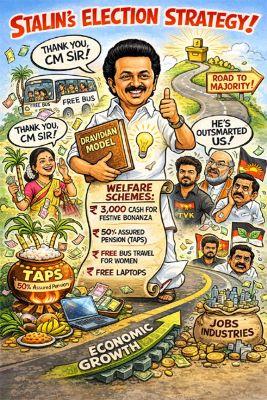
As Tamil Nadu enters a decisive Assembly election year, Chief Minister M K Stalin has stitched together a high-impact political strategy that blends women-centric welfare, social security, youth empowerment and economic realism—a governance narrative aimed at overcoming a multi-cornered contest involving the BJP’s aggressive expansion under Amit Shah, actor Vijay’s emerging TVK, and the AIADMK led by Edappadi K Palaniswami.
- From pensions to Pongal cash, a governance script built for a multi-cornered battle
- Women-centric schemes set the national template, even BJP states follow
- Jobs, industrialisation and fiscal prudence anchor welfare with stability
- Why the Dravidian Model outperforms Gujarat, Uttar Pradesh and the Centre
- Visionary governance counters BJP surge, TVK curiosity and AIADMK legacy
What distinguishes this strategy is not mere electoral timing, but policy continuity with expansion, firmly rooted in the Dravidian model of inclusive development—a model now influential enough to be replicated by BJP-ruled and alliance-partner states.
Pongal Bonanza: Universal Welfare with Cultural Resonance
ஒவ்வொரு இல்லத்திலும் மகிழ்ச்சி பொங்கும் தைப் பொங்கல்!
உள்ளத்தில் பொங்கும் மகிழ்ச்சி இல்லத்தில் கொண்டாட்டமாக நிறைய, தமிழ்நாட்டிலுள்ள 2 கோடியே 22 லட்சத்து 91 ஆயிரத்து 710 அரிசி பெறும் குடும்ப அட்டைதாரர்களுக்கும் பொங்கல் பரிசுத்தொகுப்புடன் ரூ.3000 வழங்குகிறது நமது #DravidianModel… pic.twitter.com/hg6YCtVrHo
— M.K.Stalin – தமிழ்நாட்டை தலைகுனிய விடமாட்டேன் (@mkstalin) January 4, 2026
Ahead of Pongal, the Stalin government announced a ₹3,000 cash assistance for nearly 2.23 crore rice ration card holders, including families in Sri Lankan Tamil rehabilitation camps, in addition to the traditional Pongal gift hamper.
With an expenditure of ₹6,936.17 crore, the initiative underscores DMK’s ability to combine scale, speed and sensitivity, ensuring benefits reach households before the festival through an efficient public distribution system. Politically, it reinforces DMK’s connect with women, who are often the primary managers of household finances and festival planning.
Women at the Core of the Dravidian Model
Women-centric governance has emerged as one of Stalin’s strongest political pillars.
The free bus travel scheme for women, launched soon after the DMK assumed office, transformed mobility for working women, students and informal sector workers. The scheme not only boosted workforce participation but also increased household savings—an impact so visible that multiple BJP-ruled and NDA partner states have since introduced similar women travel concessions, acknowledging Tamil Nadu’s policy leadership.
Likewise, the Kalaignar Magalir Urimai Thogai—monthly financial assistance to women heads of households—has provided direct economic agency, strengthening women’s decision-making power at home. Variants of direct benefit support to women have since appeared in states governed by the BJP and its allies, often without acknowledging their Tamil Nadu origin.
These measures have quietly but decisively reframed women as economic stakeholders rather than passive beneficiaries, a distinction that gives the DMK a decisive edge among women voters.
TAPS: Social Security as Political Consolidation
The Tamil Nadu Assured Pension Scheme (TAPS), guaranteeing 50% of last drawn salary as assured pension, further cements Stalin’s welfare architecture. Backed by full state funding beyond employee contributions, indexed Dearness Allowance, family pension and gratuity provisions, the scheme addresses a 23-year-old demand of government employees and teachers.
Read Also:
TN Govt Unveils Assured Pension Scheme, Ending 20-Year Struggle of Employees
Employee unions such as JACTO-GEO have hailed the announcement as historic, while allies and Left parties see it as proof of governance credibility. In contrast to the market-linked NPS and Central UPS models, Tamil Nadu’s assured pension offers predictability and dignity—values that resonate deeply with middle-class families.
Youth, Technology and the Future Electorate
Reinforcing long-term thinking, the revival of the ‘Ulagam Ungal Kaiyil’ free laptop scheme—with nearly 20 lakh high-configuration laptops—signals a renewed focus on digital inclusion, employability and education.
Tamil Nadu’s early adoption of free laptops has already benefitted over 52 lakh students, and the upgraded specifications underscore the state’s refusal to compromise on quality. This future-oriented approach contrasts sharply with personality-driven politics elsewhere.
Comparative Advantage: Tamil Nadu vs BJP-Ruled States
Stalin’s campaign pitch draws strength from comparative governance outcomes:
- Gujarat prioritises capital-intensive industrial growth but lags in social security coverage and gender-focused welfare.
- Uttar Pradesh has expanded welfare delivery but remains uneven in human development indicators and women’s workforce participation.
- Tamil Nadu, by contrast, balances industrialisation, job creation, women’s empowerment and fiscal discipline, resulting in stronger social outcomes and economic resilience.
The irony is not lost on political observers: many BJP-ruled states now replicate Tamil Nadu’s women-focused schemes, even while criticising the Dravidian model politically.
A Clear Path Through a Crowded Field
With BJP pushing ideological mobilisation, TVK banking on celebrity appeal, and AIADMK seeking revival through legacy politics, Stalin’s strategy rests on performance legitimacy.
By placing women at the centre, securing employees through pensions, empowering youth digitally, and sustaining economic momentum, the DMK is crafting a narrative of trust, stability and proven delivery.
In a fragmented electoral battlefield, coherence becomes the decisive weapon. And Stalin’s governance playbook—rooted in the Dravidian model—positions the DMK not just to withstand the challenge, but to return with a clear majority, powered by policies that others now seek to imitate.