R ARIVANANTHAM
CHENNAI, FEB 11
India’s first bullet train corridor is no longer just a mobility project — it is a nation-building exercise in steel, systems and skills. The 508-km Mumbai–Ahmedabad High Speed Rail (MAHSR) Project, under execution with technical and financial assistance from the Government of Japan, is laying the technological, manufacturing and operational foundation for India’s future high-speed rail (HSR) network.
Mumbai-Ahmedabad Bullet Train Project Experience Lays a Strong Foundation for India’s Future High-Speed Rail Network
🔶Indigenisation of Heavy Construction Machinery, Homegrown Slab Track Components and Specialized Track Machines Boosts India’s Domestic Manufacturing… pic.twitter.com/u0JLWTN3YY
— PIB India (@PIB_India) February 11, 2026
Planned entirely on elevated viaducts with state-of-the-art safety architecture, MAHSR is transforming India’s infrastructure DNA — from indigenised heavy construction machinery and slab track systems to advanced seismic safeguards and simulation-led traction design.
- From Japan-Backed Precision to Indigenous Power, the Mumbai–Ahmedabad High-Speed Rail Project Becomes India’s Launchpad for a National Bullet Train Grid
- 508 km MAHSR Corridor Turns Technology Transfer into Manufacturing Muscle
- 1,000 Indian Engineers Trained in Japanese Methodology; IIT-Led Innovation Powers Design Evolution
- High-Frequency Operations, Competitive Fares and Seismic-Ready Engineering Define Future Mobility
- 406 Freight Trains Daily on Dedicated Corridors Free Up Conventional Rail Capacity
- ₹86,939 Crore Invested; Land, Clearances and 17 River Bridges Completed as Under-Sea Tunnel Advances
Engineering the Future: Indigenisation & Capacity Building
Watch the latest progress update on the Mumbai–Ahmedabad Bullet Train Project#BharatKaGarv pic.twitter.com/Lanadwm0A5
— NHSRCL (@nhsrcl) February 5, 2026
The project is catalysing domestic manufacturing and deep technical capability:
- Long-span steel truss girders are being fabricated in Indian workshops, backed by analytical modelling and field measurements — strengthening domestic HSR design expertise.
- Heavy construction machinery used for full-span launching has been indigenised and is now manufactured in India.
- Slab track materials and specialised track machines are largely being produced by Indian manufacturers.
- Dynamic analysis and design variations are being handled by Indian agencies in collaboration with IITs, supported by advanced modelling tools and design charts — embedding long-term HSR capability within the country.
The knowledge transfer from Japan’s Shinkansen ecosystem is equipping Indian engineers to independently plan and execute future high-speed corridors.
First-in-India Innovations
MAHSR is also a laboratory of infrastructure innovation:
- Full-span launching method, adopted for the first time in India, enables 40-metre prestressed box girders (approximately 1,000 metric tonnes) to be launched within 16 hours — dramatically improving construction speed.
- Indigenous noise barriers are being installed along the elevated corridor to reduce impact on nearby communities.
- Advanced OHE-pantograph interaction simulation tools and a traction power supply simulation model have been developed with IIT Delhi for precision engineering.
- An underground station engineered to support a future 90-metre building demonstrates integrated urban planning foresight.
- An indigenously developed Rail Turnover Prevention Device (RTPD) enhances derailment safety.
Skill Transfer at Scale
Approximately 1,000 Indian engineers and skilled workers have been trained in Japanese methodology. Track works are now being executed under their supervision.
A Special Track Training Facility in Surat ensures continuous upskilling and refresher programmes — institutionalising high-speed rail expertise within India.
Stations as Smart, Secure City Gateways
The 12 stations — Mumbai, Thane, Virar, Boisar, Vapi, Billimora, Surat, Bharuch, Vadodara, Anand, Ahmedabad and Sabarmati — are being designed as modern gateways reflecting local identity.
Key features include:
- Controlled entry points, baggage scanners, Door Frame Metal Detectors and Closed-Circuit Television surveillance
- Anti-vibration systems, wind-pressure management in roofing and embedded structural dampers
- Seamless multimodal connectivity aligned with city master plans
- Sustainable, energy-efficient design aligned with Indian Green Building Council (IGBC) Platinum standards
Seismic Safety & Geo-Technical Precision
Given the corridor’s seismic exposure, structures are designed to international standards and validated by a Japanese High-Level Committee.
- Geo-Technical Investigations have been conducted at 100-metre intervals, closer for special structures.
- A new geo-tech laboratory has been established.
- Viaducts and bridges incorporate steel and damper stoppers to prevent dislodgement.
- An Earthquake Early Warning System (EQEWS) will provide real-time alerts.
Project Progress: Gujarat Leads, Maharashtra Accelerates
Land Acquisition: 1,389.5 hectares fully acquired.
Utilities Shifted: 1,651 completed.
Statutory Clearances: All obtained.
Gujarat Progress
- Foundation: 352 km
- Piers: 352 km
- Girder Casting: 342 km
- Girder Launching: 331 km
- Track Bed Construction: 152 km
- OHE Mast Erection: 121 km
Maharashtra Progress
- Foundation: 74 km
- Piers: 65 km
- Girder Casting: 9 km
- Girder Launching: 3 km
Foundation works are completed at eight stations — Vapi, Billimora, Surat, Bharuch, Anand, Vadodara, Ahmedabad and Sabarmati. In Maharashtra, foundation works are underway at Thane, Virar and Boisar. Excavation at the Bandra Kurla Complex (BKC) station is nearing completion, with base slab casting commenced.
River Bridges: 17 completed; major bridges across Narmada, Mahi, Tapti and Sabarmati are at advanced stages.
Depots: Thane, Surat and Sabarmati under active construction.
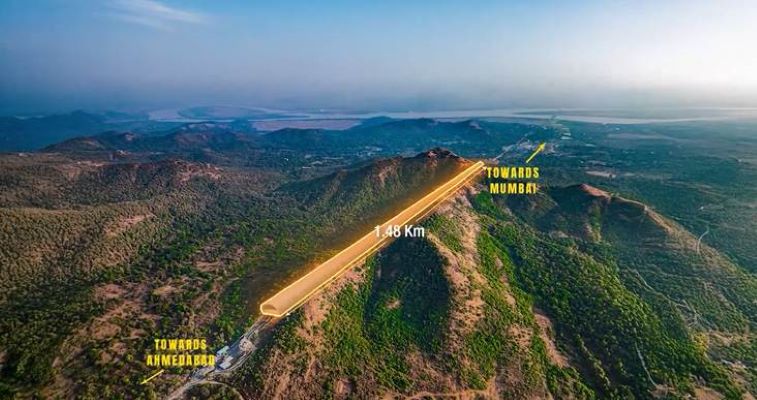
At BKC, excavation has reached 91% completion. Basement slab at Level-4 is complete. The 21-km under-sea tunnel has commenced, with 4.8 km completed between Ghansoli and Shilphata.
Make in India: Next-Gen Trainsets
Building on the success of Vande Bharat, Integral Coach Factory (ICF), in collaboration with Bharat Earth Movers Limited (BEML), is designing and manufacturing high-speed trainsets with a design speed of 280 kmph — marking India’s transition toward indigenous high-speed rolling stock capability.
Designed for Viability & Volume
The MAHSR corridor is engineered for high-frequency operations with significant passenger-carrying capacity. Ticket pricing is proposed to remain competitive with existing rail and air travel.
Project viability has been assessed on long-term economic benefits — factoring in passenger demand, time savings, productivity gains and regional development multipliers.
Total expenditure incurred till 31.12.2025 stands at ₹86,939 crore.
Freight Corridors: Unlocking Network Capacity
Parallel to the bullet train corridor, India’s Dedicated Freight Corridors (DFC) are reshaping logistics:
- Eastern DFC (1,337 km): Fully commissioned
- Western DFC (1,506 km): 1,404 route km commissioned; remaining 102 km underway
Constructed at a cost of ₹1,24,005 crore, these corridors now run 406 trains daily, diverting freight traffic away from passenger routes and unlocking substantial capacity on the conventional rail network.
This information was provided by the Union Minister for Railways, Information & Broadcasting and Electronics & Information Technology, Ashwini Vaishnaw, in a reply to questions in Lok Sabha on Wednesday.