- 180 girls from underserved communities experience science beyond textbooks
- Hands-on STEM learning turns curiosity into confidence at a premier institute
- Kasturba Gandhi portrait symbolises girls shaping India’s knowledge future
- Curiosity Programme opens pathways to science careers for rural students
NE EDUCATION BUREAU
GANDHINAGAR, DEC 13
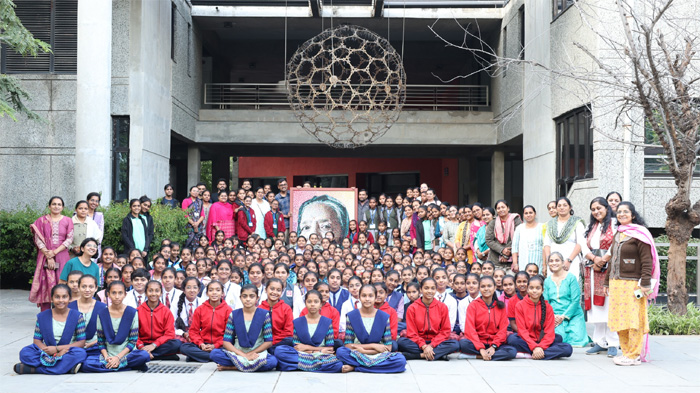
In a strong push to draw more girls towards Science, Technology, Engineering and Mathematics (STEM), 180 students and 20 teachers from 20 Kasturba Gandhi Balika Vidyalayas (KGBVs) across Gujarat visited the Centre for Creative Learning (CCL) at IIT Gandhinagar, gaining rare hands-on exposure to scientific learning at a premier institution.
For many of these girls from underserved communities, the visit marked their first interaction with an IIT campus, transforming science from a classroom subject into an exciting, achievable future.
Learning Science by Doing, Not Memorising
STEM activities ignite curiosity and clarity
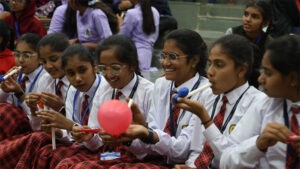
At CCL, students actively participated in hands-on STEM activities that simplified complex concepts through experimentation and play, helping them connect theory with real-world applications.
Sharing her excitement, Rupapra Yashri from KGBV RMC said, “Please keep the exposure visit for at least a week next time so that we can do all the activities present here.”
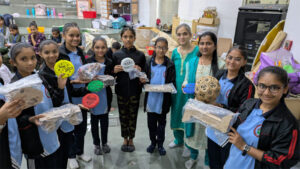
Another student, Shreyaba Jadeja from KGBV Shekhpat, Jamnagar, highlighted how the programme enhanced classroom learning: “We enjoy the activities of the Curiosity Program and feel the desire to learn new activities every day. These activities have helped us understand topics like acids and bases in an easy and interesting way.”
A teacher echoed this sentiment, noting that “learning science by doing keeps them engaged in ways textbooks cannot.”
18,000 Push Pins, One Powerful Message
Kasturba Gandhi portrait blends STEM, art and teamwork
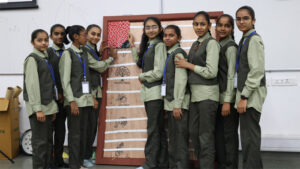
In a striking demonstration of creativity and collaboration, the girls jointly created a large-scale portrait of Kasturba Gandhi using over 18,000 colourful push pins. The artwork symbolises girls from marginalised backgrounds shaping their own futures through education and will soon be installed at the Samagra Shiksha Gujarat office.
Curiosity Programme: Taking IIT-Level STEM to Rural India
1.5 lakh girls connected across eight states
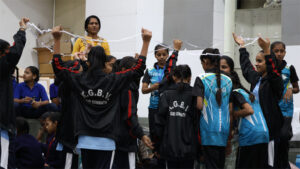
The exposure visit was organised under the Curiosity Programme (Jigyasa), a large-scale online STEM initiative that connects 1,837 KGBVs and more than 1.5 lakh girls across eight states through biweekly interactive sessions. The programme has been active in Gujarat for the past three years.
Highlighting its impact, Siddhi from KGBV Pij shared that an activity she learned through the Curiosity Programme was selected for an ISRO camp.
Explaining the programme’s mission, Neha Garg, Programme Manager for the Curiosity Programme, said,
“These girls, who come from very marginalised sections, consistently surprise us with their dedication and hunger to learn. Given the right opportunities, they persevere and excel. Our goal is to create such learning opportunities across the country.”
From IIT Campus to STEM Aspirations
Exposure builds confidence and ambition
The visit concluded with a guided tour of the IIT Gandhinagar campus, including the sports complex, the CCL lab where educational toys are developed, and the recording studio from which live Curiosity sessions are conducted every Tuesday and Friday.
By bringing KGBV students to IIT Gandhinagar, IIT Gandhinagar and Samagra Shiksha Gujarat are actively breaking barriers to STEM education, reinforcing that talent is universal, opportunity is not—and must be created.
WHY STEM FOR GIRLS MATTERS
- Unlocks equal opportunity: STEM education gives girls from underserved communities access to high-growth careers traditionally dominated by men, reducing gender and income inequality.
- Builds confidence through problem-solving: Hands-on STEM learning encourages logical thinking, creativity and resilience—skills essential far beyond classrooms.
- Strengthens India’s innovation pipeline: When girls participate in science and technology, the nation gains a broader, more diverse talent pool to drive research, innovation and development.
- Empowers rural and marginalised youth: Programmes like KGBV and Curiosity (Jigyasa) bridge the gap between elite institutions and rural classrooms, ensuring talent is not limited by geography or socio-economic background.
- Inspires the next generation: Early exposure to institutions like IIT Gandhinagar helps girls visualise themselves as scientists, engineers, technologists and leaders.
- Creates community role models: Educated girls in STEM become changemakers, influencing families and communities to value education, especially for future generations of girls.