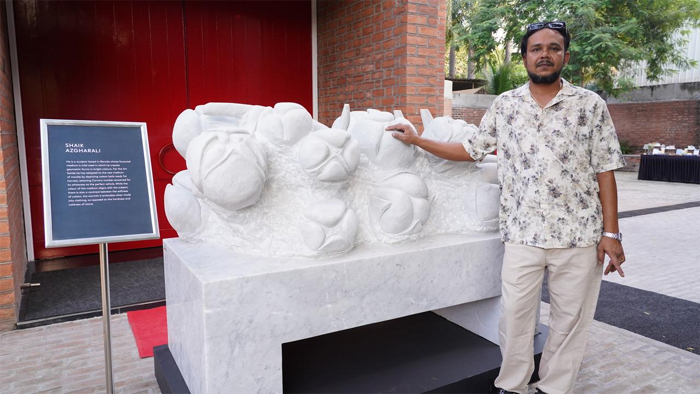
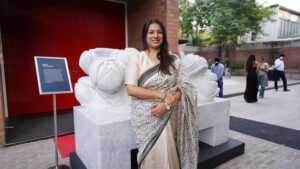
- Positioned both as offering and obstruction, the sculpture-I am Cotton- by Shaikh slows the viewer down, demanding that they touch with imagination rather than hand.
GOWRI MANICKAVASAGAM
AHMEDABAD, SEPT 20
What happens when marble learns to breathe? When a weight of centuries is reimagined as something soft, transient, almost tender? At the Urmila Kailash Black Box, Kanoria Centre for Arts, Ahmedabad, Stone Portraits — StoneX’s much-travelled multisensory showcase — unfolded this past weekend as both exhibition and meditation. It was not merely about stone as material, but stone as memory, vessel, witness.
Following its acclaimed chapters in Bangalore and Chennai, the series arrived in Ahmedabad, a city that itself is a palimpsest — of Indo-Islamic architecture, handwoven textile traditions, and a restless dialogue between heritage and modernity. Against this backdrop, stone was re-situated: not as monumentality, but as intimacy.
I am Cotton, the latest work by sculptor Shaik
At the heart of the edition stood I am Cotton, the latest work by sculptor Shaik. Hewn from Carrara Extra marble, historically the medium of Renaissance purity, the piece reimagines hand-picked cotton bales. At first glance, it is astonishingly tactile — folds and bulges that seem capable of collapse, a softness that almost exhales. And then the irony strikes: the softness is carved, not grown; the breath is trapped within tonnage.
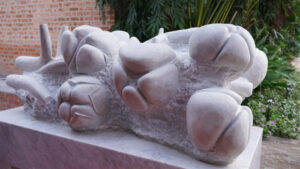
“With I am Cotton, I wanted to capture a paradox,” Shaik reflected during the opening. “Cotton is light, transient, and tied to histories of toil and trade. By translating it into stone, I force the viewer to confront fragility as permanence, labour as monument. It becomes a meditation on the unseen hands that pick and the weight of memory embedded in every fibre.”
The work lingers like a riddle — recalling Rachel Whiteread’s negative spaces or Doris Salcedo’s memory objects, but rooted in the agrarian, postcolonial realities of Gujarat. Positioned both as offering and obstruction, the sculpture slows the viewer down, demanding that they touch with imagination rather than hand.
Beyond Sight: The Senses Awakened
Yet Stone Portraits was never intended as a conventional show. The curatorial gesture was multisensory: guests were invited to see, touch, taste, and listen their way into stone’s world. Marble samples sat in palms, heavy yet strangely warm. The air carried the scent of the land, punctuated by local flavours folded into canapés. Music evoked folk memory, each note carrying the cadence of work-songs, of stone chiselled in rhythm with heartbeat.
This is a city where stone lives in walls, mosques, stepwells, and memory: Prachi
“Ahmedabad felt inevitable,” said Prachi Bhattacharya, CEO of StoneX India. “This is a city where stone lives in walls, mosques, stepwells, and memory. Our mission is not just to showcase marble, but to honour the artisans who continue to shape it and the cultural worlds it connects. With Stone Portraits, we wanted to create a journey where every sense is touched — a reminder that stone is not inert, but alive in memory, in taste, in sound.”
“With each edition of Stone Portraits, we seek to situate stone within new cultural geographies, reminding us that its presence is both timeless and deeply local. Ahmedabad, with its enduring architectural heritage and living traditions of craft, provides a resonant setting for this dialogue. Here, we are honoured to foreground the artistry of regional artisans alongside contemporary practice, reaffirming our commitment to celebrating stone as both material and memory,” said Sushant Pathak, Chief Marketing Officer, StoneX Global.
Lineages in Marble
Equally powerful was the presence of the artisans themselves. Drawn from the border districts of Rajasthan and Gujarat, many were third-generation stone workers, chiselling marble as their fathers and grandfathers did before them. Their practice is singular: marble or nothing. Within its veins, they hear continuity.
Their chisels, worn smooth by decades, inscribe more than form; they preserve a relationship between human endurance and mineral time. In Ahmedabad, their craft was not background labour but foregrounded artistry — stone emerging as archive, every groove a footnote in cultural history.
A City, A Memory, A Material
In its Ahmedabad chapter, Stone Portraits reaffirmed what stone can mean: not just architecture, monument, or commodity, but tenderness, illusion, resistance. The exhibition blurred lines between object and experience, leaving guests to reckon with stone not as something cold or mute, but as something that listens, remembers, and speaks back.
In the end, what lingered was not marble’s weight but its breath.