R ARIVANANTHAM
CHENNAI, MAR 16
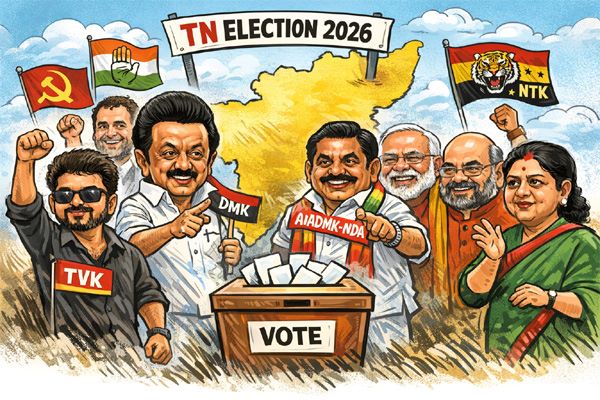
Tamil Nadu’s April 23 Assembly election is shaping up as a high-stakes political contest with traditional Dravidian heavyweights facing emerging challengers and new voter aspirations.
- From Stalin’s governance pitch to EPS’s comeback strategy and Vijay’s disruptive entry, the Assembly election turns into a defining political moment
- Opinion polls indicate DMK ahead but AIADMK narrowing the gap as TVK and NTK reshape the electoral arithmetic
- A fierce ‘freebie contest’ among parties highlights the central role of welfare economics in Tamil Nadu politics
- Alliance dynamics involving Congress and BJP add a national dimension to the state’s regional electoral battle
- Experts say youth voters, women beneficiaries and urban middle classes will decide the outcome
- Informed voting and scrutiny of manifestos seen as crucial for strengthening democratic accountability
The ruling Dravida Munnetra Kazhagam (DMK) led by Chief Minister M. K. Stalin is seeking a second consecutive term, projecting its “Dravidian Model” of governance based on welfare schemes, social justice and economic development.
The opposition All India Anna Dravida Munnetra Kazhagam (AIADMK) under Edappadi K. Palaniswami hopes to capitalise on anti-incumbency sentiment and regain power with the backing of the Bharatiya Janata Party and other allies.
Adding unpredictability to the contest is actor Vijay, whose party Tamilaga Vettri Kazhagam (TVK) is attempting to mobilise young voters seeking an alternative to the traditional Dravidian duopoly.
Meanwhile, Seeman’s Naam Tamilar Katchi (NTK) continues to champion Tamil nationalist politics, contesting all seats independently.
Political observers say the election is becoming a referendum not just on governance but also on the future direction of Dravidian politics in the state.
Election Data Dashboard: Tamil Nadu Political Landscape
1. Vote Share Trends in Tamil Nadu Elections
| Election Year | DMK Alliance | AIADMK Alliance | Others |
| 1996 | ~60% | ~32% | 8% |
| 2001 | ~37% | ~51% | 12% |
| 2011 | ~40% | ~51% | 9% |
| 2016 | ~39% | ~41% | 20% |
| 2021 | ~45% | ~39% | 16% |
Key Insight:
Tamil Nadu politics has historically alternated between the two Dravidian giants, but the vote share of smaller parties has steadily increased over the last decade.
Political analyst Prof Ramu Manivannan notes: “The gradual rise in vote share for smaller parties reflects growing voter experimentation beyond the traditional DMK-AIADMK binary.”
2. Early Poll Survey Snapshot – 2026
| Party | Estimated Vote Share |
| DMK Alliance | 41–42% |
| AIADMK-NDA | 35–37% |
| TVK | 12–14% |
| NTK | 7–8% |
| Others | 2–3% |
Expert View
Chennai-based election analyst Sumanth Raman says: “The DMK still appears ahead, but the rise of TVK and NTK could influence margins in many constituencies. Multi-cornered contests often produce unpredictable results.”
3. Regional Vote Bank Dynamics
| Region | Dominant Political Influence |
| Northern TN | PMK influence, NDA competition |
| Western TN (Kongu belt) | AIADMK stronghold |
| Southern districts | Competitive between DMK and AIADMK |
| Chennai & urban areas | DMK advantage |
| Rural belts | NTK and regional parties gaining traction |
4. The Great Freebie Contest
Tamil Nadu elections have historically featured welfare promises, but the 2026 contest has intensified the competition among parties.
| Party | Major Welfare Promises |
| DMK | Free bus travel for women, ₹1000 monthly aid to women heads |
| AIADMK | ₹10,000 one-time assistance to citizens |
| TVK | “Super Six” scheme including free LPG cylinders and financial support |
| NTK | Employment-oriented programmes and rural development |
Economist Dr S Narayanan calls this phenomenon “competitive welfare populism.”
“Welfare schemes have improved social indicators in Tamil Nadu, but voters must examine the fiscal sustainability of such promises,” he said.
5. Possible Seat Projection Scenarios
| Scenario | Outcome |
| DMK retains current momentum | Comfortable majority |
| AIADMK consolidates anti-incumbency | Close contest |
| TVK surge among youth voters | Hung assembly possibility |
| Split opposition vote | Advantage DMK |
Key Issues Driving the Election
Welfare vs Fiscal Prudence
The debate over free welfare schemes versus sustainable economic policy has become a central campaign theme.
Youth Employment
Young voters are demanding job creation and economic opportunities.
Federalism and State Rights
The DMK continues to emphasise state autonomy and centre-state relations.
Identity Politics
Tamil linguistic pride and regional identity remain powerful political narratives.
Experts’ Advice to Voters
Political analysts say voters should carefully evaluate:
- governance record of parties
- credibility of welfare promises
- financial viability of schemes
- leadership experience
Political scientist Prof Ramu Manivannan emphasises: “An informed voter is the strongest pillar of democracy. Citizens must examine policies rather than merely personalities while casting their vote.”
The Democratic Verdict Ahead
With over five crore voters expected to participate, the Tamil Nadu Assembly election could redefine the state’s political trajectory.
- For the DMK, it is a test of governance credibility.
- For the AIADMK, a battle for revival.
- For new entrants like TVK and NTK, an opportunity to reshape the political narrative.
Ultimately, the verdict will determine whether Tamil Nadu continues under the established Dravidian framework or witnesses the emergence of a new political order.