
NE HEALTH BUREAU
CHENNAI, OCT 17
Tamil Nadu has launched a field research initiative in Kadayanallur to examine how dengue vaccination and mosquito-protection measures can be used more effectively in the fight against the mosquito-borne disease, bringing the state’s public health machinery and the Indian Council of Medical Research’s National Institute of Epidemiology (ICMR–NIE), Chennai, together for a science-led assessment.
- State launches a first-of-its-kind field research initiative in Tenkasi district, partnering with ICMR–National Institute of Epidemiology
- Studies to assess the practical value of dengue vaccination and different mosquito-repellent measures
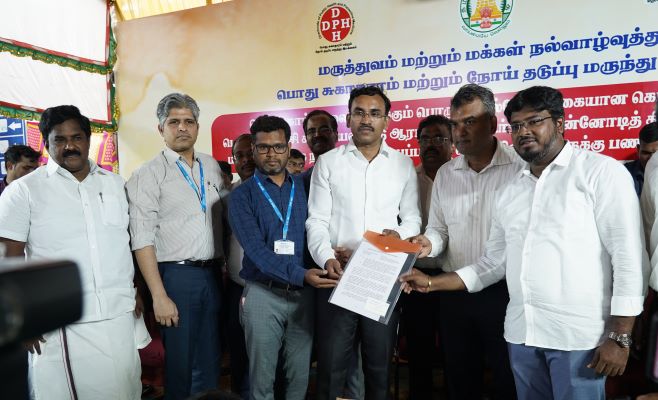
- Health Minister Dr K. G. Arunraj hands over preliminary approval letter for field research
- Voluntary participation, informed written consent, ethical oversight and follow-up monitoring form key safeguards
- Separate mosquito-control studies to cover all 33 urban wards of Kadayanallur
- Government says any wider rollout will depend on scientific evidence and expert recommendations
Health Minister Dr K. G. Arunraj announced the initiative at Kadayanallur Government Hospital in Tenkasi district on Saturday and handed over a preliminary approval letter to ICMR representatives for the field research. The programme also includes studies on different mosquito repellents and measures intended to reduce exposure to mosquito bites.
The initiative follows India’s approval in July of Qdenga, a dengue vaccine developed by Takeda. However, the Kadayanallur programme is a research initiative, and the announcement does not amount to confirmation of a mass vaccination drive. The state says its findings will help guide decisions on how best to introduce effective preventive measures in practice.
Vaccine research: The next frontier
Addressing the gathering, Dr Arunraj said dengue prevention had long depended on mosquito control, surveillance, early diagnosis and timely treatment. Scientific advances, he said, had opened another avenue for investigation.
“The vaccine is a shield. But we cannot allow water to stagnate in our homes and rely on that shield alone. We need the vaccine, and we need mosquito control. Only when both work together will dengue retreat,” he said, underlining that vaccination must complement rather than replace established preventive measures.
Qdenga is designed to protect against all four dengue virus serotypes and is administered in two doses three months apart. India’s Central Drugs Standard Control Organisation (CDSCO) granted marketing authorisation in July 2026 for use in people aged four to 60. The approval followed scientific evaluation, including evidence from an Indian study, and made Qdenga the first dengue vaccine authorised in the country.
The state’s research effort is intended to address practical questions beyond regulatory approval: how suitable preventive measures can be delivered, whether people will accept and consistently use them, and how their benefits and safety should be evaluated under real-world conditions.
Voluntary participation and scientific oversight
The government has outlined safeguards for the vaccine-related research. According to the announcement, participation will be voluntary; eligible individuals will receive an explanation of the study and vaccination will be offered only after written informed consent. No one will be compelled to participate.
The research will be conducted in accordance with approved study protocols, ethics committee clearances and national guidelines. Participants who receive the vaccine will be monitored, and findings will be submitted to scientific and technical bodies, including the National Technical Advisory Group on Immunisation (NTAGI), for consideration.
Any decision on expanding the initiative across Tamil Nadu, the minister said, would depend on the evidence generated and the recommendations received. The purpose is to establish how safely and effectively the intervention can serve the public, rather than presume the outcome before the research is complete.
Mosquito repellents under the lens
Alongside the vaccine-related work, the state is planning studies on mosquito-protection strategies, including repellents applied to the skin and other household measures. The research will examine whether such interventions offer additional protection against bites from Aedes mosquitoes, which transmit dengue, and whether they are safe, acceptable and practical for sustained use.
The mosquito-control research is to be conducted across all 33 urban wards of Kadayanallur municipality, in collaboration with ICMR–NIE and the Tamil Nadu Public Health Department. The initiative follows an announcement made in the State Assembly on September 8, 2026.
The studies will assess the usefulness of the measures under everyday conditions, including whether households can use them consistently and whether they can be integrated with existing public health interventions. If the evidence supports their effectiveness, the government will consider whether the measures should be incorporated into wider dengue-prevention efforts.
A public health lesson beyond Kadayanallur
The launch was attended by Environment and Climate Change Minister Dr K. Rajiv, Kadayanallur MLA T. M. Rajendran, Health and Family Welfare Department Secretary Dr Darez Ahmed, National Health Mission Director Dr S. Anish Sekhar and Tenkasi District Collector Ranjeet Singh, among others.
Dr Arunraj said the initiative would require cooperation among ICMR–NIE scientists, medical and public health personnel, district and municipal administrations, and residents. The objective, he said, was to generate credible evidence that could strengthen dengue prevention in Tenkasi district and inform the state’s wider response.
The central challenge is to turn scientific findings into practical, trusted public health action. Kadayanallur’s studies will therefore have to assess not only whether interventions work, but also whether they can be delivered safely, adopted by households and sustained over time.
For Tamil Nadu, the test will be whether research can help build a stronger line of defence against dengue—one that combines evidence-based vaccination decisions with effective mosquito control, public participation and timely medical care.