

R ARIVANANTHAM
CHENNAI, OCT 1
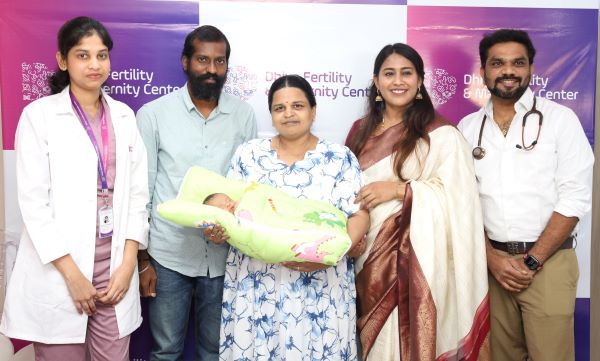
A nine-year journey through infertility, two unsuccessful IUI cycles and a failed IVF attempt has culminated in the birth of a healthy baby girl, with Dhiya Fertility and Maternity Center claiming Tamil Nadu’s first robot-assisted Intracytoplasmic Sperm Injection (ICSI) procedure in a 37-year-old woman.
The advanced procedure was performed after the woman, who had type 2 diabetes and low ovarian reserve, had undergone fertility treatments elsewhere without achieving pregnancy. Following an individualised treatment plan at Dhiya Fertility and Maternity Center, robot-assisted ICSI resulted in embryo development to the blastocyst stage, followed by a successful pregnancy and full-term vaginal delivery.
- Dhiya Fertility and Maternity Center reports birth of healthy baby girl after advanced procedure
- 37-year-old woman conceived following unsuccessful IUI and IVF treatments elsewhere
- Robot-assisted ICSI offers precise, stable egg manipulation during sperm injection
- Three mature eggs fertilised; embryos reached Day-5 blastocyst stage
- Centre says robotic ICSI is being offered as an affordable procedure despite technology investment
- Doctor flags low sperm count among youth as a growing concern; lifestyle changes urged
The procedure represents an emerging application of robotics in assisted reproduction, with the robotic system designed to provide greater stability and precision during the highly delicate process of holding the egg and injecting a single sperm.
Three eggs, three fertilisations, Day-5 blastocysts
Given the woman’s low ovarian reserve and previous unsuccessful fertility treatments, the medical team opted for dual egg collection in October and November 2025. Three eggs were retrieved, all of which were mature (M2) and suitable for fertilisation.
The team used robot-assisted ICSI to inject a single sperm into each mature egg. All three eggs fertilised, with the resulting embryos developing to Day 5 and reaching the blastocyst stage.
Using the robotic system again, the team transferred one Day-5 embryo into the uterus on January 12, 2026. The pregnancy progressed normally and ultimately resulted in the birth of a healthy baby girl at full term through vaginal delivery.
How robotic ICSI differs
In conventional ICSI, an embryologist uses a holding pipette with gentle suction to stabilise the egg while a fine injection pipette delivers a single sperm into it.
In the robot-assisted approach used by the centre, suction-based holding is replaced by a tiny, non-pneumatic mechanical gripper designed to securely hold and stabilise the egg. This allows controlled and consistent micromanipulation during egg positioning and sperm injection.
“Though an egg may appear as a two-dimensional structure under a microscope, it is actually a three-dimensional spherical structure and extremely fragile. In conventional ICSI, the egg is held using gentle suction, which can place mechanical stress on the egg. In robotic ICSI, a non-pneumatic mechanical gripper is used instead of suction to hold and stabilise the egg. This allows precise and stable manipulation of the egg during the ICSI procedure,” Dr Keerthana Ashwin, Director and Consultant Gynaecologist, Dhiya Fertility and Maternity Center, said.
“In our experience, we have also observed a higher rate of blastocyst development compared with our experience with conventional ICSI,” she added, while indicating that the observation was based on the centre’s experience.
‘Advanced technology need not mean unaffordable care’
Dr Keerthana said ICSI is now followed by fertility centres, while the robotic assistance introduced by Dhiya Fertility and Maternity Center represents a new technological approach to the procedure in Tamil Nadu.
“Though the centre has heavily invested in robotic equipment, it has not passed on the financial burden to aspiring mothers,” she said, adding that the robot-assisted procedure has been made affordable for patients.
She said the initiative was aimed at combining advanced technology with accessibility, rather than making the use of robotics an additional financial barrier for couples seeking fertility treatment.
Low sperm count among youth a concern
Dr Keerthana also flagged persistently low sperm counts among young men as a concern in Tamil Nadu, pointing to lifestyle factors as one area that deserves attention.
She said healthy lifestyle changes, regular exercise and good food habits could help improve sperm health and urged young people to pay greater attention to preventive health and lifestyle choices.
The observation assumes significance as male-factor infertility can form part of the clinical assessment of couples undergoing assisted reproductive treatment, although individual causes and treatment outcomes vary from patient to patient.
Embryo preservation offers flexibility for a second child
Responding to a query from navjeevanexpress.com, Dr Keerthana said a healthy embryo can be preserved for up to five years, subject to applicable clinical and regulatory requirements and appropriate cryopreservation conditions.
She said this could give couples who have undergone ICSI an option to plan for a second child at a later stage, using a preserved embryo, depending on their medical circumstances and clinical advice.
The multidisciplinary procedure was led by Dr Keerthana Ashwin, with Dr Poovannan, Consultant Anaesthesiologist, and Sreenithya K, Senior Embryologist, supporting the treatment and embryology procedures.
“We are delighted to have performed Tamil Nadu’s first robot-assisted ICSI and to see the treatment culminate in a successful pregnancy and the birth of a healthy baby girl. The patient had been on a long and challenging fertility journey for nearly nine years, undergoing multiple treatments without achieving a successful pregnancy. For her and her family, the birth of the baby marks a deeply meaningful outcome after years of perseverance and hope,” Dr Keerthana said.
“This achievement is also an important milestone for our team as we continue to explore advanced technologies that can enhance precision in fertility care,” she added.
The centre said the successful case marks its first reported robot-assisted ICSI birth in Tamil Nadu, with further procedures planned at its facility at OMR, Kandanchavadi, Perungudi, Chennai.