- The overseas tours are not just symbolic. In recent years, Tamil Nadu has attracted significant FDI commitments from firms in Germany, Japan, South Korea, and the U.S. Investments in automobile manufacturing (Chennai, Hosur), electronics (Sriperumbudur, Coimbatore), and renewable energy (Tuticorin, Ramanathapuram) are transforming the state’s industrial landscape.
- Tamil Nadu will need to address rising power costs, urban infrastructure bottlenecks, and competition from other Indian states like Gujarat, Maharashtra, and Karnataka that are equally aggressive in wooing investors.
R ARIVANANTHAM
When Tamil Nadu Chief Minister M.K. Stalin embarked on a series of overseas tours, the political opposition was quick to question their necessity. But behind the optics of high-profile meetings and cultural moments lies a carefully calibrated effort: to position Tamil Nadu as a global investment destination and consolidate its reputation as India’s industrial powerhouse.
A Case for Global Engagement
In his address at the SIIMA Awards in Germany, Stalin directly addressed critics who saw his foreign visits as unnecessary. “Some have questioned the need for such visits. But when I spoke about Tamil Nadu at an investors’ meet in Germany, many participants said it motivated them to come here,” he remarked.
This anecdote illustrates the rationale driving such tours: face-to-face engagement with potential investors, signaling not just the state’s openness but its active pursuit of global partnerships. In an era where states are competing aggressively for capital and technology, visibility and personal diplomacy have become as important as policy frameworks.
Tamil Nadu as the “Germany of India”
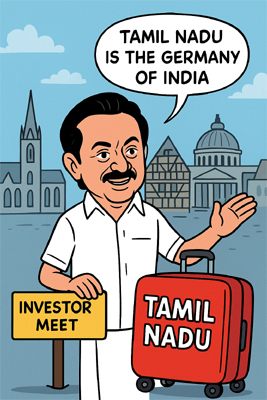
Stalin’s most striking assertion on this trip was describing Tamil Nadu as the “Germany of India.” The analogy was not casual. Germany, long regarded as Europe’s industrial heartland, is known for its advanced manufacturing, robust small and medium enterprises, and export-driven economy. Stalin’s comparison was designed to underscore Tamil Nadu’s strengths:
- Second-largest economy in India with a GSDP exceeding ₹28 lakh crore.
- Double-digit growth in manufacturing, particularly in automobiles, electronics, and renewable energy.
- 54 lakh MSMEs, the highest in the country, making Tamil Nadu the backbone of India’s small-scale industrial sector.
- A diversified export basket, ranging from automobiles and textiles to IT services and electronics.
The comparison also speaks to ambition. Just as Germany plays a pivotal role in Europe’s economy, Stalin wants Tamil Nadu to be seen as a state that drives India’s economic momentum.
The Policy Framework: Beyond Optics
What lends credibility to these tours is that Tamil Nadu has already laid the policy groundwork to absorb new investments. Over the past two years, the state government has pushed targeted reforms:
- Single-window clearance systems to reduce bureaucratic hurdles.
- Sector-specific policies in areas such as electric vehicles, renewable energy, aerospace, and fintech.
- Investment promotion agencies such as Guidance Tamil Nadu, which actively engages with global firms.
- Skill development initiatives through institutions like Naan Mudhalvan, designed to create a workforce aligned with industry needs.
The state has also showcased resilience, consistently ranking among the top performers in India’s Ease of Doing Business assessments.
Global Opportunities, Local Gains
The overseas tours are not just symbolic. In recent years, Tamil Nadu has attracted significant FDI commitments from firms in Germany, Japan, South Korea, and the U.S. Investments in automobile manufacturing (Chennai, Hosur), electronics (Sriperumbudur, Coimbatore), and renewable energy (Tuticorin, Ramanathapuram) are transforming the state’s industrial landscape.
For instance, German engineering firms and auto-component manufacturers have already established bases in and around Chennai. Stalin’s pitch in Europe seeks to deepen these ties, positioning Tamil Nadu as a natural partner for industries diversifying supply chains beyond China.
Countering the Political Criticism
Opposition leader Edappadi K. Palaniswami has alleged that Stalin’s foreign trips are linked to his family’s business interests. The Chief Minister countered this with sharp rhetoric: “The only investments I have made in their land are self-respect policies and Periyar’s ideas.”
While the political sparring continues, what matters from a development perspective is the tangible outcome of these visits. If announcements translate into factories, jobs, and technology transfers, the tours will gain legitimacy not through speeches, but through results visible on the ground.
A Cultural Dimension: Periyar at Oxford
Interestingly, Stalin’s trip also included a cultural and ideological highlight — the unveiling of a portrait of social reformer E.V. Ramasamy Periyar at Oxford University. Describing it as the “greatest honour” of his life, Stalin said the moment reflected the global relevance of Periyar’s philosophy of self-respect, rationalism, and social justice.
This symbolic gesture was not divorced from the developmental narrative. By linking Periyar’s values with Tamil Nadu’s modern growth model, Stalin projected the state as one where economic development and social inclusion go hand in hand. This dual emphasis sets Tamil Nadu apart in a global investment landscape where investors increasingly look at both growth prospects and social stability.
The Road Ahead: Can Tamil Nadu Lead India’s FDI Story?
With India itself being aggressively marketed as a global investment destination by the Union government, Tamil Nadu’s proactive state-level diplomacy raises interesting questions. Can Tamil Nadu replicate Germany’s model of combining a strong manufacturing base with global leadership in innovation?
Several factors work in the state’s favor:
- Geography: Proximity to ports like Chennai, Ennore, and Tuticorin strengthens export competitiveness.
- Workforce: High literacy rates and a skilled talent pool, particularly in engineering and IT.
- Infrastructure: Industrial corridors, dedicated freight corridors, and SEZs already in place.
- Policy continuity: A tradition of relatively stable governance compared to some other states.
However, challenges remain. Tamil Nadu will need to address rising power costs, urban infrastructure bottlenecks, and competition from other Indian states like Gujarat, Maharashtra, and Karnataka that are equally aggressive in wooing investors.
Conclusion: The Global Stage Beckons
Stalin’s overseas tours may draw political criticism, but in developmental terms, they align with Tamil Nadu’s long-standing identity as an industrial frontrunner. By positioning the state as the “Germany of India,” the Chief Minister is not only making a branding statement but also setting a benchmark for what Tamil Nadu aspires to achieve.
If the tours succeed in converting intent into investment, they will not only validate Stalin’s strategy but also strengthen Tamil Nadu’s role as a key driver of India’s economic story. In a world where capital is mobile and competition is fierce, sitting still is not an option. Tamil Nadu has chosen to step onto the global stage — and the spotlight, for now, is firmly on Chennai.